







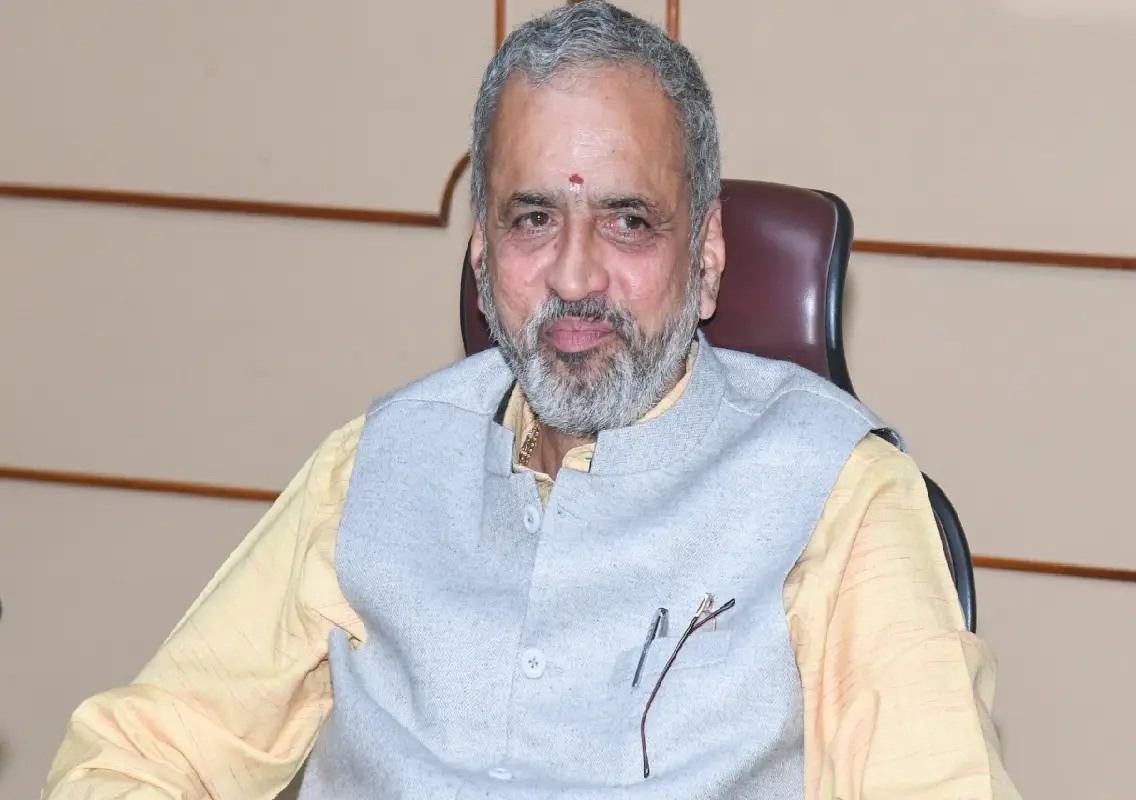


Bengaluru: A political controversy erupted in Karnataka after BJP MP Vishweshwar Hegde Kageri claimed that India’s national anthem, Jana Gana Mana, was composed to welcome a British official, drawing sharp criticism from Congress minister Priyank Kharge and sparking a heated historical debate.
Kageri’s remark at Honnavar event
Speaking at an event in Honnavar commemorating 150 years of Vande Mataram, Kageri argued that the national song deserved greater recognition and should be given equal status with the national anthem.
“I don’t want to dig into history. There were strong calls to make Vande Mataram the national anthem, but our ancestors then decided to keep Vande Mataram as well as Jana Gana Mana, which was composed to welcome the British officer. We have accepted and are following it,” Kageri said at the gathering.
The Uttara Kannada MP further emphasised that Vande Mataram had played a pivotal role in inspiring India’s freedom movement. “In this 150th year, Vande Mataram should reach everyone. It must reach schools, colleges, youngsters, and the masses,” he added.
Priyank Kharge slams Kageri’s comments
Kageri’s remarks quickly drew a sharp response from Priyank Kharge, Karnataka’s Minister for Information Technology and son of Congress president Mallikarjun Kharge. Taking to X (formerly Twitter), Kharge dismissed the statement as “utter nonsense” and accused the BJP leader of spreading “RSS WhatsApp history.”
“BJP MP Kageri now claims that the National Anthem is British. Utter nonsense. Another day, another RSS WhatsApp history lesson,” Kharge wrote.
He further clarified the historical context of the anthem, stating that Rabindranath Tagore composed Bharoto Bhagyo Bidhata in 1911, and its first stanza later became the national anthem, Jana Gana Mana. “The anthem was first sung on December 27, 1911, at the Indian National Congress session in Calcutta, not as a royal tribute,” Kharge added.
Tagore’s clarification on meaning
Kharge cited Tagore’s own letters from 1937 and 1939, where the Nobel laureate explicitly stated that Jana Gana Mana celebrated the “Dispenser of India’s destiny” — referring to the divine will, not any British monarch.
“Tagore made it clear that it could never be George V, George VI, or any other George,” Kharge wrote, mocking Kageri’s claim.
“RSS has a tradition of disrespecting national symbols”
In a pointed counterattack, Kharge urged BJP and RSS members to “revisit history” by reading the early writings of the RSS mouthpiece, Organizer.
“I strongly urge every BJP, RSS leader, worker and swayamsevak to revisit history by reading the editorials of RSS’s Organizer and know that RSS has a great tradition of disrespecting the Constitution, the Tricolour, and the National Anthem. This viRSS needs to be cured,” he said, coining a pun on the word “virus.”
Historical background of Vande Mataram
The year 2025 marks 150 years of Vande Mataram, the national song penned by Bankimchandra Chatterji in 1875. According to the Press Information Bureau (PIB), the song was written during Akshaya Navami on November 7, 1875, and first appeared in Chatterji’s novel Anandamath.
The song became a rallying cry during India’s freedom movement, inspiring generations of revolutionaries and freedom fighters. The Constituent Assembly, after Independence, adopted Vande Mataram as the national song, while Jana Gana Mana was designated the national anthem.
Political reactions and debate
Kageri’s remark has reignited a long-standing ideological debate between the BJP and Congress over cultural nationalism and interpretations of India’s pre-Independence history.
While several BJP leaders have previously argued that Vande Mataram should be accorded greater prominence, historians and scholars have repeatedly clarified that Tagore’s composition was a poetic invocation of the divine spirit guiding India’s destiny, not a tribute to the British Crown.
Conclusion
As the 150th anniversary of Vande Mataram rekindles patriotic sentiment, Kageri’s comment has underscored how historical interpretation continues to be a flashpoint in India’s political discourse. While Congress leaders have condemned the statement as historically inaccurate, the controversy has once again highlighted the ongoing tug-of-war between nationalism and historical revisionism in contemporary Indian politics.