







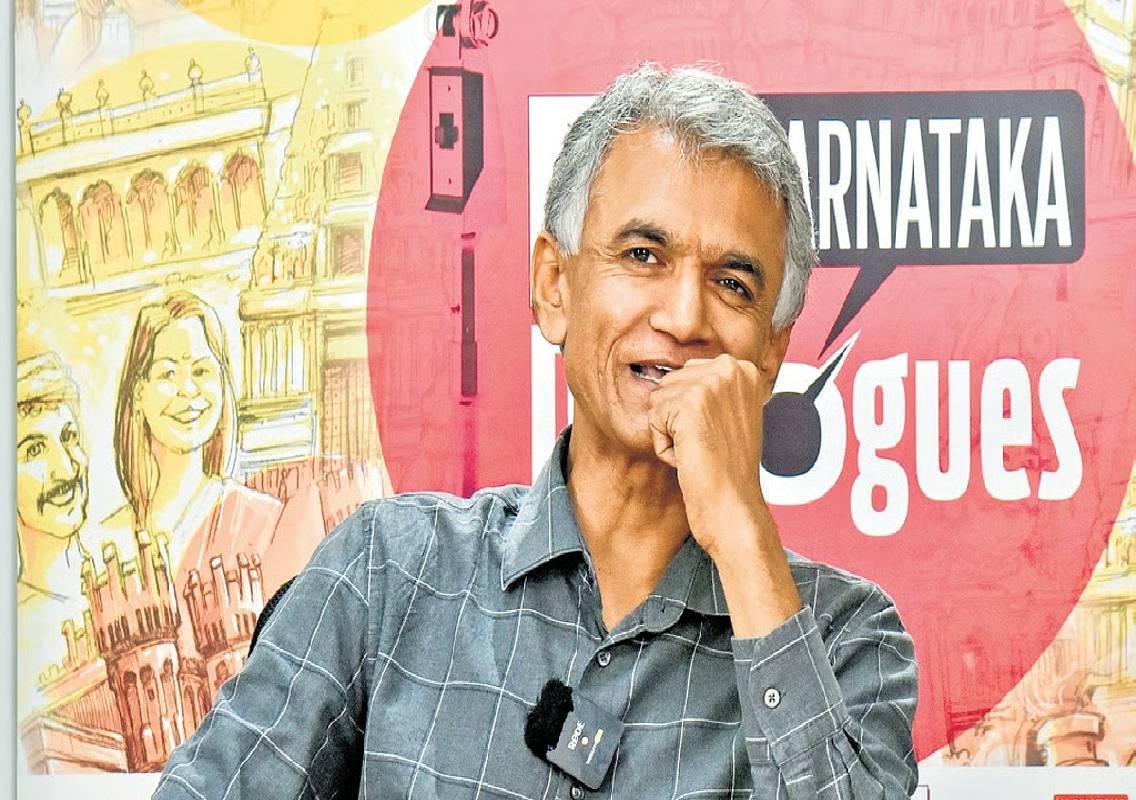


Bengaluru: Bengaluru needs a balanced mobility strategy that combines mass public transport with adequate road infrastructure, Greater Bengaluru Development Minister Krishna Byre Gowda has said, arguing that asking people to stop buying cars and two-wheelers is not a realistic solution to the city’s traffic problems.
In an interview with The New Indian Express published on September 7, Gowda said the city must invest heavily in mass transit while simultaneously improving road capacity. He said the choice should not be between public transport and roads, as Bengaluru’s growing population and mobility requirements demand both.
His comments come as the city continues to grapple with congestion, increasing vehicle ownership, limited road space and the need for faster expansion of public transport infrastructure.
Bengaluru cannot depend on one mode of transport
Gowda said residents would continue to aspire to own cars and two-wheelers and that simply asking people to stop purchasing private vehicles would not address the underlying mobility challenge.
Instead, he advocated investment across different modes of transport.
“Bengaluru needs both mass transit and adequate road capacity,” Gowda said, stressing that public transport and road infrastructure should be developed together.
The minister’s argument reflects the reality of a rapidly expanding metropolitan region, where commuters use a combination of buses, Metro services, private vehicles, taxis and other modes.
While increasing public transport capacity can encourage more people to shift away from private vehicles, roads will continue to be required for buses, goods vehicles, emergency services, taxis and private transport.
Tunnel roads among options for Bengaluru
Gowda also argued that Bengaluru needs additional road capacity, including tunnel roads.
The proposal comes amid continuing debate over how the city can create more transport capacity without further consuming valuable surface land.
Tunnel roads have previously been discussed as a possible way of addressing some of Bengaluru’s major traffic bottlenecks. However, such projects involve substantial financial, engineering and environmental considerations.
Gowda’s comments indicate that the government is looking at mobility as a combination of solutions rather than relying exclusively on one infrastructure model.
For a city where surface road expansion is increasingly difficult, underground infrastructure could potentially provide another layer of connectivity. But any such project would require detailed feasibility studies, funding arrangements, environmental assessments and careful construction planning.
Greater Bengaluru Authority completes one year
The minister also assessed the first year of the Greater Bengaluru Authority (GBA), which was established as part of a restructuring of Bengaluru’s civic administration.
Gowda said the new governance structure had been put in place and described it as an important beginning for managing a city with a population of around 1.5 crore.
Under the new system, Bengaluru has five corporations, each with its own commissioner, while the GBA is intended to provide coordination among the corporations and other civic agencies.
According to Gowda, managing a city of this size through a single corporation was not sustainable. He said the five-corporation model should make administration more accessible and responsive while the GBA would provide an institutional mechanism for coordination.
He acknowledged that the system would take time to become fully effective but said the restructuring represented the first serious rethink of Bengaluru’s administrative structure in several decades.
Five corporations to change civic administration
Gowda said Bengaluru had previously been governed under the Karnataka Municipal Corporations Act without a separate administrative framework specifically designed for the metropolitan city’s evolving requirements.
The creation of five corporations, along with the GBA, is intended to distribute administrative responsibilities and bring civic governance closer to residents.
The minister described the restructuring as a comprehensive attempt to address the city’s governance challenges, while acknowledging that competing interests would make the process complex.
The immediate task, he said, was to make the new system work effectively.
Mass transit remains a major priority
Despite supporting additional road infrastructure, Gowda stressed the importance of heavy investment in mass transit.
Bengaluru’s public transport system is already undergoing significant expansion. The Namma Metro network is being extended through multiple projects, while suburban rail infrastructure is also under development.
The first 7.5-km elevated section of the Metro’s Pink Line, between Kalena Agrahara and Tavarekere, is expected to open in September, subject to final approvals. The stretch has six stations and includes an interchange at Jayadeva Hospital with the Yellow Line.
The complete Pink Line will eventually extend for 21.25 km from Kalena Agrahara to Nagawara, with both elevated and underground sections.
Meanwhile, the Bengaluru Suburban Railway project is also progressing, with four planned corridors intended to improve connectivity between the city and its growing outskirts.
These projects are expected to expand the range of alternatives available to commuters, particularly those travelling long distances every day.
Parking and road space remain major concerns
The minister’s comments also come against the backdrop of a broader debate over how Bengaluru uses its limited road space.
Recent discussions around the city’s traffic problems have focused not only on the number of vehicles but also on the amount of road space occupied by parked vehicles.
Gowda recently highlighted parking as a major contributor to congestion and argued for stronger enforcement and more efficient use of existing roads.
This suggests that improving mobility will require more than simply constructing new roads. Better parking management, enforcement, public transport, pedestrian infrastructure and traffic management could all play a role in making the existing road network more efficient.
Balancing private vehicles and public transport
The minister’s approach recognises that Bengaluru’s mobility challenge cannot be solved by focusing on a single category of commuter.
Private vehicles will continue to be part of the city’s transport ecosystem, while buses and Metro services remain essential for moving large numbers of people efficiently.
The challenge for policymakers is therefore to ensure that public transport becomes sufficiently reliable, comfortable and accessible to persuade more commuters to use it, while ensuring that essential road infrastructure keeps pace with the city’s growth.
Better integration between different modes could also help commuters combine Metro, buses, walking, cycling, taxis and other services rather than relying on a single mode for an entire journey.
Conclusion
Krishna Byre Gowda’s comments underline the Karnataka government’s argument that Bengaluru needs a multi-modal approach to its growing mobility needs.
The minister has rejected the idea that expanding public transport should come at the expense of road infrastructure, instead calling for greater investment in both. His support for tunnel roads, meanwhile, places underground infrastructure among the options being discussed to address the city’s limited road capacity.
At the same time, the ongoing expansion of Metro and suburban rail infrastructure could provide Bengaluru with greater mass-transit capacity.
For a city of around 1.5 crore people, the long-term challenge will be to connect these different modes into an efficient transport system while making better use of existing roads and public spaces. The success of the GBA’s new administrative structure will also depend on how effectively the different civic agencies coordinate these projects and deliver them to residents.