







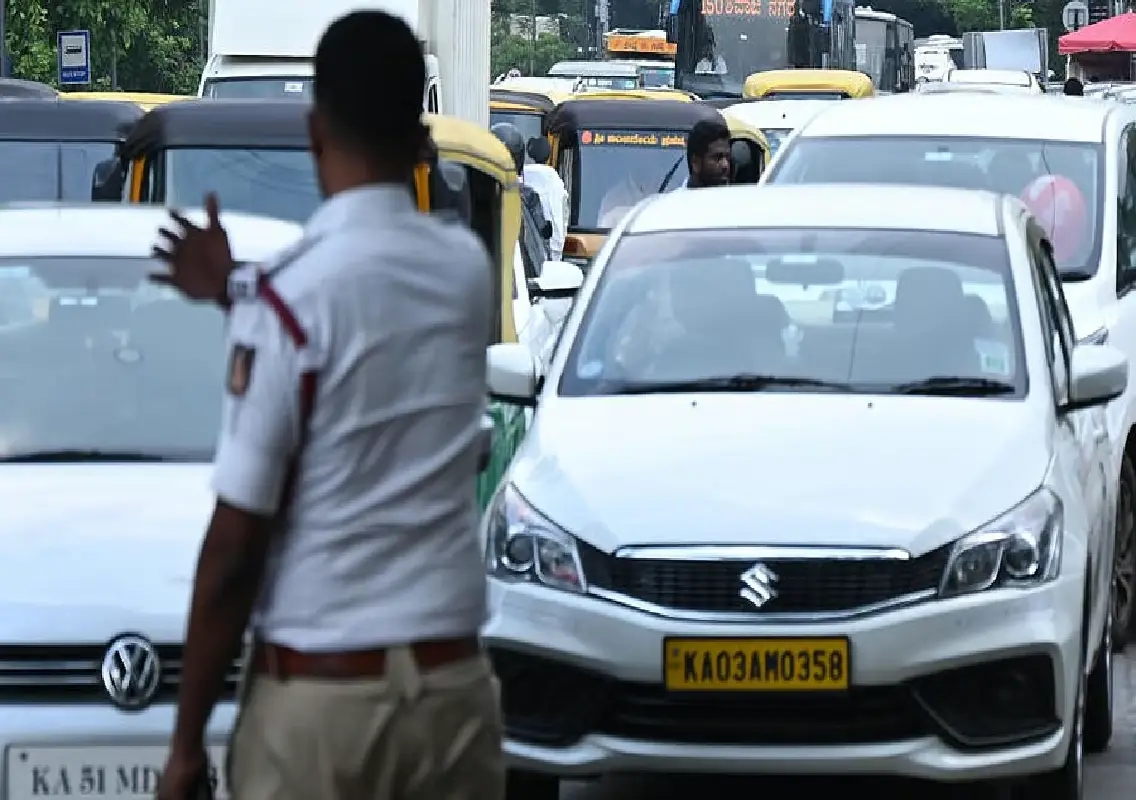


Bengaluru: Standing for long hours in the middle of traffic, exposure to pollution and constant interaction with the public already make traffic duty physically demanding. For many women traffic police personnel, the lack of reliable sanitation facilities adds another layer of stress during their daily work.
Women officers stationed at busy junctions often struggle to find accessible and hygienic toilets during their shifts.
Rajeshwari, a traffic police constable attached to Upparpete Traffic Police Station, said officers are frequently forced to depend on nearby public facilities or seek help from residents.
“Sometimes we use public toilets in the vicinity. At times, we request residents to allow us to use their toilets. If they are kind enough, they permit us. But not everyone agrees,” she said.
Poor maintenance of public restrooms
Officials said public toilets available near traffic junctions are often poorly maintained, raising concerns about hygiene and safety.
As a result, many officers hesitate to use them during duty hours.
In several areas, the absence of dedicated facilities for police personnel forces them to either travel a distance to find a restroom or rely on the goodwill of nearby establishments.
These challenges become more significant during long shifts when officers remain stationed at a single point for several hours.
Officers reduce water intake
Some officers adopt unhealthy coping mechanisms to avoid the difficulty of finding a restroom.
Savithri, another constable posted at Upparpete Traffic Police Station, said she reduces her water intake during the day to avoid needing to use the toilet frequently.
Officers say such practices can affect their health in the long run but are often seen as the only practical option while on duty.
Greater challenges during menstruation
The lack of proper sanitation facilities becomes particularly challenging during menstruation.
Women officers said standing for long hours without access to clean and private restrooms causes significant discomfort and difficulty in managing their duties.
“Standing for long hours without proper facilities causes significant discomfort,” Rajeshwari said.
Need for better facilities
Traffic police personnel have been calling for better infrastructure, including dedicated restrooms and rest areas at major traffic junctions.
Such facilities, they say, would help improve working conditions and ensure the health and dignity of women officers who perform demanding duties on city roads every day.
Authorities have acknowledged the issue in the past, and police personnel hope that steps will be taken to provide adequate sanitation facilities for traffic officers across the city.