







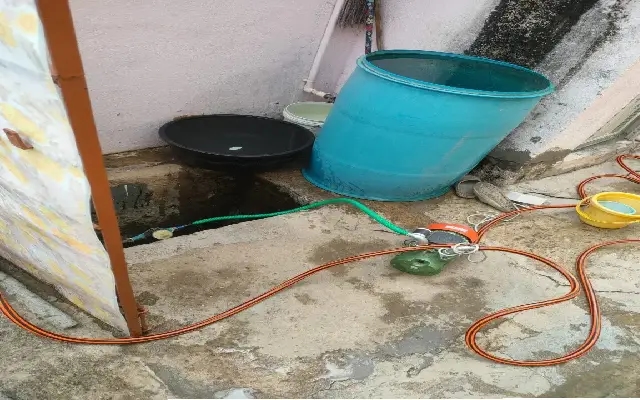


Without the aid of motors, residents of Bengaluru’s slums say even a single bucket of Cauvery water is out of reach.
In Triveninagara slum, KR Pura, Hajira Bhanu shares how they had no choice but to shift to Cauvery water after the community borewell ran dry last summer. Despite the connection, the feeble water flow for barely three hours, twice a week, forces families to depend on motors—deemed illegal by BWSSB.
As Bengaluru’s groundwater dries up, the government encourages Cauvery connections, offering subsidised rates for slums. Yet for many, the real cost lies in installing storage tanks, meters, and motors—expenses few can afford.
Of Bengaluru’s 413 recognised slums, around 80% initially relied on communal borewells. But as these wells failed, the burden shifted to an inconsistent Cauvery supply. Some better-off slums secured household taps, while others share common points or queue up at water ATMs.
In summer, the crisis worsens, forcing families to buy private tanker water costing ₹800–1,500 for 12,000 litres. Though BWSSB dispatches small tanks under the Mini Water Supply Scheme, it remains insufficient.
Residents complain about erratic Cauvery supply—water comes only for a few hours on alternate days, and sometimes not at all. Many accuse valve operators of irregularities, alleging water pressure is controlled and bribes are demanded to increase flow time.
Compounding the crisis is water contamination, as drinking lines often run dangerously close to sewage pipes. Despite repeated complaints, little has changed, leaving residents forced to boil, filter, or discard foul-smelling, dirty water.
Read Also: