







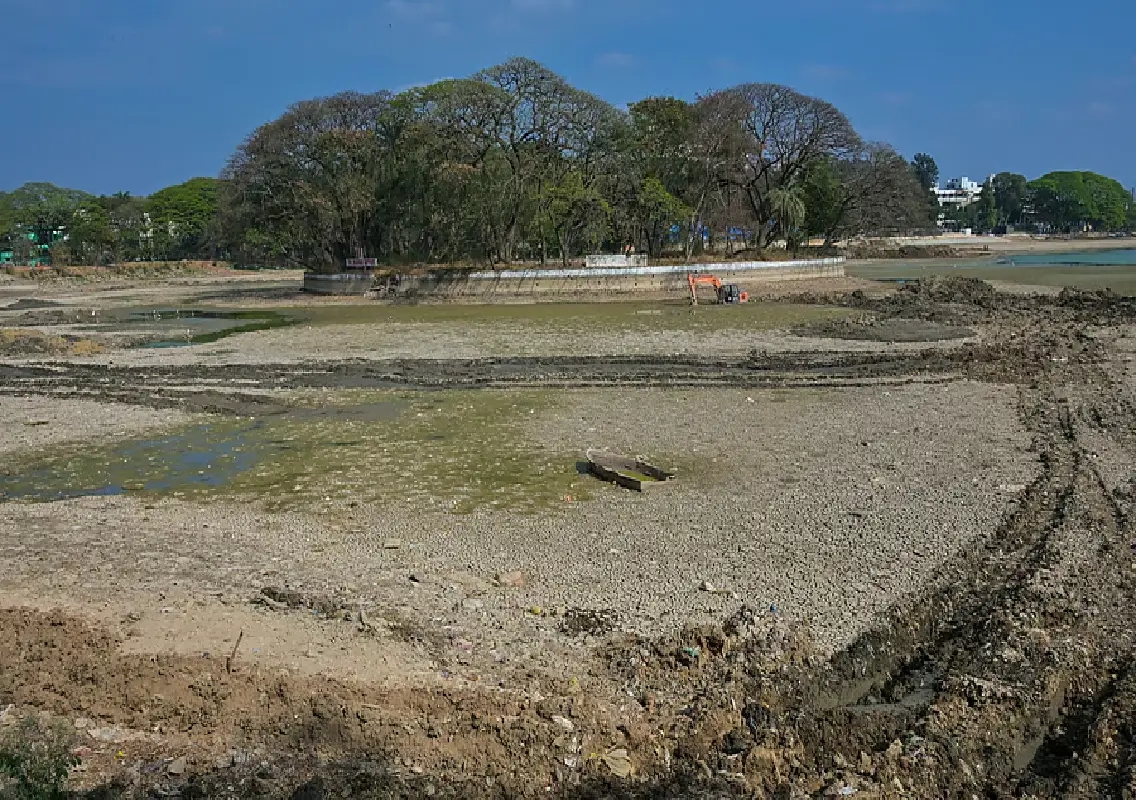


Bengaluru: Once celebrated as the “land of a thousand lakes”, Bengaluru is now witnessing a deepening ecological crisis, with a significant share of its remaining waterbodies slipping into the poorest water quality category.
Between April and November 2025, nearly four in ten monitored lakes in Bengaluru fell into Class E — the lowest water quality classification — every single month, according to official data from the Monitoring of Indian National Aquatic Resources (MINARS) programme. The data, published by the Karnataka State Pollution Control Board (KSPCB), reveals a grim picture of sustained pollution and untreated sewage inflow.
Samples were collected from 149 lakes across the city during the eight-month period. On average, 59.5 per cent of lakes were categorised under Class D, while 40.5 per cent were in Class E. The worst month was May 2025, when 46.6 per cent of the tested lakes fell into Class E.
Not a single sampled lake achieved Class A, B or C standards — categories considered suitable for drinking water (with treatment), bathing, or conventional potable supply.
Sewage inflow remains rampant
Among the worst-affected lakes are Vengaihnakere in Mahadevapura, Kannur Lake on Hennur Road and Rayasandra Tank in Sarjapura, all of which indicate continuous sewage inflow. Other lakes including Yelamallapa Chetty, Chikkagubbi, Madiwala, Varthur, Munekolalu, Bandematta, Hosakerehalli and Machohalli also remain heavily polluted.
Even prominent and relatively well-funded lakes such as Ulsoor, Jakkur and Yelahanka have failed to achieve satisfactory water quality standards.
For perspective, the faecal coliform count in Hosakerehalli Lake stands at 1.40 lakh MPN per 100 ml — 280 times higher than the Central Pollution Control Board’s bathing standard of 500 MPN/100 ml. In comparison, Sankey Tank recorded 225 MPN/100 ml, while Kengeri Lake fared relatively better at 43 MPN/100 ml.
The data suggests that while rainfall during the monsoon months offered temporary dilution, core pollution sources — domestic sewage and industrial effluents — remain largely unaddressed.
Investment paradox
The persistent decline in lake water quality comes despite more than a decade of heavy capital expenditure on sewage treatment plants (STPs), lake rejuvenation projects, remodelling of stormwater drains (SWDs), and the construction of sewage diversion channels.
In Bengaluru, the responsibility for supplying Cauvery water and managing domestic sewage lies with the Bangalore Water Supply and Sewerage Board (BWSSB), while the five newly carved municipal corporations oversee lakes and stormwater drains.
BWSSB Chairman Ramprasath Manohar said that STPs currently treat about 1,348 million litres per day (MLD) of sewage. “In the next two months, the infrastructure capacity for treating sewage will go up by 628 MLD. On top of that, we have proposed an additional nine STPs capable of treating 535 MLD of sewage,” he said.
He added that the BWSSB has begun releasing treated water into 23 lakes and plans to extend this to 40 more lakes to promote transparency in STP functioning.
However, experts argue that excessive emphasis has been placed on building treatment plants, while insufficient attention has been paid to ensuring complete sewer network coverage.
Gaps in sewer connectivity
MN Thippeswamy, a retired BWSSB engineer, pointed out that even before Cauvery Stage 5 was commissioned, the city was supplied with 1,440 MLD of water. Considering an additional 500 MLD of groundwater usage and assuming that 80 per cent of water consumption converts into sewage, treatment plants had the theoretical capacity to handle up to 80 per cent of sewage.
“Yet, no lake was free from sewage at that time. This shows that the city does not have a complete conveyance network connecting sewage sources to treatment plants,” he said.
Residents in the city’s outskirts, especially in Mahadevapura and KR Puram, echo this concern. Kochur Shankar, a resident of Horamavu, said that while Cauvery and sanitary lines have been laid, many houses continue to rely on septic tanks because BWSSB has not yet connected individual homes to the network.
“This is because the STP in Kalkere is too small to handle the load. Until it is upgraded, a lot of sewage will continue to flow into drains and lakes,” he said.
Governance and accountability concerns
Environmental groups have also raised concerns over regulatory oversight. V Ramprasad, convener of Friends of Lake, questioned the absence of a benchmark for lake water quality.
“No government agency, neither the BWSSB nor the Greater Bengaluru Authority, has set a clear benchmark and worked towards achieving it,” he said. He also pointed out that BWSSB, considered a primary polluter, is represented on the board of the KSPCB, the regulatory body.
As a temporary measure, authorities have initiated bioremediation projects and sewage diversion channels. However, experts stress that unless the source of sewage discharge is identified and fully integrated into the sanitary network, such measures will offer only limited relief.
With projections indicating that Bengaluru’s lakes could become sewage-free by 2029 if planned STPs are completed and connected effectively, the coming years will test whether infrastructure expansion can translate into ecological revival.
For a city that once prided itself on its interconnected lake system, the challenge now is not merely restoration but survival.