







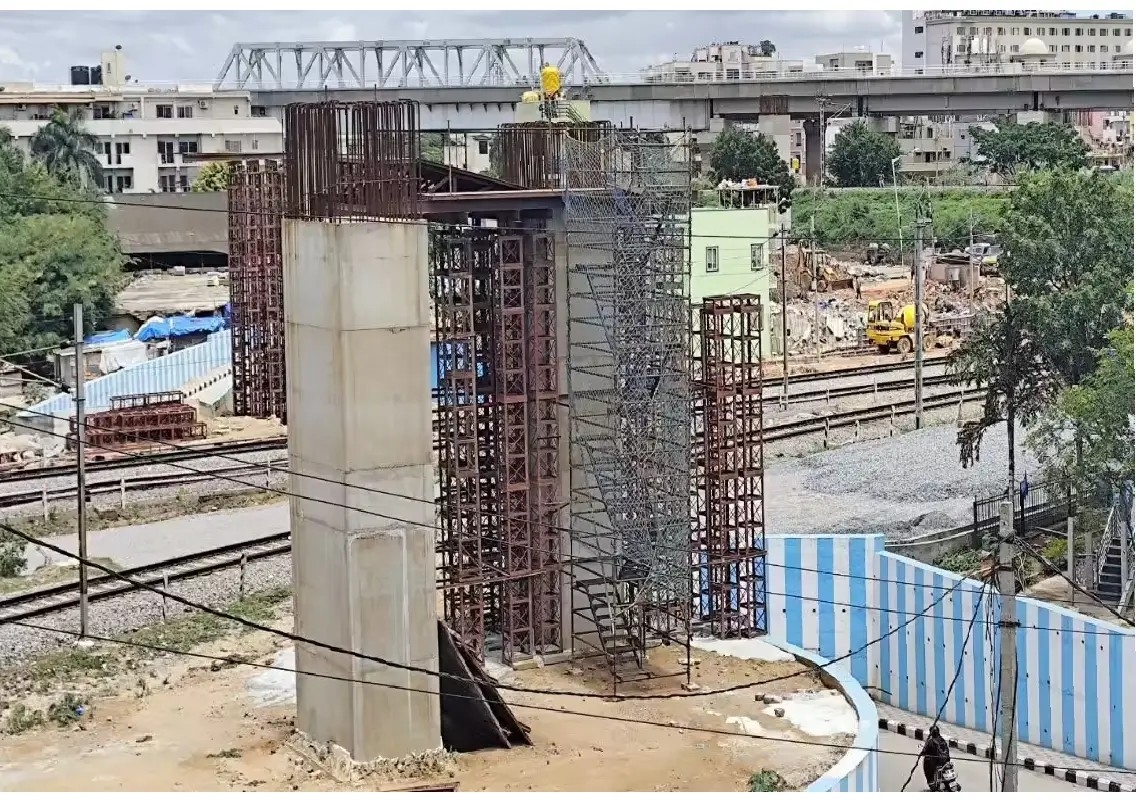


Bengaluru’s ambitious Metro expansion programme has entered an extended period of stagnation, with no new corridor reaching the construction stage for more than four-and-a-half years despite the city’s rapidly growing transport needs.
The last Metro project to enter execution was the extended Airport Line connecting KR Pura and Kempegowda International Airport. Contracts for the corridor were awarded by the Bangalore Metro Rail Corporation Limited (BMRCL) in November 2021, and construction commenced in early 2022.
Since then, no fresh Metro project has broken ground, raising concerns about the pace of infrastructure development in one of India’s fastest-growing cities.
Key projects remain stuck in approval process
Two major projects — Phase III and Phase IIIA — continue to await various approvals.
Phase III comprises the 45-km Orange Line, connecting JP Nagar 4th Phase to Kempapura and Hosahalli to Kadabagere. Although the Centre approved the project in August 2024 at a cost of ₹15,611 crore, subsequent modifications introduced fresh delays.
A major point of contention has been the proposed 37.1-km double-decker corridor, featuring a road flyover below and Metro viaduct above. The flyover component alone is estimated to cost ₹9,700 crore and will be funded entirely by the state government.
Phase IIIA also faces hurdles
The 37-km Sarjapur-Hebbal corridor under Phase IIIA has encountered similar challenges.
Initially estimated at ₹28,405 crore, the project cost was revised down to ₹25,999 crore after redesigning underground stations and reviewing alignment plans. The Ministry of Housing and Urban Affairs reportedly suggested several modifications, including the removal of the proposed Veterinary College station.
Questions have also been raised over the feasibility of incorporating double-decker structures within the project, leading BMRCL to seek technical inputs from IIT Roorkee.
Delays driving up costs
Officials warn that prolonged approval timelines are causing substantial cost escalations. Infrastructure projects typically witness annual cost increases of at least five per cent due to inflation, land acquisition expenses and material costs.
The impact is already visible in Phase II of Namma Metro. Originally sanctioned at ₹26,405 crore, the 72-km project’s revised cost has surged to ₹40,425 crore — an increase of nearly 53 per cent.
With Bengaluru adding more than 22.6 lakh vehicles over the past four-and-a-half years, transport experts say timely Metro expansion is critical to reducing congestion and meeting the city’s future mobility needs.