


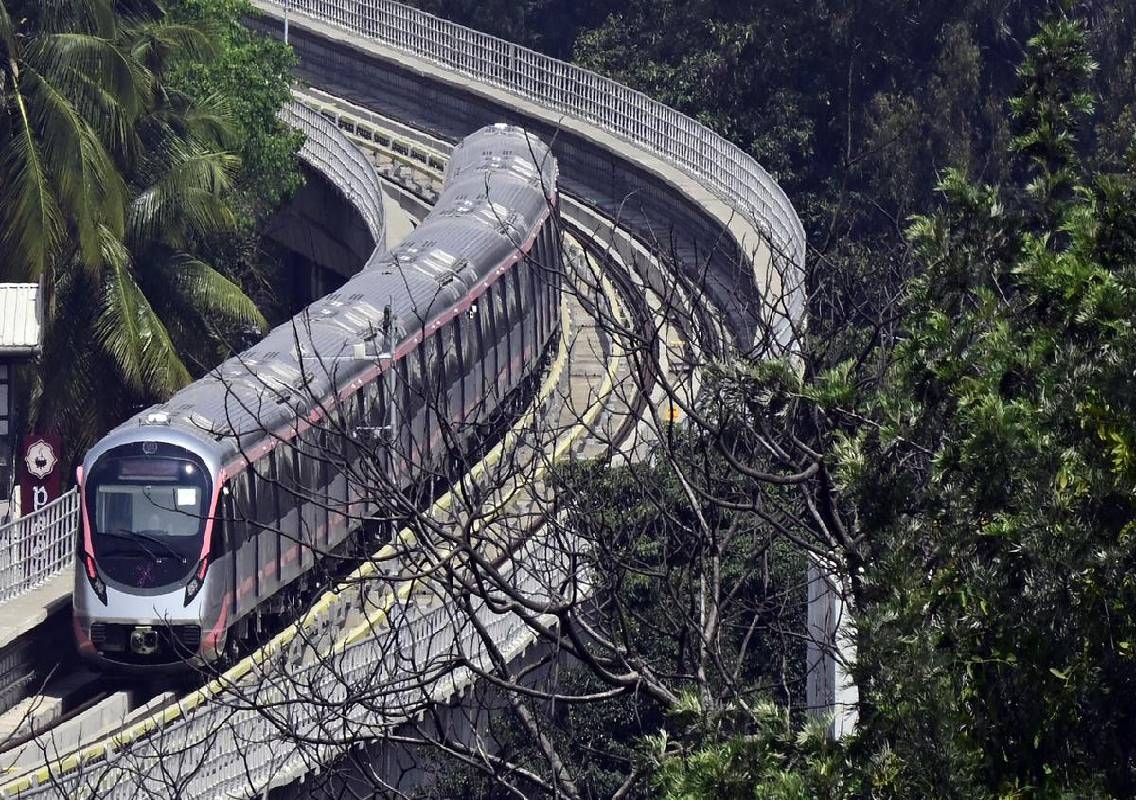


Bengaluru: The proposed opening of the elevated section of Namma Metro’s Pink Line has raised concerns among commuters about increased passenger congestion at the RV Road interchange station. While the new stretch is expected to improve connectivity for south Bengaluru, passengers fear that the partial opening could shift crowding to an already busy interchange.
The 7.5-km elevated section between Kalena Agrahara and Tavarekere is expected to be inaugurated on November 13. However, the remaining 13.8-km underground section, which will connect Dairy Circle to Nagawara, is still under construction. Until the entire corridor becomes operational, commuters travelling towards central and eastern Bengaluru may have to change trains multiple times.
Multiple interchanges may increase passenger movement
The concern is particularly significant for people travelling from south Bengaluru towards destinations such as M.G. Road, Whitefield and other parts of the central business district.
Under the partial-operation arrangement, passengers may have to use a combination of the Pink, Yellow, Green and Purple lines to reach their destinations.
For instance, commuters travelling from the south towards M.G. Road may need to take the Pink Line to Jayadeva Hospital, switch to the Yellow Line and travel to RV Road, change to the Green Line to reach Majestic and then board the Purple Line.
This journey could involve multiple transfers, increasing travel time and passenger movement at interchange stations.
Sunitha K., a commuter from Bilekahalli, expressed concern that RV Road station could become even more crowded than Majestic, particularly during peak hours. She also said that the partial opening would offer limited convenience for her regular journey towards M.G. Road.
RV Road station already faces crowding concerns
RV Road is an important interchange connecting the Yellow and Green lines. The station has previously witnessed heavy passenger movement following the introduction of Yellow Line services.
In August 2025, reports indicated that the interchange was handling around 30,000 to 35,000 passengers daily, with queues forming as commuters switched between trains. Barricades were installed on platforms to help manage the movement of passengers.
With the Pink Line’s elevated section becoming operational, commuters fear that additional transfers could put further pressure on the station’s platforms and circulation areas.
Advaith Raj, a resident of Hulimavu, said the underground section would make a substantial difference to passengers travelling between south Bengaluru and the central business district. He pointed out that commuters heading towards Whitefield would still need to make multiple changes under the partial-operation arrangement.
Some commuters may continue using road transport
The additional transfers and longer journey times could discourage some passengers from using the Metro, prompting them to continue relying on buses, autorickshaws and cabs.
Manoj Kumar, a resident of BTM Layout, said the new stretch could attract commuters travelling towards Majestic and other destinations. However, he felt that the additional interchange requirements could influence the travel choices of passengers.
The concerns underline the importance of completing the underground section so that the Pink Line can provide a continuous north-south connection rather than functioning as a limited corridor.
BMRCL to monitor passenger movement
A Bangalore Metro Rail Corporation Limited (BMRCL) official said passenger movement and crowd levels at RV Road would be monitored after the elevated section becomes operational.
The corporation would assess passenger volumes, interchange movement and peak-hour congestion. Depending on the situation, it may introduce measures such as regulating passenger movement and deploying additional staff to manage crowds.
Full Pink Line expected to open in 2027
The Pink Line is a 21.3-km corridor connecting Kalena Agrahara in south Bengaluru with Nagawara in the north. It consists of a 7.5-km elevated section and a 13.8-km underground stretch.
The elevated section will have six stations: Kalena Agrahara, Hulimavu, IIMB, JP Nagar 4th Phase, Jayadeva Hospital and Tavarekere. Jayadeva Hospital station will provide an interchange with the operational Yellow Line.
The underground section will pass through important locations in central and northern Bengaluru, including Dairy Circle, M.G. Road and Shivajinagar. Its completion is expected to provide a more direct connection between southern neighbourhoods and central Bengaluru.
BMRCL is targeting the first half of 2027 for the opening of the entire corridor, subject to completion of the remaining work, testing and statutory clearances. Until then, commuters may have to adjust to additional transfers and possible crowding at key interchange stations.