







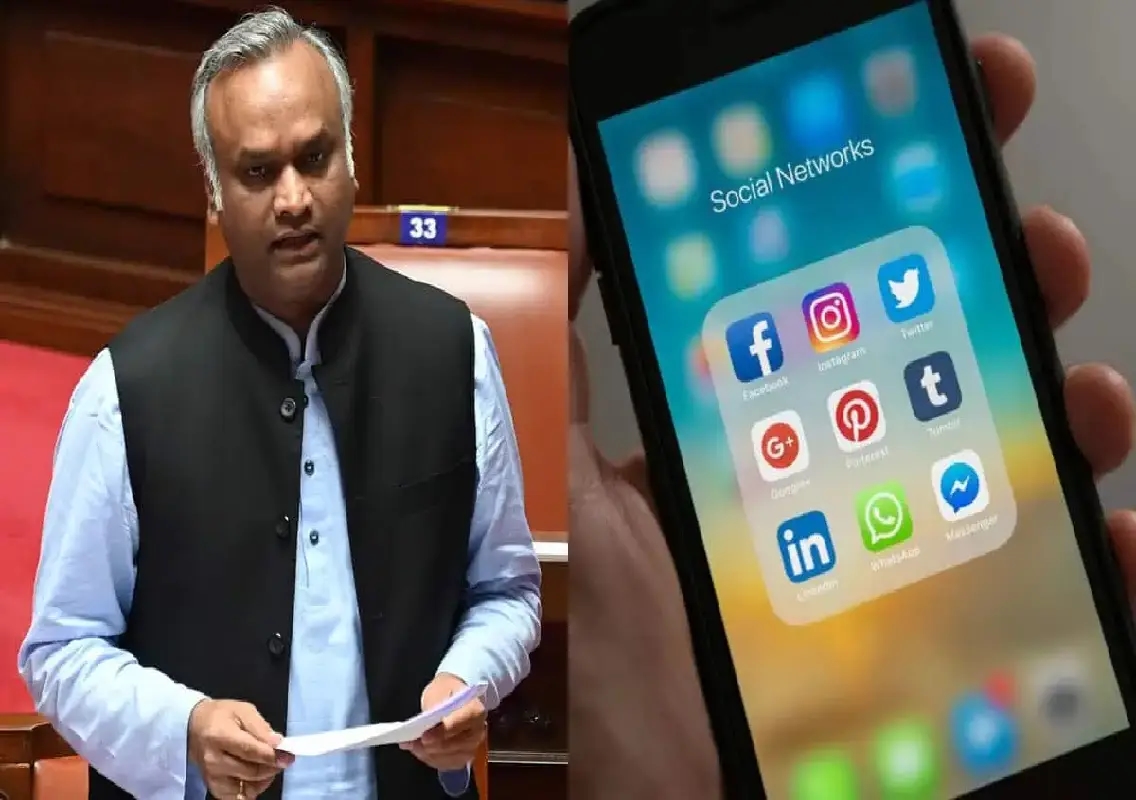


Bengaluru: The Karnataka government is actively considering a ban on the use of social media for children below the age of 16, drawing inspiration from similar steps taken by countries such as Australia and Finland. The proposal, still at a discussion stage, was revealed in the Legislative Assembly on Friday by Minister for Rural Development and Panchayat Raj and IT-BT, Priyank Kharge, amid growing concerns over the harmful impact of unregulated social media use on children and adolescents.
The issue came up during the Assembly session when senior BJP leader and MLA S Suresh Kumar raised concerns over the widespread abuse of social media platforms, particularly by minors. Responding to the query, Kharge acknowledged that excessive and irresponsible use of social media has emerged as a serious social and psychological challenge, especially among young users.
Global precedents influencing Karnataka’s thinking
Kharge pointed out that several countries have already taken concrete steps or are in the process of doing so to regulate children’s access to social media. Finland has implemented measures to protect children from excessive digital exposure, the United Kingdom is considering similar age-based restrictions, and Australia imposed a ban on social media use for children below a certain age about two months ago.
“These developments have prompted us to look at the issue seriously. The impact of social media on children’s mental health, behaviour and learning abilities cannot be ignored any longer,” Kharge said, as quoted by The New Indian Express.
The minister added that Karnataka is studying international models to understand how such regulations can be implemented effectively without infringing on personal freedoms or access to essential digital resources.
State initiatives on digital detox and responsible use
Highlighting the steps already taken by the state, Kharge said Karnataka has launched a digital detoxification programme aimed at promoting the responsible use of artificial intelligence and social media. The initiative is being implemented by the IT-BT department in collaboration with Meta.
According to the minister, the programme has already reached over three lakh children and one lakh teachers across the state. The initiative focuses on educating students about the risks of digital addiction, cyberbullying, misinformation and unhealthy screen habits, while also training teachers to guide students in developing balanced digital behaviour.
“The idea is not just restriction, but education and awareness. Children need to understand how to use technology responsibly,” Kharge said.
‘Beyond Screens’ programme and detox centre
Kharge also informed the House that in March 2025, the Karnataka government launched a dedicated initiative called ‘Beyond Screens’ to support individuals dealing with digital addiction. The programme was announced during the GAFX 2025 summit, a major event focused on gaming, animation, visual effects and emerging technologies.
As part of the initiative, the government inaugurated a ‘Beyond Screens’ digital detox centre and launched an official website to provide access to information and services. The detox centre functions as a dedicated hub offering counselling, awareness sessions and structured intervention programmes designed to help individuals, including children and adolescents, develop healthier digital habits.
Officials said the centre also works with parents and educators, recognising that tackling digital addiction requires a collective approach involving families, schools and communities.
Assembly debate and Economic Survey reference
During the discussion, S Suresh Kumar referred to the Economic Survey 2025–26, which was presented in the Lok Sabha on Thursday. The survey recommended that governments seriously consider age-based restrictions on social media usage for children, citing rising evidence of its adverse impact on mental health, attention spans and social behaviour.
Kumar argued that while technology has become an integral part of modern life, unchecked exposure to social media at a young age can have long-term consequences. He urged the state government to act decisively to protect children from digital harm.
Challenges and legal considerations
While the proposal has found support in principle, officials acknowledged that implementing a blanket ban poses several challenges. These include defining enforceable age-verification mechanisms, ensuring compliance by social media companies, and addressing concerns related to freedom of expression and access to information.
Experts have also pointed out that children increasingly use social media for educational collaboration, creativity and communication, especially in urban areas. Any restriction, they argue, would need to be accompanied by clear guidelines, parental involvement and robust digital literacy programmes.
Kharge indicated that the government would hold consultations with legal experts, child psychologists, educators, parents and technology companies before taking a final call.
Conclusion
The Karnataka government’s move to consider a social media ban for children below 16 reflects growing global and national concern over digital addiction and online harm among minors. While the proposal is still under discussion, the state’s emphasis on digital detox programmes and awareness initiatives signals a broader strategy focused on responsible technology use. The final decision is expected to balance child safety, legal feasibility and the realities of an increasingly digital society.