







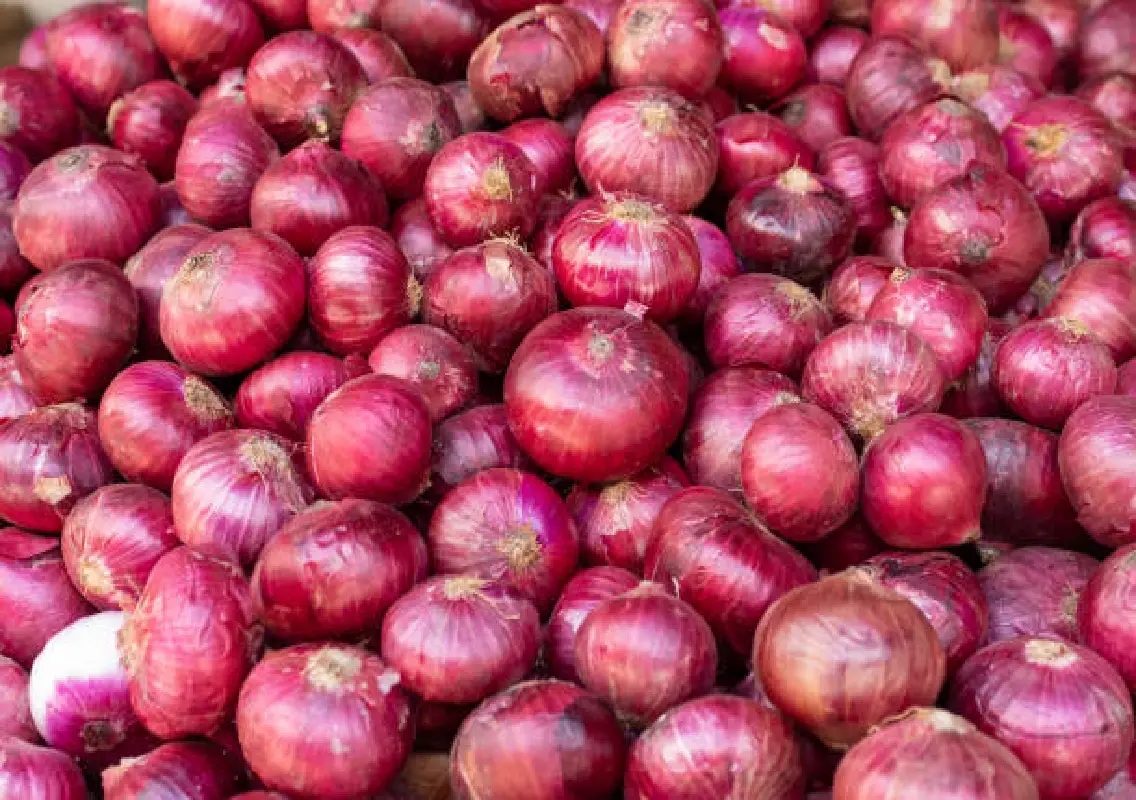


Bengaluru: Retail onion prices across Karnataka have fallen sharply below Rs 10 per kg this festive season, with procurement rates plunging to Rs 700–1,500 per quintal, compared to last year’s Rs 4,000–7,000. The sudden decline has reignited calls from farmer organisations to include all perishable crops under market intervention schemes with a guaranteed minimum support price (MSP). Plans for a statewide agitation are underway to press this demand.
Impact of rains and export restrictions
Normally, Karnataka exports onions to states such as West Bengal, Maharashtra, Odisha, Andhra Pradesh, Telangana, Kerala, and even abroad to Bangladesh and Sri Lanka. However, above-normal rainfall during this kharif season has made these regions self-sufficient, prompting Karnataka to halt exports.
Farmers in districts including Vijayanagar, Ballari, Chitradurga, and Davanagere have delayed harvesting, while previously harvested onions are rotting due to inadequate storage facilities.
“Onion growers are in distress,” said HS Basavarajappa, state president of Karnataka Raitha Sangha and Hasiru Sene. “Repeated pleas to the government to establish cold storages at district level have fallen on deaf ears. The inclusion of perishable crops in MSP schemes has also been a long-pending demand. We will soon revive the demand for a market intervention scheme for all horticulture crops.”
Calls for comprehensive MSP reforms
Basavarajappa noted that the agitation seeking a constitutional guarantee for MSP will complete five years in November, yet the demand remains unfulfilled. “Programmes are being planned across the state to mark this milestone, and farmers will come together to seek market intervention schemes for all crops,” he added.
T Yashawanta, state general secretary of Karnataka Prantha Raitha Sangha, criticised the current MSP system, saying, “The scheme in its present form does not cover the major crops grown in Karnataka. Our demand is to include all crops and give it a legal guarantee. The Kerala government has introduced an MSP scheme for vegetables and fruits, which must be adopted at the national level.”
Currently, the Centre has listed 14 kharif and 6 rabi crops for MSP this year. From Karnataka, only paddy, ragi, and jowar are included, though the state has repeatedly urged the Centre to also incorporate minor millets and other crops.
“The time has come for comprehensive reforms to schemes such as MSP,” said Agriculture Minister N Cheluvarayaswamy. “Currently, farmers from a few states in north India are taking most of the benefits. Reforms are needed to make the support system useful for farmers across all states. We have urged the Centre to include all crops grown in Karnataka in the MSP scheme.”
Market intervention and government support
B Ravishankar, secretary of Bangalore Onion and Potato Merchants Association, pointed out that the state government recently implemented a market intervention scheme for mango growers. “A similar initiative is needed for onion farmers,” he said.
Last week, Chief Minister Siddaramaiah announced additional compensation of Rs 8,500 per hectare over and above NDRF payouts for crop loss in Kalyana Karnataka districts. Farmers are now demanding that this initiative be extended to all crops across the state, to prevent distress during periods of oversupply or weather-related losses.
The ongoing price slump highlights the urgent need for reforms in MSP and storage infrastructure, particularly for perishable crops, to ensure Karnataka farmers can earn sustainable incomes even during bumper harvests.