







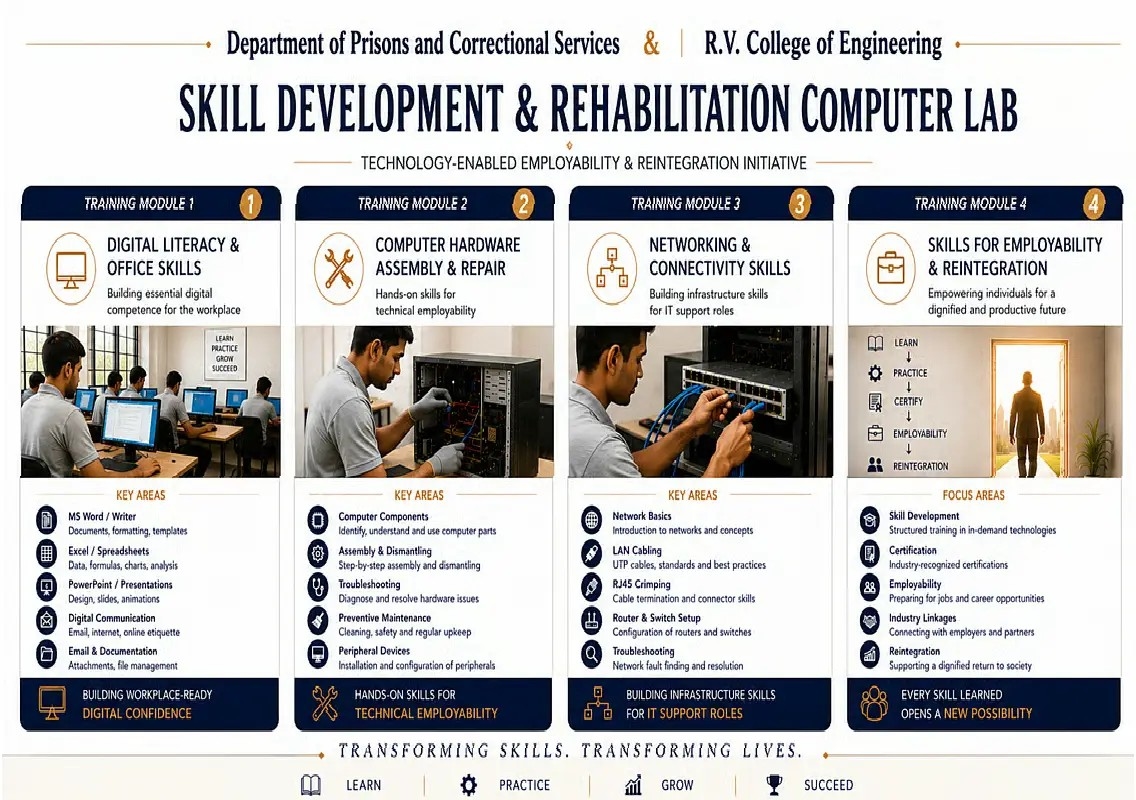


In a significant move towards strengthening rehabilitation through education and skill development, the Department of Prisons and Correctional Services, Karnataka, and RV College of Engineering (RVCE) are working towards a pioneering collaboration to create a sustainable learning ecosystem for prison inmates across the state.
The initiative, proposed through a Memorandum of Understanding (MoU), seeks to transform correctional institutions into centres of learning, personal growth and future readiness.
Focus on skills and rehabilitation
The collaboration aims to provide inmates with access to digital literacy, employability skills, technical education and livelihood-oriented training. The initiative is designed to support rehabilitation by helping inmates acquire practical competencies that can improve their prospects after release.
According to RVCE, the programme is based on the belief that meaningful rehabilitation begins by creating opportunities for individuals to rebuild confidence, develop skills and rediscover purpose.
Computer lab at Parappana Agrahara
The first phase of the initiative is being rolled out at the Central Prison, Bengaluru, also known as Parappana Agrahara.
A dedicated computer training laboratory is being established with support from institutional contributions, industry partnerships, corporate social responsibility (CSR) initiatives and academic volunteers.
The facility will be equipped with computers, networking infrastructure, digital learning tools and curated educational content designed specifically for correctional settings.
Promoting reformative justice
RVCE stated that the project goes beyond conventional prison education and aligns with modern correctional philosophies that prioritise reformative justice over punitive isolation.
Several computer systems have already been identified through refurbishment efforts, reflecting a sustainable approach that combines resource reuse with social impact.
The proposed laboratory is envisioned as more than a training centre. It is expected to serve as a space where inmates can engage productively, improve their skills and prepare for successful reintegration into society