







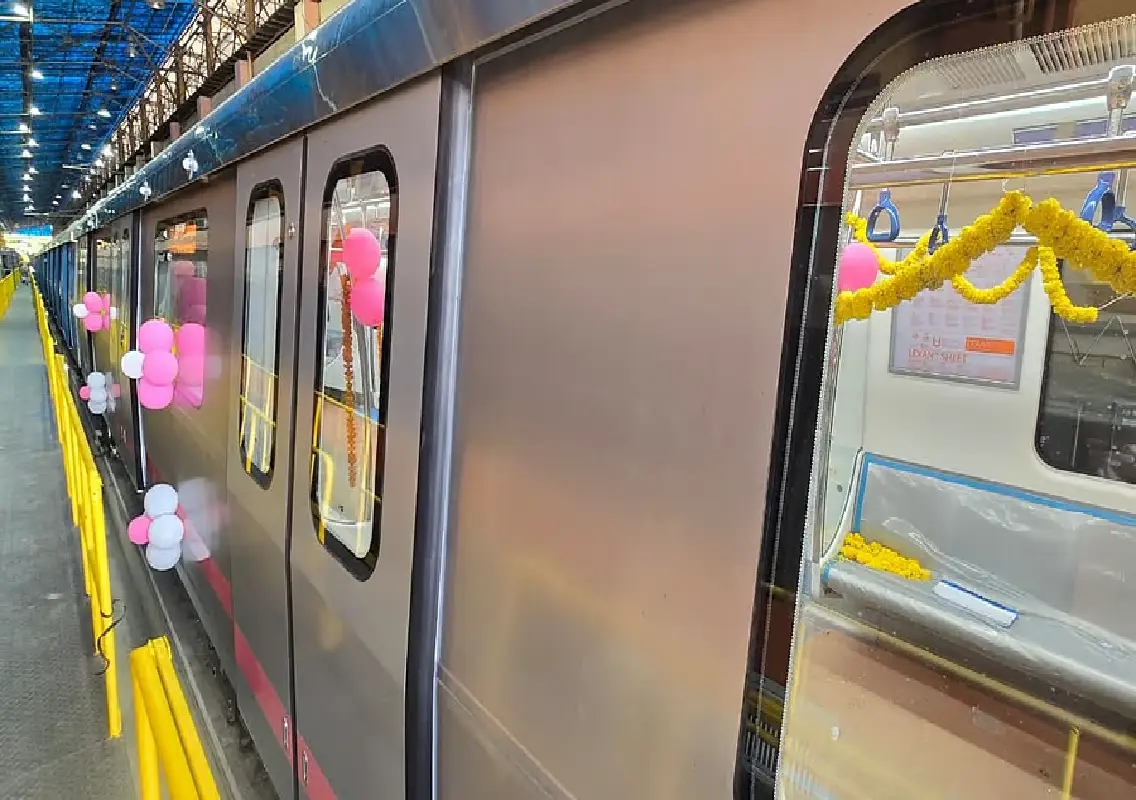


Bengaluru: The Bengaluru Metro Rail Corporation Limited (BMRCL) is set to take another significant step towards operationalising the much-awaited Pink Line, with the second driverless train expected to be dispatched on Friday. Sources familiar with the development said the six-coach train is currently undergoing final finishing work at BEML’s New Thippasandra manufacturing unit and will soon be moved to the Pink Line depot at Kothanur on Bannerghatta Road.
The arrival of the second train marks an important milestone in the rollout of Bengaluru’s first fully driverless metro corridor, which is being developed under the city’s expanding mass rapid transit network.
Train ready after final touches at BEML
According to officials, the train is in the last stages of inspection and finishing. Once dispatched, it will be transported to the Kothanur depot, where it will undergo further checks, system integration and preparatory work before being inducted into trial operations.
BEML, a public sector undertaking under the Ministry of Defence, is manufacturing the driverless rolling stock for the Pink Line. The trains are equipped with Communication-Based Train Control (CBTC) technology, enabling fully automated operations without a driver.
Pink Line elevated section to open in May
BMRCL is planning to open the 7.5-km elevated section of the Pink Line between Kalena Agrahara and Tavarekere by May 2026, subject to statutory approvals. Officials said that five to six driverless trains are expected to be available for operations when the elevated stretch is commissioned.
The Pink Line, when fully operational, will connect Kalena Agrahara in south Bengaluru to Nagawara in the north, significantly improving east-west and north-south connectivity and easing pressure on existing metro corridors and road networks.
Prototype train already on trial runs
The first driverless train, which serves as the prototype, was rolled out on December 11, 2025, and is currently undergoing extensive trial runs on the Pink Line’s elevated section. These trials are being conducted to test critical systems such as braking, signalling, communication, platform screen door coordination and emergency response protocols.
Metro officials said the data and performance feedback from the prototype train will play a key role in fine-tuning subsequent trains, including the second unit scheduled to arrive this week.
Focus on approvals and safety certifications
BMRCL officials are working towards securing all mandatory approvals from relevant authorities, including the Commissioner of Metro Railway Safety (CMRS), well ahead of the proposed May opening. This includes approvals for the new rolling stock, signalling systems and passenger safety measures.
“The objective is to complete trials and certifications without rushing the process, while still meeting the planned timelines,” a senior official said. “Driverless operations require a higher level of scrutiny, and safety remains the top priority.”
Significance of driverless technology
The Pink Line will be the first corridor in the Namma Metro network to operate fully driverless trains. The CBTC-based system is expected to allow higher frequency of services, better punctuality and improved operational efficiency.
Experts say that driverless trains can help optimise energy usage, reduce human error and provide smoother rides. However, they also require robust cyber security, redundancy systems and extensive staff training for monitoring and emergency interventions.
Progress amid challenges
The Pink Line project has faced delays in the past due to land acquisition issues, design changes and the impact of the COVID-19 pandemic. Despite these challenges, the recent progress in rolling stock deployment and trial runs has renewed optimism about phased openings starting in 2026.
Commuters in south Bengaluru, particularly those travelling along Bannerghatta Road and surrounding areas, are expected to benefit significantly once the elevated section opens.
Conclusion
The dispatch of the second driverless train signals steady progress towards the launch of Namma Metro’s Pink Line. With trial runs underway, additional trains being readied and approvals in process, BMRCL appears on track to open the elevated stretch by May. Once operational, the Pink Line is expected to play a crucial role in transforming Bengaluru’s urban mobility with advanced, automated metro services.