







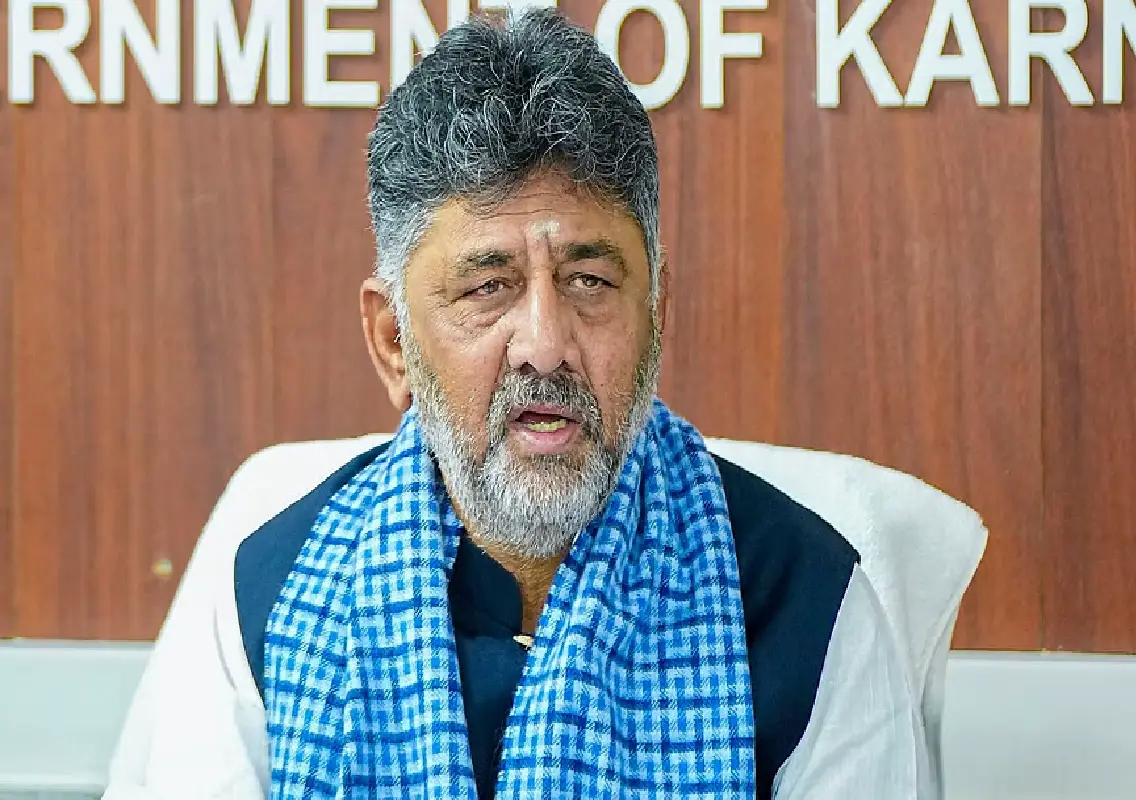


Bengaluru: Back from his visit to the World Economic Forum (WEF) in Davos, Deputy Chief Minister D K Shivakumar on Sunday praised Switzerland as a model for urban planning and infrastructure, while outlining the Karnataka government’s ambitious plan to develop a comprehensive mobility grid across all cities in the state with a 25-year horizon.
Speaking to reporters after returning from Switzerland, Shivakumar said rapid urbanisation across Karnataka has prompted the government to think long-term and proactively plan infrastructure, especially road networks, to meet future demand. He noted that investors are increasingly keen to understand how governments are preparing cities to handle growth pressures related to population, transport and logistics.
“As cities are becoming more urbanised, investors want clarity on how the government will respond to future infrastructure requirements. Keeping this in mind, we have decided to develop a mobility grid by notifying areas for future roads well in advance,” Shivakumar said.
Learning from Switzerland’s infrastructure model
Shivakumar described Switzerland as “heaven” while praising its road network, traffic discipline, railway connectivity and overall urban planning. He said the European nation offered several lessons that Karnataka could adapt, particularly in managing mobility in dense urban regions.
Referring to his travel experience, Shivakumar said Davos, which hosts the annual WEF summit, is about twice the size of Sadashivanagar in Bengaluru. Despite its small size, he observed that traffic congestion during the event was significant, prompting world leaders and delegates to walk short distances of one to two kilometres instead of relying on vehicles.
“All world leaders preferred to walk short distances because of long traffic jams. Even the airport was about 200 kilometres away,” he said, highlighting the need for efficient planning even in developed regions.
He also recalled his road journey from Zurich to Davos, during which he passed through 40 to 50 tunnels. “Some of them were short, while a few were as long as 20 kilometres,” he said.
Mobility grid plan to be formalised soon
The deputy chief minister said the state government would soon convene a meeting involving the Urban Development, Revenue and Panchayat Raj ministers to formally discuss and approve the mobility grid plan. The idea, he explained, is to identify and notify land for future roads and transport corridors well in advance, thereby avoiding costly land acquisition and disputes at later stages.
Officials said the proposed mobility grid would serve as a guiding framework for future infrastructure projects, helping cities expand in a more planned manner. The plan is expected to cover not just Bengaluru but also tier-2 and tier-3 cities across Karnataka, which are witnessing rapid growth.
Shivakumar emphasised that infrastructure planning must look far beyond immediate political or administrative terms. “We are thinking about the next 25 years. If we don’t plan now, our cities will struggle later,” he said.
Investor interest at Davos
During his Davos visit, Shivakumar said Karnataka received strong interest from global investors. According to him, as many as 45 companies expressed their intent to invest in the state across multiple sectors.
However, he clarified that the government deliberately chose not to sign any formal agreements at Davos. “We decided not to sign any agreements there. Instead, we invited investors to participate in the Global Investors’ Meet,” he said.
Shivakumar added that several investors showed particular enthusiasm for the proposed artificial intelligence (AI) city planned in Bidadi, near Bengaluru. The AI city is envisioned as a major hub for technology, research and innovation, aimed at strengthening Karnataka’s position as a global tech destination.
Tunnel roads and comparisons with Europe
Shivakumar indirectly defended the state government’s controversial proposal to build tunnel roads in Bengaluru, drawing comparisons with European infrastructure. He pointed out that extensive tunnel networks are a common feature in countries like Switzerland and are used effectively to manage traffic and preserve surface-level urban spaces.
He said he had discussed tunnel projects with the Maharashtra chief minister, noting that Maharashtra is currently building several tunnels. “They have shared some suggestions, especially about parking facilities near tunnels. We would like to visit some of the tunnel projects in Maharashtra,” he said.
The deputy chief minister also revealed that the Karnataka government plans to approach the Japan International Cooperation Agency (JICA) for a loan to fund the proposed second tunnel road, which would serve as an east-west corridor in Bengaluru.
Technology and global interest in Bengaluru
Touching upon technology, Shivakumar mentioned that billionaire Elon Musk owns a company that manufactures tunnel-boring machines. However, he noted that the machines currently produced by Musk’s firm have a diameter of only three to six metres.
“These machines are suitable for metro projects, but tunnel roads require much bigger machines,” he said, indicating the technical challenges involved in such large-scale infrastructure projects.
Reiterating Bengaluru’s global importance, Shivakumar said the world is increasingly looking at India through the lens of the Karnataka capital. He compared Bengaluru with other major Indian cities, pointing out its unique strengths.
“New Delhi is facing severe air pollution problems. Mumbai does not have the IT workforce and human resources that Bengaluru enjoys. This is our biggest asset,” he said.
According to him, most investor inquiries during Davos were related to data centres, global capability centres, aviation, food and beverage, renewable energy, electric vehicles (EVs) and allied sectors.
Conclusion
Shivakumar’s remarks underscore the Karnataka government’s push to position the state as a future-ready investment destination by focusing on long-term infrastructure planning. By drawing lessons from global examples like Switzerland and aligning them with local needs, the government aims to address urban challenges proactively while reinforcing Bengaluru’s role as India’s technology and innovation hub.