







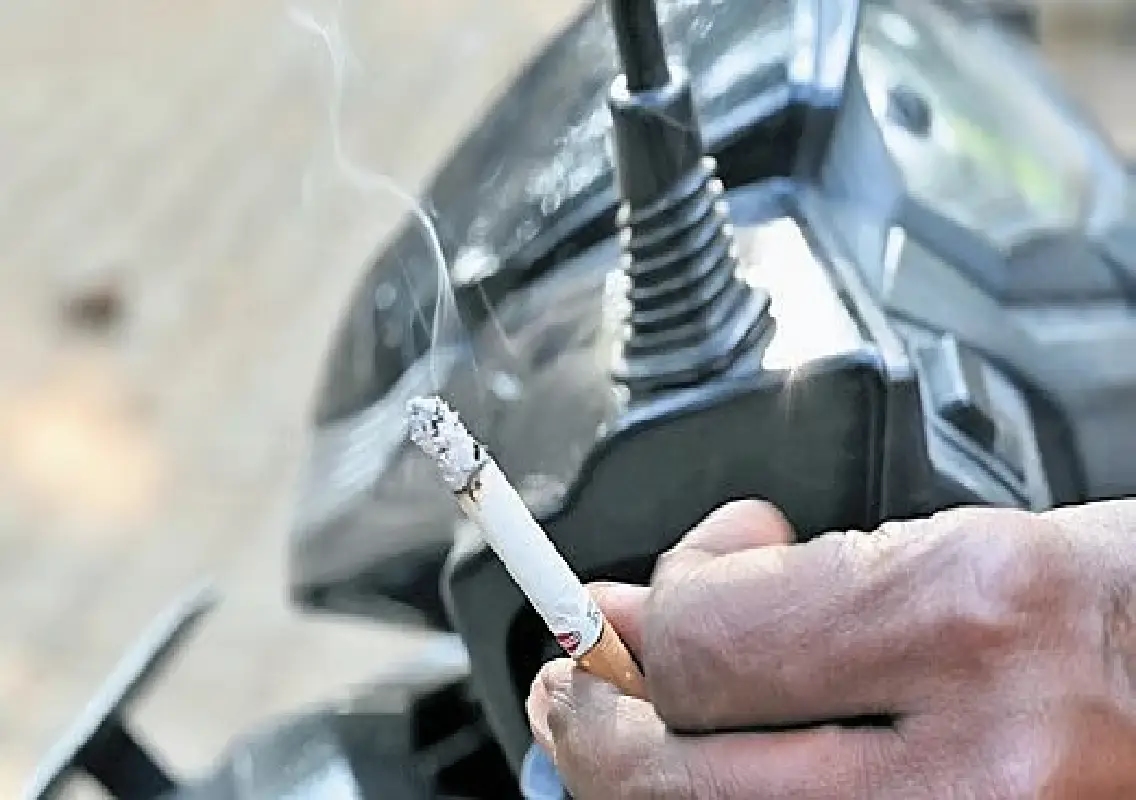


Bengaluru: Growing traffic congestion and long waits at traffic signals in Bengaluru have given rise to a concerning trend—motorists lighting cigarettes while driving or while waiting at signals. While authorities regularly penalise smoking in designated public spaces such as malls, railway stations and government buildings, smoking by motorists on roads continues largely unchecked due to legal ambiguity and lack of monitoring.
Public health experts say that although smoking in public places is restricted under existing laws, the absence of clear provisions regarding smoking on roads has created a regulatory grey area, allowing motorists to continue the practice without fear of penalties.
Legal framework lacks clarity on roads
India’s Cigarettes and Other Tobacco Products Act (COTPA), 2003, along with the Prohibition of Smoking in Public Places Rules, 2008, clearly prohibits smoking in several public locations. These include hospitals, hotels, educational institutions, malls and railway stations.
However, roads and footpaths—areas that witness heavy public movement—are not explicitly mentioned in the list of restricted places. This omission has made enforcement difficult, particularly when individuals smoke while riding motorcycles or driving vehicles.
Public health specialist Dr Triveni B S highlighted the enforcement gap.
“If a person smokes in a hotel, you can complain to the owner. If it happens in a mall, you approach the manager. But if someone smokes on the road while driving, it becomes unclear who should be responsible for taking action,” she said.
According to experts, this lack of legal clarity allows motorists to avoid penalties even though their actions may affect the health and safety of other commuters.
Health experts warn about second-hand smoke risks
Public health advocates warn that smoking while driving not only affects the smoker but also exposes fellow road users, pedestrians and passengers to second-hand smoke.
SJ Chander, convenor of the Consortium for Tobacco-Free Karnataka, emphasised the need for personal responsibility among smokers.
“Not smoking will not cause death; at most it may create restlessness for the smoker. People should learn to postpone the urge when they are in public spaces such as roads,” he said.
Medical professionals point out that second-hand smoke exposure can cause respiratory problems, aggravate asthma and increase the risk of heart disease and cancer among non-smokers.
Given Bengaluru’s already congested traffic conditions, experts say the presence of smoke in crowded intersections can worsen the experience for pedestrians, cyclists and other motorists.
Replacement strategies suggested for addicted smokers
Health professionals acknowledge that quitting smoking is not easy for individuals with strong addiction. As a result, they recommend alternative coping strategies to help smokers manage their cravings while travelling.
Cardiologist Dr Natesh B H, president of the Foundation for Sustainable Health India (FSHI), explained that behavioural replacement is often the first step in de-addiction.
“The first step in de-addiction is replacement. Something simple like eating a chocolate, chewing gum, or choosing a harmless and nutritious snack can help manage the urge,” he said.
He added that policymakers and health experts should work together to identify practical substitutes that can help people gradually move away from smoking habits.
According to him, asking individuals to quit abruptly without offering alternatives often proves ineffective.
Need for stronger enforcement at traffic signals
Experts believe that traffic signals and major junctions are the most common locations where motorists smoke while driving or waiting in traffic.
They suggest that authorities could deploy enforcement personnel at such locations to monitor and discourage the practice.
Public health advocates have also proposed using technology to strengthen enforcement.
One suggestion involves introducing a reporting mechanism similar to the Public Eye app, which currently allows citizens to report traffic violations.
“An app-based reporting system could allow commuters to upload photos or videos of public smoking incidents on roads. This would enable citizens and law enforcement agencies to work together in addressing the issue,” an expert suggested.
Such systems, experts say, could help authorities identify repeat offenders and increase accountability among motorists.
Public awareness remains key
While enforcement and legal clarity are important, experts stress that long-term change will depend on public awareness and behavioural change.
Campaigns highlighting the dangers of second-hand smoke and the importance of responsible behaviour in public spaces could help discourage smoking while driving.
With Bengaluru continuing to face heavy traffic congestion and rising pollution levels, public health advocates say discouraging smoking on roads is essential to creating safer and healthier commuting environments for everyone.
Conclusion
The growing trend of motorists smoking on Bengaluru roads has exposed a significant gap in existing tobacco control regulations. While the law clearly prohibits smoking in several public spaces, the absence of explicit rules regarding roads has made enforcement difficult.
Experts believe that a combination of clearer legal provisions, stronger monitoring at traffic signals, citizen reporting mechanisms and public awareness campaigns could help address the issue and reduce the risks posed by second-hand smoke on busy city roads.