







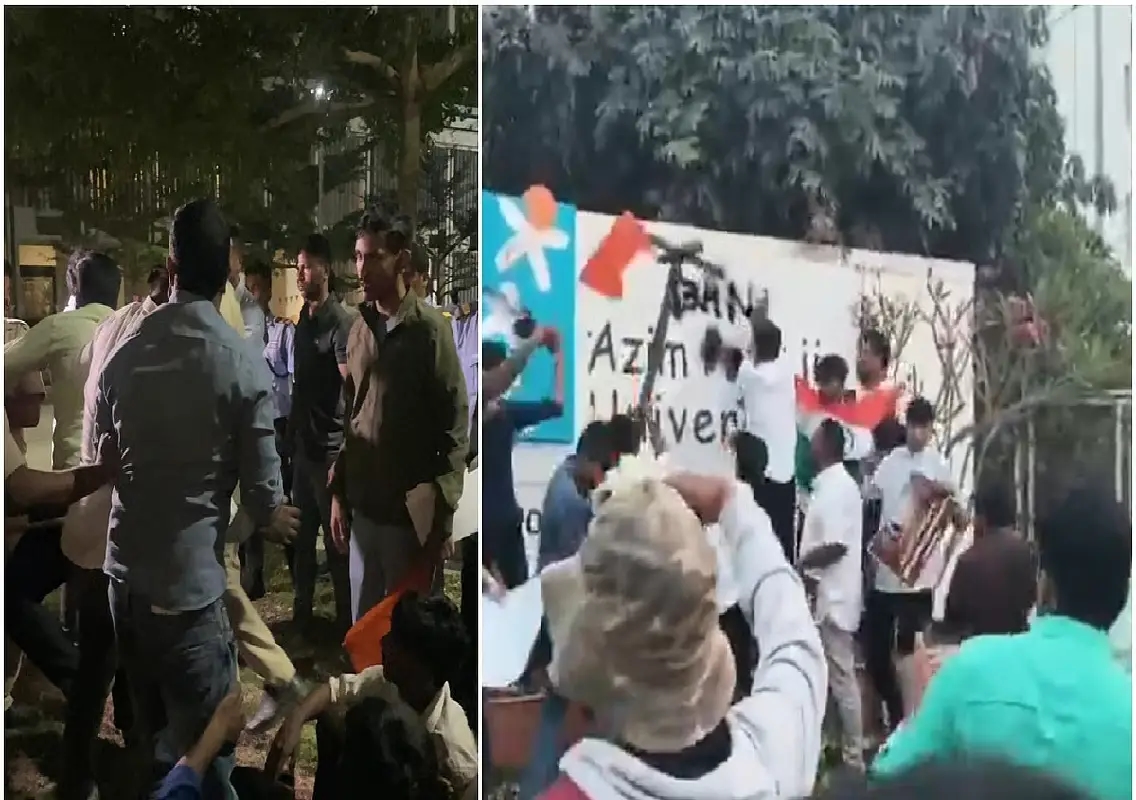


Bengaluru: Tension prevailed at Azim Premji University (APU) near Sarjapur on Tuesday after activists of the Akhil Bharatiya Vidyarthi Parishad (ABVP) allegedly barged into the campus protesting a scheduled discussion on Kashmir. Police detained around 25 ABVP activists as a preventive measure and deployed two platoons of the State Reserve Police to maintain law and order.
The programme, titled ‘Kunan Poshpora’ and scheduled for 6 pm, was reportedly organised by Spark APU, a reading circle affiliated with the All India Students Association (AISA), the student wing of the Communist Party of India (Marxist-Leninist) Liberation. ABVP members claimed that the discussion sought to promote “anti-national” views.
Protest over Kashmir discussion
Posters for the event, titled ‘Kunan Poshpora — 35 years after the incident occurred in Kashmir’, referred to allegations that 35 women were gang raped by security forces in the villages of Kunan and Poshpora in Kupwara district in 1991. The posters stated that no convictions had followed and invited participants to discuss what they described as “violence by the Indian State in Kashmir”.
By Tuesday evening, ABVP activists gathered outside the university gate, shouting slogans against the proposed event. According to police officials, some protesters allegedly smeared black paint on and damaged the university’s name board before attempting to enter the campus.
“They tried to scale the gate and force their way in and were moved to Sarjapur police station,” an investigating officer said. The police later confirmed that around 25 activists were taken into preventive custody to avert escalation of tension.
University clarifies no permission granted
In a statement issued later, Azim Premji University clarified that it had not granted permission for the event in question and that no such discussion took place on its premises.
“Those who had forced their way into our campus were protesting an event that they claimed was going to be held on our campus. Azim Premji University had not authorised any event of such nature. This event, allegedly planned by a small group of students, did not happen at all,” the statement read.
The university strongly condemned what it described as “ruckus and violence” on campus and emphasised its commitment to maintaining a safe and respectful academic environment.
Ideological clash between student groups
With the programme called off, large groups of students led by AISA later assembled inside the campus to protest ABVP’s actions. AISA representatives described the incident as an attempt to curb academic freedom and suppress open discussion in universities.
Aratrika, general secretary of AISA’s Bengaluru chapter, termed the episode “a clash of ideologies” and accused ABVP of trying to intimidate students into silence.
On the other hand, ABVP issued a statement alleging that through AISA-affiliated Spark, gatherings were being organised to portray Indian soldiers as perpetrators and promote anti-national narratives. The organisation further claimed that the programme aimed to condemn Operation Sindoor and express support for Naxal and Maoist ideologies, thereby “sowing anti-national thoughts in young minds”.
ABVP demanded that the university’s recognition be revoked if such events were allowed to take place.
Heavy police presence on campus
In view of the tension, police deployed two platoons of the State Reserve Police Force at the university as a precautionary measure. Authorities maintained that the situation was brought under control and no injuries were reported.
Senior police officials stated that preventive action was taken to avoid any confrontation between rival student groups. “The objective was to ensure that law and order is maintained and no untoward incident occurs,” a senior officer said.
The incident has reignited debate over freedom of expression in academic institutions and the limits of political activism on campuses. While some argue that universities must remain spaces for critical discussion and dissent, others contend that discussions perceived as undermining national institutions should not be permitted.
As of Tuesday night, the campus remained under police watch, though normal academic activities were expected to resume. The episode underscores the growing polarisation in student politics and the challenges universities face in balancing free discourse with public order.