







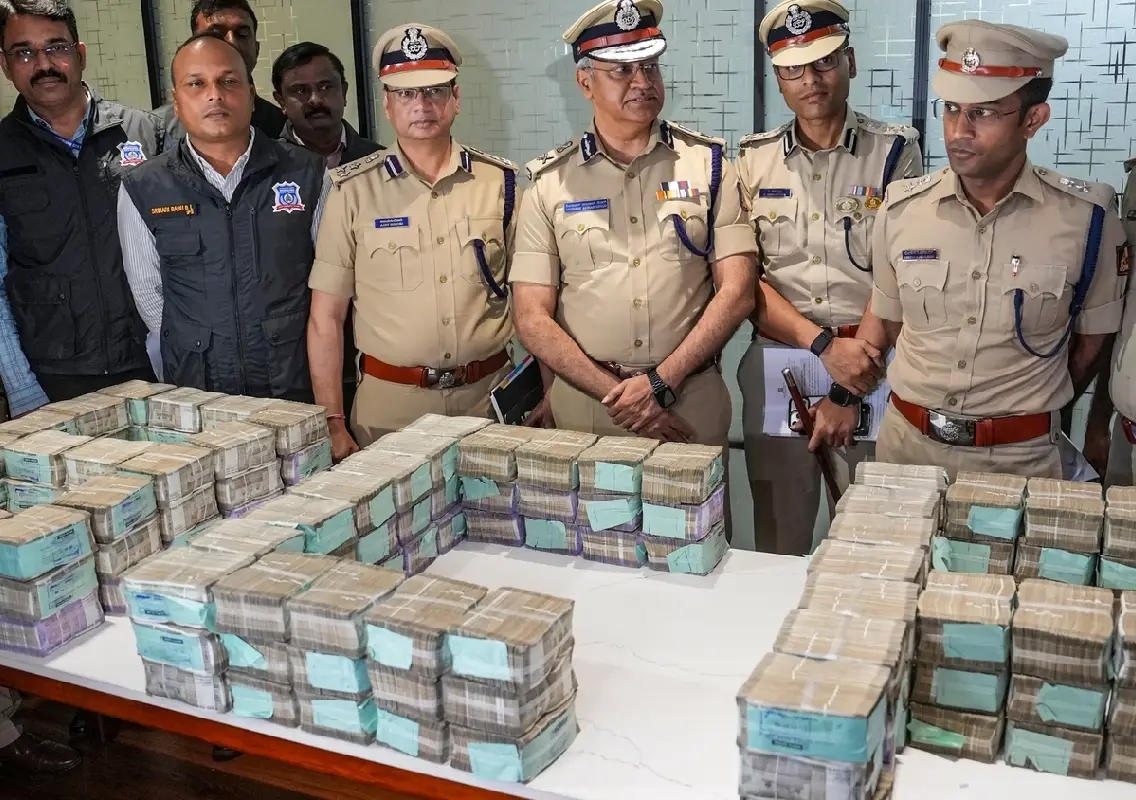


Police in Bengaluru have arrested three people in connection with a daring daylight heist in which a cash van carrying ₹70 crore was robbed by armed men impersonating officials of the Reserve Bank of India (RBI). The arrests, recovery of a large portion of the stolen cash, and ongoing operations across multiple states mark one of the most significant breakthroughs in a case that shocked the city earlier this week.
The heist, which unfolded on Wednesday in the busy Lalbagh area, involved meticulous planning, coordinated movements, and the strategic exploitation of loopholes in cash-handling procedures. Initial estimates placed the stolen amount at ₹70 crore (₹700 million), equivalent to approximately $800,000 or £600,000. The sheer scale and audacity of the crime prompted the Bengaluru police to launch an extensive multi-state manhunt immediately after the incident.
Three accused nabbed; bulk of stolen cash recovered
Bengaluru Police Commissioner Seemant Kumar Singh confirmed on Saturday that three suspects had been arrested and ₹57.6 crore of the stolen money had been recovered. “Our investigation is on track to get the remaining amount,” Singh told reporters, adding that the police were actively pursuing two to three additional suspects believed to be part of the gang.
The arrested individuals have been identified as Gopal Prasad, an employee of CMS — the cash management company responsible for transporting the money — former CMS worker J. Xavier, and police constable Annappa Naik. Their involvement suggests that the robbery may have been an inside operation, benefiting from specific knowledge of the cash van’s routine, staffing and movement patterns.
The heist: meticulous planning and a convincing disguise
According to police, the robbers posed as RBI officials and intercepted the cash van while it was en route to replenish ATMs. Citing the need to inspect paperwork for transporting such a large amount of cash, the gang managed to gain the confidence of the crew.
The cash custodian and two security guards were asked to step out of the van and move into an SUV waiting nearby. While the guards complied, one member of the gang took control of the van and drove off with the cash. Investigators later discovered that the gang had switched vehicles multiple times, used fake registration plates, and selected locations with minimal CCTV coverage to transfer cash boxes into new vehicles.
Senior officers said the planning behind the operation indicated deep familiarity with the company’s protocols and the vulnerabilities in its transport system.
Multi-state manhunt brings rapid breakthroughs
More than 200 police personnel were deployed across Karnataka and neighbouring states — Kerala, Tamil Nadu, Telangana, Andhra Pradesh and Goa — to track the suspects. Teams visited toll plazas, scrutinised CCTV footage from multiple cities, and conducted raids in villages and urban pockets where the gang was believed to have hidden.
Commissioner Singh told the BBC that the arrests were made possible due to continuous surveillance and coordinated operations between state police forces. “We are looking for two to three more people,” he said, indicating that the gang may have involved both ground operatives and planners.
CMS under scrutiny for protocol violations
Police are also probing the role of CMS and whether the firm violated essential guidelines related to cash transport. Commissioner Singh noted that vans should not follow predictable routes or timings, as this exposes them to greater risk.
Investigators are examining whether Wednesday’s route had been frequently used and if any deviation or security reinforcement could have prevented the robbery. The possibility of negligence in following RBI and Home Ministry guidelines for cash transit — including escort vehicles, trained personnel, and surveillance mechanisms — is also being reviewed.
Security concerns and larger implications
The incident has sparked fresh debate on the need to strengthen cash transit systems in India, especially in metro cities where ATM replenishment operations are frequent and high-value. Experts say that the increasing sophistication of criminal networks and insider threats make it crucial for companies to adopt advanced surveillance, route randomisation, and real-time vehicle tracking.
The Bengaluru heist also highlights potential vulnerabilities in coordination between private cash management firms and the police, particularly in high-density urban zones with complex traffic patterns.
Conclusion
As the Bengaluru Police intensify their search for the remaining suspects and the missing cash, the case has already exposed systemic gaps in cash transit operations. With three arrests and a substantial recovery, law enforcement agencies believe they are close to fully cracking the case. However, questions about insider involvement, cash management protocols, and preventive measures for future operations continue to dominate discussions.
The next phase of the investigation is expected to shed further light on the planning, funding and execution of one of Bengaluru’s most audacious ATM van robberies in recent years.