







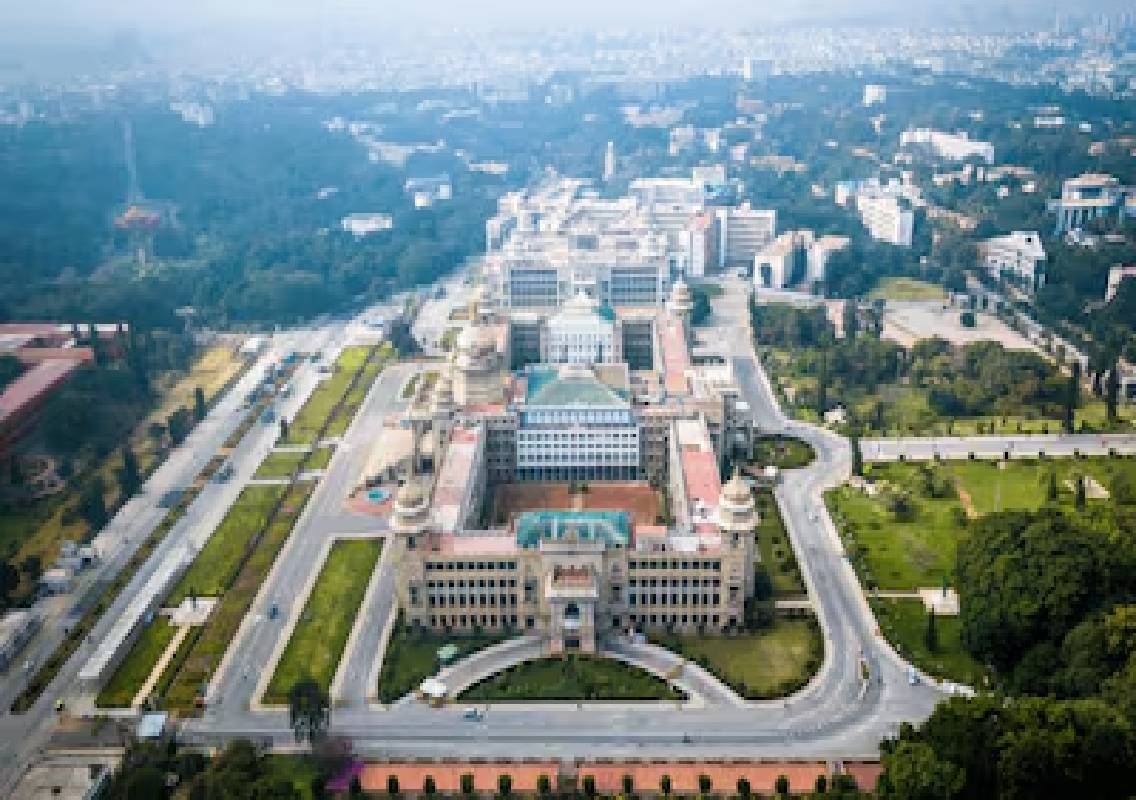


Bengaluru: The recent political developments within the Karnataka government have once again highlighted the immense significance of the Bengaluru Development portfolio, a ministry that has increasingly become one of the most influential positions in the state’s political landscape.
Within a span of days, two senior Congress leaders reportedly expressed dissatisfaction over the handling of the portfolio, underscoring its growing importance in a city that has evolved into Karnataka’s economic powerhouse and India’s technology capital.
The controversy began when senior Congress leader and minister Ramalinga Reddy was reportedly unhappy after not being allotted the Bengaluru Development portfolio, a position he was believed to have expected. Though the issue was eventually resolved with Reddy accepting the Water Resources portfolio, the matter quickly gave way to another dispute involving Revenue Minister Krishna Byre Gowda.
Why the portfolio sparked a political debate
Krishna Byre Gowda, who was assigned the Bengaluru Development portfolio, reportedly declined to take charge immediately. His concerns were not about the ministry itself but about the exclusion of key agencies from its control.
Deputy Chief Minister D. K. Shivakumar retained oversight of the Bengaluru Development Authority (BDA) and the Bengaluru Metropolitan Region Development Authority (BMRDA), two agencies that play a central role in shaping the city’s growth and expansion.
According to reports, Byre Gowda conveyed that a Bengaluru Development Ministry without authority over major planning agencies would have limited practical influence. The issue reportedly reached the Congress high command as discussions continued over the allocation of responsibilities.
The episode has reignited a broader conversation about why the portfolio attracts such intense political interest.
Bengaluru’s growing economic and political importance
The answer lies in Bengaluru’s transformation over the past two decades.
Far beyond its role as Karnataka’s administrative capital, Bengaluru has emerged as the state’s largest economic engine, attracting substantial domestic and international investment while serving as India’s leading technology and start-up hub.
The city contributes significantly to Karnataka’s revenue generation and remains a major destination for multinational corporations, entrepreneurs and investors.
As a result, the success or failure of infrastructure projects in Bengaluru often becomes a direct reflection of a government’s performance.
Projects such as Metro rail expansions, flyovers, tunnel roads, township developments, ring roads, lake rejuvenation initiatives and urban infrastructure upgrades are highly visible to residents and investors alike. Their progress often shapes public perception of governance.
The agencies that shape Bengaluru’s future
At the centre of Bengaluru’s development ecosystem are institutions such as the Bengaluru Development Authority (BDA), Bengaluru Metropolitan Region Development Authority (BMRDA), Bengaluru Metro Rail Corporation Limited (BMRCL) and Bengaluru Water Supply and Sewerage Board (BWSSB).
These agencies oversee land acquisition, urban planning, infrastructure development, transport projects and future city expansion.
In a rapidly growing metropolitan region where land and infrastructure investments carry significant economic value, control over these institutions translates into considerable administrative and political influence.
This reality has historically prompted Chief Ministers and senior political leaders to retain close oversight of Bengaluru’s development machinery.
From former leaders such as S. M. Krishna, B. S. Yediyurappa and H. D. Kumaraswamy to administrations led by Siddaramaiah and Basavaraj Bommai, Bengaluru’s urban development agencies have generally remained under the supervision of the state’s most influential decision-makers.
Evolution of the Bengaluru Development Ministry
The dedicated Bengaluru Development Ministry was established because policymakers recognised that the city’s challenges required coordinated governance.
Before 2015, responsibilities related to Bengaluru’s development were spread across multiple departments and agencies. The Siddaramaiah-led government sought to streamline decision-making by creating a dedicated ministry and bringing several agencies under a unified political structure.
Former minister K.J. George became the first full-fledged Cabinet-rank Bengaluru Development Minister.
The objective was to address interconnected urban challenges such as traffic congestion, flooding, housing, water supply and infrastructure planning through coordinated governance rather than fragmented administration.
A decade later, questions about coordination and authority remain central to the debate.
Governance versus political ownership
Supporters of Krishna Byre Gowda’s position argue that effective urban governance requires authority over the agencies responsible for planning and execution. Without unified oversight, coordination challenges may persist.
Supporters of D.K. Shivakumar, however, maintain that continuity is essential for ongoing projects. Major initiatives such as the Bengaluru Business Corridor, the proposed Bidadi Township and governance reforms under the Greater Bengaluru Authority framework have been closely associated with his leadership.
Critics view the situation differently, arguing that Bengaluru’s development apparatus remains too politically valuable to be fully delegated.
The portfolio’s significance extends beyond administration. Every completed Metro corridor, major road project and infrastructure milestone contributes to the political profile of the leader overseeing it.
What it means for Bengaluru residents
Amid the political discussions, Bengaluru continues to face pressing urban challenges.
The city is approaching another monsoon season with recurring concerns over flooding. Traffic congestion remains a major issue, water stress continues to affect residents during summer months and elections to the proposed corporations under the Greater Bengaluru Authority framework are yet to take place.
For residents, the primary concern is not which political leader controls the portfolio but whether governance structures can deliver timely solutions to the city’s growing challenges.
As Bengaluru continues to expand and evolve, the debate surrounding the Bengaluru Development portfolio serves as a reminder that effective coordination, accountability and long-term planning remain critical to the city’s future. While the ministry may be one of Karnataka’s most sought-after political assignments, its ultimate purpose remains the same — ensuring that India’s technology capital functions efficiently and sustainably.