







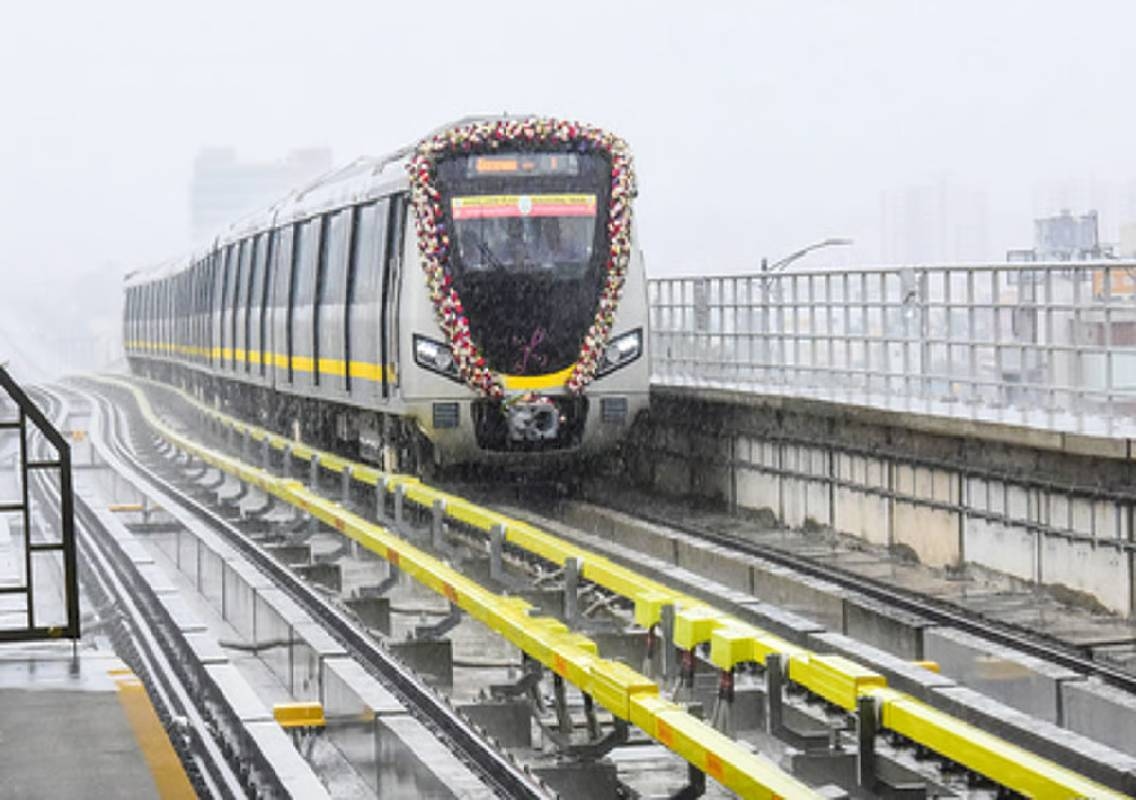


Bengaluru: The Yellow Line metro corridor is emerging as a major relief for commuters travelling to Electronic City, especially amid concerns over rising fuel shortages and increasing transportation costs across the country.
The metro connectivity provided by the Bangalore Metro Rail Corporation Limited (BMRCL) has not only improved accessibility to the city’s major technology hub but has also encouraged several companies to strengthen work-from-office policies by offering employees an alternative to fuel-dependent private transport.
Industry representatives and employees say the metro line is gradually transforming commuting patterns in Bengaluru’s southern technology corridor.
Metro connectivity boosts office attendance
According to officials and industry representatives, the Yellow Line has become particularly beneficial for companies operating in Electronic City, one of Bengaluru’s largest IT and industrial hubs.
Bangalore Metro Rail Corporation Limited developed the Yellow Line to improve connectivity between residential and commercial zones while reducing dependence on road transport.
Rama NS, advisor to the Electronic City Industries Association, said many companies are now encouraging employees to use metro services for daily commuting.
“There are two prominent metro stations on the Yellow Line serving Electronic City. Several companies are supporting employees with last-mile connectivity through shuttle services to and from offices,” she said.
Industry observers believe the improved metro access has made it easier for organisations to ask employees to return to offices more frequently after years of hybrid and remote work models.
Hybrid work continues in some firms
While metro connectivity has encouraged office attendance, many technology companies continue to offer flexible work arrangements.
According to Rama NS, there is no standard work model being followed across all organisations in Electronic City.
“Some companies require employees to work from office two or three days a week, while others expect full-time office attendance,” she explained.
However, manufacturing companies operating in the area reportedly face greater limitations when it comes to remote work.
Due to the operational nature of manufacturing and industrial activities, several smaller firms are unable to provide work-from-home options for employees.
Industry experts note that metro connectivity is especially important for manufacturing workers who must be physically present at factories and production units.
Fuel concerns influence commuting choices
The discussion around the Yellow Line has gained significance amid growing concerns regarding fuel shortages and rising petrol and diesel prices.
The Union government has recently encouraged reduced dependence on private vehicles and promoted fuel conservation measures, including greater use of public transport and work-from-home arrangements wherever possible.
In this context, metro services are increasingly being viewed as a more reliable and cost-effective commuting alternative.
Since metro rail systems operate independently of traditional vehicular fuel, many commuters see them as less vulnerable to fluctuations in fuel availability and pricing.
Daily commuters say metro travel also helps avoid Bengaluru’s heavy traffic congestion, reducing travel stress and commuting time.
Not all companies adopting remote work
Employees working outside Electronic City say work-from-home policies are still not widely implemented across Bengaluru’s corporate sector.
An employee working at a technology company in Marathahalli said his organisation had not announced any plans to expand remote working arrangements despite the fuel concerns.
“We have not received any information about work-from-home being introduced. As far as I know, only one company in our office complex offers that option,” he said.
Another Bengaluru-based employee working remotely for a Gurgaon-based non-profit organisation said her job had always been flexible and remote in nature.
She added that employees already working remotely are less affected by transportation disruptions compared to daily commuters dependent on road travel.
Metro seen as long-term urban mobility solution
Urban mobility experts believe the Yellow Line could significantly reshape commuting patterns in Bengaluru over the coming years.
Electronic City has historically faced severe traffic congestion due to its large concentration of IT parks, industries and office spaces.
Improved metro connectivity is expected to reduce pressure on roads, lower fuel dependence and encourage greater use of public transportation.
Analysts also point out that reliable metro services may help companies maintain regular office operations while reducing the burden on employees during periods of fuel uncertainty.
As Bengaluru continues to expand, transport planners say integration of metro services with shuttle connectivity and feeder systems will be crucial for improving urban mobility across the city.