







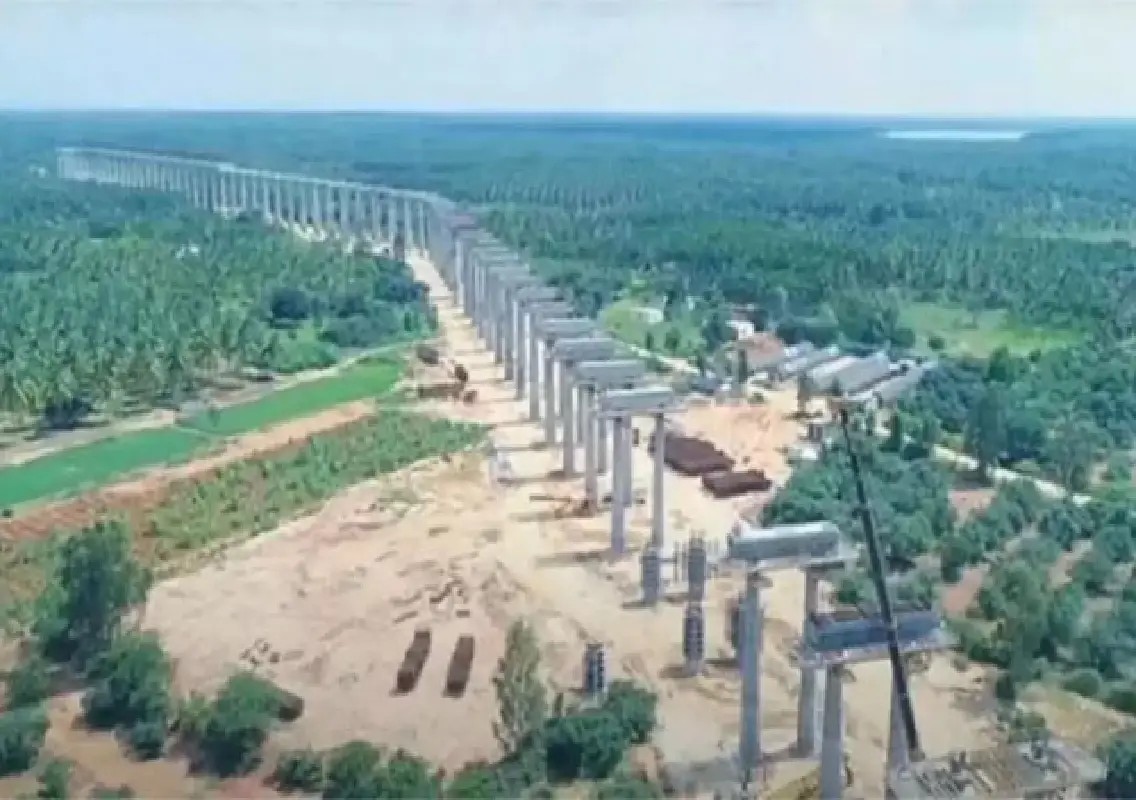


Bengaluru: The ambitious Yettinahole project in Karnataka is planned to be completed by the end of 2027, after which drinking water will be supplied to the targeted seven districts, Water Resources Minister N Cheluvarayaswamy said.
The minister provided the information in response to a question raised by Legislative Council member Ivan D’Souza.
The project, which has been under implementation in phases since 2013-14, is intended to provide drinking water to several water-stressed areas of Karnataka. Its execution has involved multiple infrastructure packages, including pipelines, feeder systems and balancing reservoirs.
Forest clearance enables work to progress
The Ministry of Environment, Forest and Climate Change granted Stage-I approval for the integrated forest clearance proposal for the first phase of the Yettinahole project on April 1, 2026.
Subsequently, permission was granted on May 20 for carrying out earthwork for one year, excluding concreting works.
Following these permissions, work on the project has commenced, according to the minister.
Forest clearances have been among the factors that contributed to delays in implementing the project. The latest approval is expected to enable construction activities to move forward in areas requiring the necessary environmental and forest permissions.
The government is now working to advance the remaining components so that the overall project can meet the target completion timeline of the end of 2027.
Nearly 250 km of pipeline work completed
Several important feeder pipeline works have already made substantial progress.
The Madhugiri-Pavagada feeder, TG Halli-Ramanagara feeder and Gauribidanur feeder pipeline works branch off before the balancing reservoir and have been taken up under four packages.
The combined length of these pipeline works is 254.97 km.
According to the minister, 249.21 km of the pipeline network has already been completed, leaving around 5.76 km to be completed. The remaining works are progressing at different stages.
The completion of these feeder systems is an important component of the wider project because they will facilitate the movement and distribution of water to the designated areas.
Lakkenehalli proposed for balancing reservoir
A major change has been proposed in the location of one of the project’s balancing reservoirs.
According to the revised project report, instead of constructing the balancing reservoir near Bhairagondlu village in Koratagere taluk, the government has proposed constructing it near Lakkenehalli village in Doddaballapur taluk.
The board of directors of the implementing corporation has approved the proposal.
Necessary steps are now being taken to award the contract for construction, the minister said.
The change in location forms part of the government’s efforts to move ahead with the project after considering technical and implementation requirements.
Additional reservoir proposed at Vaderahalli
The government is also examining the possibility of creating additional storage capacity to meet future drinking water requirements.
At the 33rd meeting of the board of directors on November 6, 2025, approval was granted to prepare a detailed project report for another balancing reservoir near Vaderahalli in Koratagere taluk.
The proposed reservoir would have a storage capacity of 1.20 TMC.
This would be in addition to the proposed 1.38-TMC Lakkenehalli balancing reservoir.
The decision was taken in view of the possibility of increased drinking water demand in the coming years.
Accordingly, tenders have been invited for appointing consultants to prepare the detailed project report.
The proposed additional storage infrastructure is expected to help the system address future demand if the government proceeds with the project after completing the necessary technical and administrative processes.
Kolar and Srinivaspur pipeline works underway
Work is also progressing on several components after the balancing reservoir.
The Kolar Lift Package-1 and Gravity Pipeline Package-2 are currently progressing at different stages.
Meanwhile, approvals are being processed for alignment, design drawings and quality assurance plans for Kolar Gravity Pipeline Packages 3 and 4.
Five packages covering the construction of Kolar and Srinivaspur feeder pipelines are also being taken forward.
These components are crucial to extending the water distribution network towards the intended beneficiary areas.
The government is simultaneously working on the administrative and technical approvals required to prevent further delays in construction.
Land acquisition remains an important task
Land acquisition is another key component of the project that is currently being addressed.
The government is working towards entering into tripartite agreements with farmers to facilitate the acquisition of land and expedite the start of pending works.
According to Cheluvarayaswamy, the government is persuading farmers and acquiring land through such agreements to enable the implementation of the project.
Land acquisition can be particularly challenging for large infrastructure projects because pipeline networks and associated structures require land across extensive stretches.
The government is therefore attempting to resolve land-related issues through agreements with affected farmers and accelerate the construction schedule.
Multiple factors contributed to delays
The Yettinahole project has been implemented through different packages and phases since 2013-14.
However, the project has faced delays over the years because of several regulatory, legal and land-related issues.
The minister said delays in obtaining forest clearances, cases before the National Green Tribunal, permissions from the National Highways authorities, approvals from the Railway Department, land acquisition and clearances from various other departments had contributed to delays in implementation and completion.
The need to obtain multiple approvals has affected the pace at which different components could be taken up.
The latest forest clearance and subsequent permission for earthwork are therefore significant steps towards advancing construction.
Government targets drinking water supply by 2027
With several pipeline components nearing completion and other major works progressing, the state government has set the end of 2027 as the target for completing the Yettinahole project.
Once the project is completed, drinking water is expected to be supplied to the targeted seven districts.
The project’s progress will depend on timely completion of the remaining construction packages, land acquisition, regulatory approvals and associated infrastructure.
The proposed additional balancing reservoir at Vaderahalli will also require preparation of a detailed project report and further approvals before construction can proceed.
For now, the government is focusing on resolving the remaining administrative and land-related hurdles while accelerating construction wherever permissions have already been secured.
If the revised timeline is achieved, the Yettinahole project could mark a significant expansion of drinking water infrastructure for the targeted districts and provide a long-term water supply system for areas facing increasing demand.