







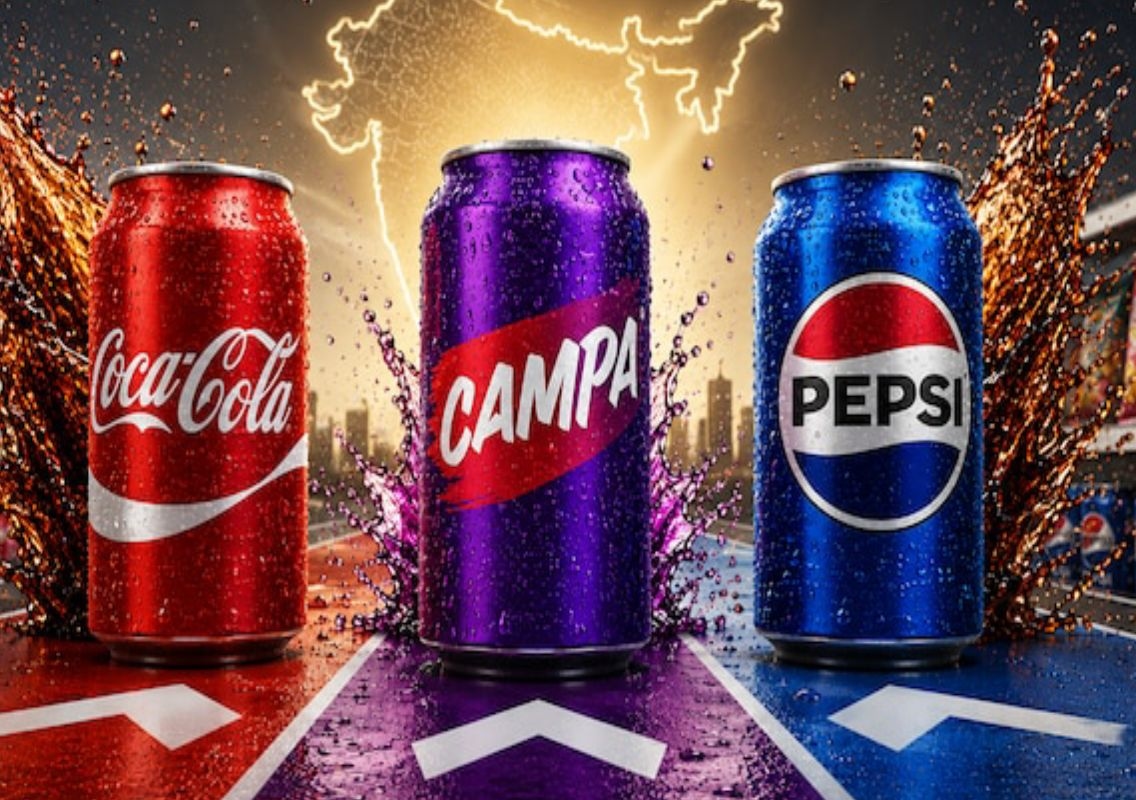


India: The carbonated soft drinks market in India is witnessing a growing three-way competition between global beverage giants The Coca-Cola Company, PepsiCo and Reliance Consumer Products’ Campa. While Coca-Cola continues to maintain its leadership position, Campa has emerged as a fast-growing challenger by using aggressive pricing, attractive distributor incentives and the extensive retail network of the Reliance Group.
According to industry estimates, Coca-Cola currently holds around 40-42% of India’s carbonated beverages market, making it the clear market leader. PepsiCo follows with an estimated 28-30% share, while Campa has quickly built a presence of around 7-8% after its relaunch in March 2023.
The rapid growth of Campa has changed the dynamics of India’s soft drinks sector, forcing established companies to strengthen their pricing strategies, distribution networks and retailer relationships.
Campa’s aggressive strategy drives rapid expansion
Campa, a legacy Indian beverage brand acquired and relaunched by Reliance Consumer Products, has adopted a value-focused approach to compete with multinational beverage companies.
The brand has focused on offering products at competitive prices while providing higher trade margins to distributors and retailers. This strategy has helped Campa expand quickly across different sales channels, including modern retail outlets, traditional neighbourhood stores and Reliance Retail locations.
Campa’s portfolio currently includes popular variants such as Campa Cola, Campa Orange and Campa Lemon. By combining affordable pricing with wider availability, the company has managed to attract consumers in a highly competitive market.
The backing of Reliance’s distribution strength has been one of Campa’s biggest advantages. The Reliance Group’s nationwide retail presence has allowed the brand to reach customers across multiple regions faster than many new beverage entrants.
Coca-Cola maintains market leadership
Despite Campa’s rapid growth, Coca-Cola continues to dominate India’s carbonated drinks industry due to its strong brand recognition, large-scale manufacturing capabilities and extensive distribution network.
The company’s beverage portfolio includes some of India’s most recognised soft drink brands such as Coca-Cola, Thums Up, Sprite, Fanta and Limca.
Coca-Cola operates through multiple bottling partners across India, including Hindustan Coca-Cola Beverages, allowing it to maintain strong availability in urban as well as rural markets.
Brands such as Thums Up and Sprite have developed strong consumer loyalty over several years, giving Coca-Cola an advantage in terms of brand recall and market penetration.
The company’s established supply chain and retailer relationships remain key strengths as competition intensifies.
PepsiCo relies on beverages and snacks portfolio
PepsiCo continues to remain one of India’s largest beverage companies while also benefiting from its strong snacks business.
The company’s carbonated beverage portfolio includes Pepsi, Mountain Dew, 7UP and Mirinda. In addition, its snacks brands such as Lay’s, Kurkure, Doritos, Uncle Chipps and Cheetos provide a diversified business model.
This combination allows PepsiCo to engage consumers across multiple categories rather than relying only on soft drinks.
The company’s domestic bottling operations are largely managed through Varun Beverages, one of PepsiCo’s largest franchise bottlers globally. PepsiCo products contribute a significant majority of Varun Beverages’ revenue, strengthening the company’s beverage distribution capabilities.
Campa’s financial growth highlights rising influence
Campa’s expansion has also reflected in its financial performance. The brand reportedly recorded around Rs 2,900 crore in sales during the first quarter of FY27, highlighting its rapid scale-up after the relaunch.
Analysts estimate that Campa contributes around 20-22% of Reliance Consumer Products’ overall revenue, making it one of the fastest-growing segments within the company’s consumer business.
The growth indicates that Campa is no longer competing only as a regional or niche brand but is increasingly becoming a national-level player in India’s beverage market.
Reliance’s strategy appears focused on gaining market share first by improving availability and affordability, before competing on premium positioning.
Price competition likely to increase
The entry and expansion of Campa have increased competition in India’s soft drinks market. Established players are now facing greater pressure to defend their shelf space and maintain retailer relationships.
Higher distributor incentives and aggressive pricing have become important factors in determining product visibility in stores.
While Coca-Cola and PepsiCo continue to benefit from decades of brand-building and operational scale, Campa’s approach has introduced a new level of price competition.
The battle is no longer limited to consumer preferences but has expanded to areas such as distribution efficiency, retailer margins and supply chain strength.
Future outlook for India’s carbonated drinks market
India’s soft drinks market is expected to remain competitive as changing consumer habits, rising disposable incomes and expanding retail networks create new opportunities.
Coca-Cola is likely to retain its leadership position due to its strong portfolio and widespread distribution. PepsiCo’s diversified food and beverage strategy will continue to support its position in the market.
However, Campa’s rapid rise shows that new entrants backed by strong financial resources and distribution capabilities can significantly reshape established industries.
Conclusion: Campa changes India’s cola competition
Coca-Cola remains the undisputed leader in India’s carbonated beverages market, but Campa’s aggressive expansion has created a stronger competitive environment.
With Reliance’s financial backing, pricing strategy and retail network, Campa is emerging as a serious challenger to traditional market leaders. The coming quarters are expected to see increased competition as beverage companies fight for consumer attention, retailer support and market share.