







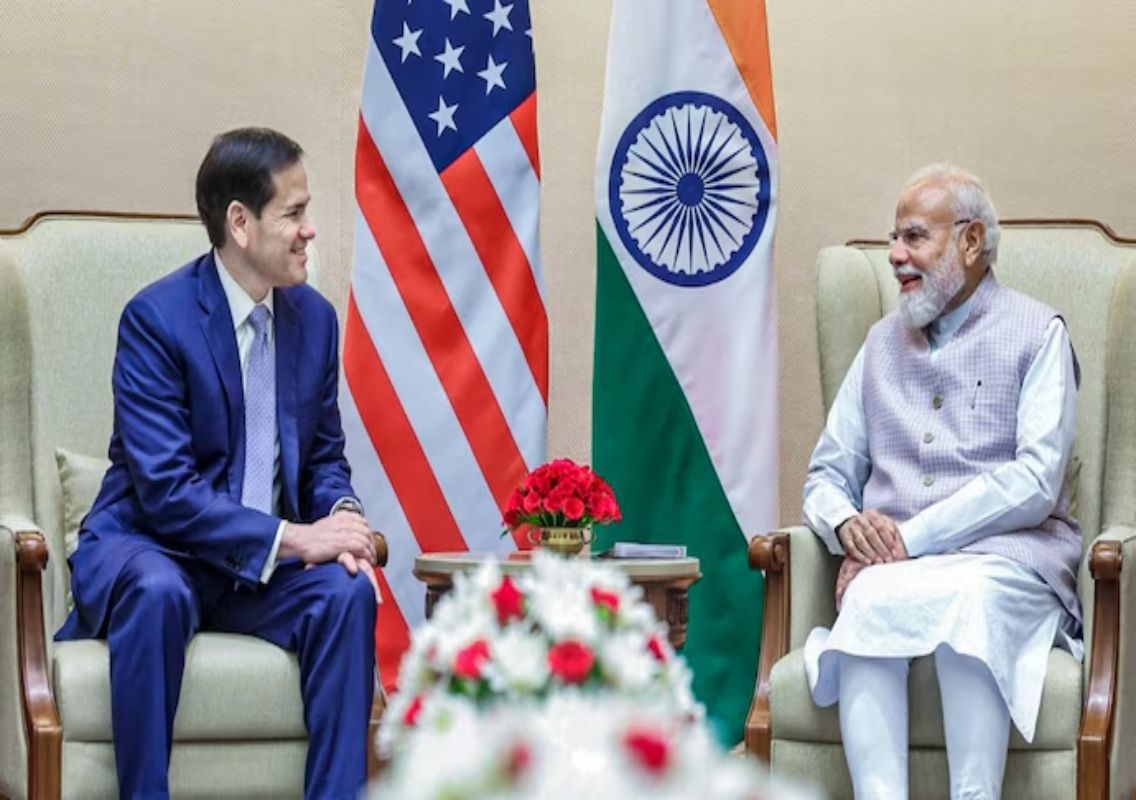


New Delhi: A fresh debate has emerged in India’s policy and business circles after remarks by United States Secretary of State Marco Rubio suggested that New Delhi had committed to purchasing $500 billion worth of American goods over the next five years. The statement, made during his recent visit to the capital, has raised concerns over whether such an arrangement would serve India’s long-term economic and strategic interests.
The issue has gained traction at a time when India is navigating multiple economic pressures, including fluctuations in the rupee, elevated global crude oil prices, and an uncertain international trade environment. Experts and opposition voices are now questioning whether India may be entering into a disproportionately large import arrangement without securing adequate concessions in return.
Trade target or binding commitment?
The roots of the controversy lie in an earlier understanding reached between India and the United States in February. At that time, both countries had indicated an intention to expand bilateral trade, with references to increased Indian purchases of American goods such as energy resources, coal, and advanced technology.
However, the language used in official communications suggested that the $500 billion figure was more of a long-term aspiration or trade target rather than a legally binding commitment. India’s Commerce Ministry had also mentioned the number in a statement, but it was not highlighted as a firm obligation.
Rubio’s recent characterisation of the figure as a “commitment” has therefore altered the perception of the agreement. By presenting it as a definitive pledge, the statement has triggered renewed scrutiny about the scope, feasibility, and implications of such a large-scale import plan.
Commerce Minister Piyush Goyal has attempted to downplay the concerns, stating that India’s expanding economy can absorb higher imports. He pointed out that the aviation sector alone could account for nearly $100 billion (approximately ₹8.3 lakh crore) in purchases over five years, given the country’s rapidly growing demand for aircraft and related equipment.
Economic concerns and strategic questions
Despite official reassurances, analysts have flagged several potential risks. One major concern is the timing of the proposed increase in imports. Since the February understanding, global trade dynamics have shifted significantly, particularly due to policy changes in the United States.
The US administration has imposed a standard 10 per cent tariff on multiple trading partners, raising questions about whether India is receiving sufficient trade benefits in exchange for committing to large-scale purchases. Critics argue that New Delhi should leverage its market size to negotiate better terms rather than narrowing its supplier base.
There are also concerns related to India’s external financial position. With signs of negative net foreign direct investment flows — where outflows exceed inflows — and pressure on foreign exchange reserves, a substantial increase in imports could widen the trade deficit. This, in turn, may exert further downward pressure on the rupee.
Experts have emphasised that large import commitments, especially in sectors like defence, energy, and aviation, should ideally be balanced with export opportunities or technology transfers to ensure mutual benefit.
Diplomatic context and shifting equations
Rubio’s visit took place against a backdrop of evolving India-US relations. While both countries have strengthened strategic ties over the past two decades, recent developments have introduced elements of uncertainty.
Trade tensions have resurfaced due to tariff policies, and concerns have also arisen over immigration restrictions affecting Indian professionals in the United States. Additionally, Washington’s recent diplomatic outreach to countries such as China and Pakistan has drawn attention in New Delhi.
During his visit, Rubio sought to reassure Indian leaders that bilateral relations remain strong. He described the partnership as continuing to move forward despite disagreements on trade. External Affairs Minister S. Jaishankar echoed a pragmatic stance, noting that both nations are pursuing policies aligned with their respective national interests.
Political and policy implications
The reported $500 billion import arrangement is not just an economic issue but also a politically sensitive one. Any perception that India is conceding too much in trade negotiations could invite criticism domestically, especially at a time when the government is promoting self-reliance and domestic manufacturing under initiatives such as ‘Make in India’.
Moreover, the scale of the proposed purchases raises questions about sectoral priorities. Analysts argue that India must ensure that increased imports do not undermine local industries or reduce competitiveness in key sectors.
Conclusion
The evolving discourse around the proposed $500 billion trade expansion highlights the complexity of balancing economic growth with strategic autonomy. While closer economic ties with the United States can offer opportunities in technology, energy security, and infrastructure, the terms of engagement will be crucial.
As negotiations continue, India faces the challenge of ensuring that any large-scale import arrangement is matched by tangible gains, whether through market access, investment inflows, or technological collaboration. The coming weeks, particularly the discussions involving visiting US trade officials, are likely to determine whether the deal evolves into a mutually beneficial partnership or remains a subject of concern.