









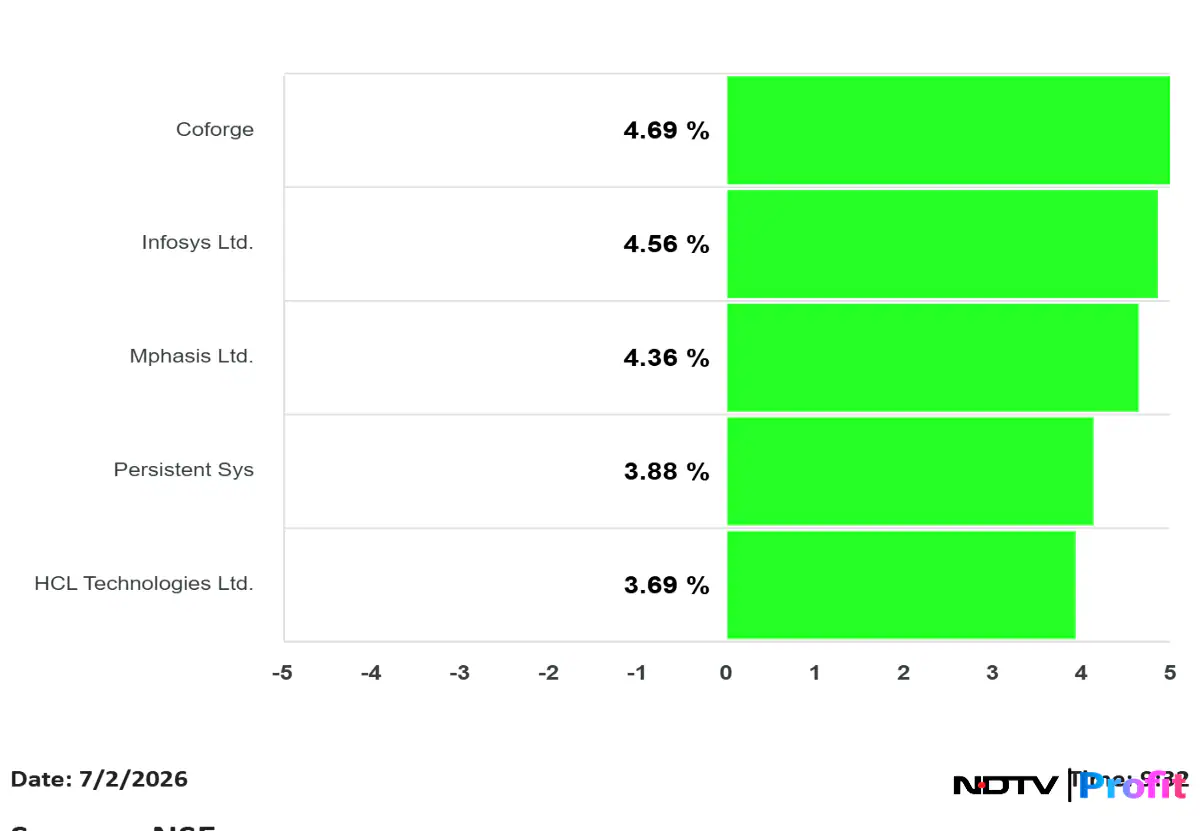
Mumbai: Indian information technology stocks staged a broad-based recovery on Thursday, ending a four-session losing streak as buying interest lifted the Nifty IT index to the top of the sectoral performance charts. Coforge, Mphasis and Infosys led the gains, with all constituents of the index trading in positive territory during the session.
Coforge emerged as the biggest gainer, rising 4.35 per cent to Rs 1,430.30. Mphasis followed with a 3.99 per cent increase to Rs 2,211.60. Among large-cap IT companies, Infosys advanced 3.97 per cent to Rs 1,024.40, while Persistent Systems gained 3.51 per cent to Rs 4,482.40.
The recovery offered some relief to investors after a prolonged sell-off in the technology sector. However, concerns over artificial intelligence, subdued discretionary technology spending and foreign investor outflows continue to weigh on sentiment towards Indian IT services companies.
Nifty IT leads sectoral recovery
The Nifty IT index emerged as the best-performing sectoral gauge during Thursday’s trading session, supported by gains across its constituents.
HCL Technologies rose 3.48 per cent to Rs 1,070.20, while Tata Consultancy Services (TCS) gained 2.48 per cent to Rs 2,031.70. Tech Mahindra advanced 2.08 per cent to Rs 1,390.60. Oracle Financial Services Software and Wipro also traded higher.
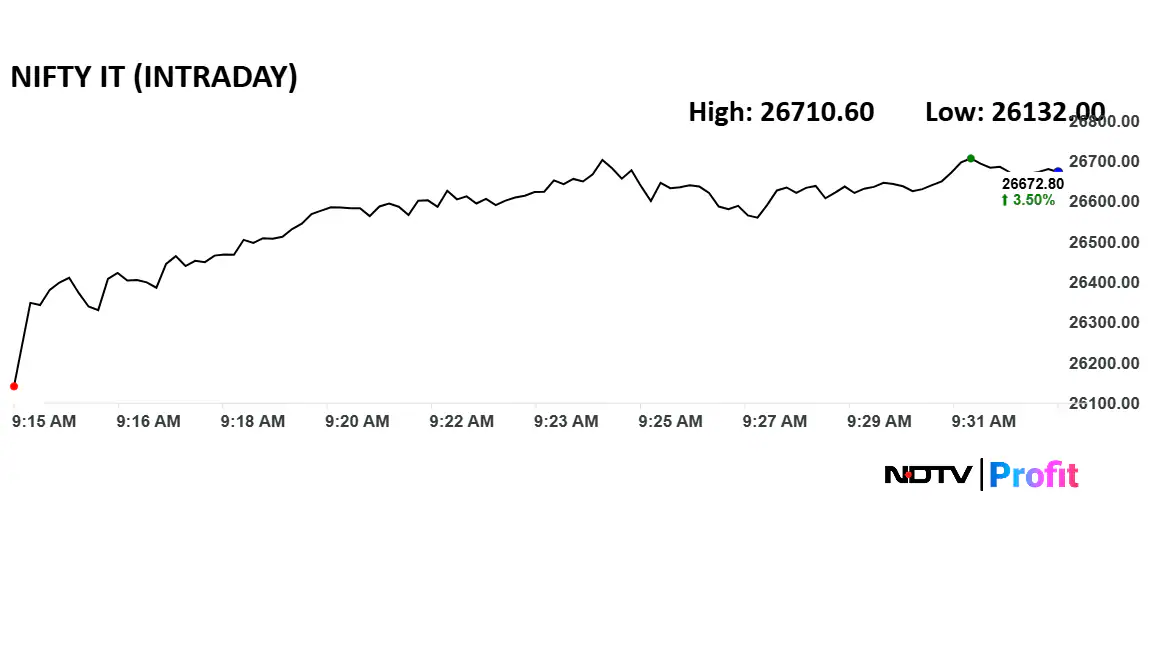
The broad-based nature of the recovery indicated that buying interest extended beyond a few individual stocks. Nevertheless, a single session of gains does not necessarily signal a sustained reversal in the sector’s broader trend.
Investors will be watching subsequent trading sessions to determine whether the rebound can continue and whether the recent correction has created opportunities in companies with strong balance sheets and established cash-generating businesses.
AI disruption concerns weigh on IT shares
Indian IT stocks have faced several challenges in 2026, with concerns about the potential impact of generative artificial intelligence emerging as a key factor influencing investor sentiment.
The rapid development of AI tools has raised questions about the traditional IT services model, particularly businesses that rely on large teams of software developers and technology professionals for coding, testing, maintenance and other services.
Investors are assessing whether AI-driven automation could reduce the amount of human effort required for some projects, potentially affecting billing models, revenue growth and profit margins.
At the same time, AI adoption could create new business opportunities for IT service providers through consulting, implementation, cloud migration and the integration of AI tools into enterprise systems. The extent to which companies can convert these opportunities into sustainable revenue growth remains an important consideration for the sector.
Weak discretionary technology spending in the United States has added to the pressure. When clients become cautious about economic conditions, they may delay or reduce spending on non-essential technology projects.
Cautious commentary from global technology companies, valuation compression and sustained foreign institutional investor selling have also contributed to the correction.
Buybacks return to investor focus
The decline in IT share prices has renewed attention on the cash reserves held by major Indian technology companies and their ability to return capital to shareholders.
Infosys and Wipro have completed share buybacks in recent periods, attracting substantial participation from investors. Buybacks allow companies to repurchase their own shares, potentially returning surplus cash to shareholders and reducing the number of shares outstanding.
However, a buyback does not automatically support a stock’s market price over the long term. Its impact depends on factors such as the offer price, the number of shares repurchased, the company’s financial position and its future earnings performance.
The gap between recent buyback prices and current market levels has nevertheless become a point of discussion among investors.
Infosys shares are trading nearly 45 per cent below the November 2025 buyback price of Rs 1,800, while Wipro is around 32 per cent below its June 2026 buyback price of Rs 250, according to the figures provided.
These differences highlight the extent of the subsequent price declines. They should not, however, be interpreted as evidence that either company will announce another buyback or that its shares will return to the earlier offer price.
Could TCS announce another buyback?
Tata Consultancy Services has attracted particular attention because of its history of returning cash to shareholders.
The company has undertaken five large buybacks since 2017, typically offering premiums of 10–18 per cent to prevailing market prices, according to the figures provided. As of the financial year 2025–26, TCS reported cash and cash equivalents of more than Rs 50,000 crore.
Its substantial cash position and history of shareholder payouts have fuelled speculation about the possibility of another buyback.
However, the company’s cash reserves alone do not establish that a fresh offer is imminent. Any decision would depend on its capital-allocation priorities, future investment requirements, financial performance and the approval process.
Investors should therefore distinguish between market speculation and a formally announced corporate action.
What investors will watch next
Thursday’s rally brought some relief to an IT sector that has been under pressure from concerns about AI-led disruption, slower client spending and persistent selling by institutional investors.
The gains in Coforge, Mphasis, Infosys and other technology stocks suggest that investors were willing to buy into the sector during the session. Whether that interest develops into a longer-lasting recovery will depend on earnings visibility, client demand and companies’ ability to adapt to technological changes.
Shareholder returns could remain another focus, particularly for cash-rich companies such as TCS. However, buybacks are only one part of the investment case; revenue growth, margins, cash generation and valuations remain equally important.
For now, the rebound marks a break in the four-session losing streak rather than confirmation that the sector’s challenges have passed. Investors will be looking for sustained price strength and clearer business signals before drawing conclusions about the direction of Indian IT stocks