







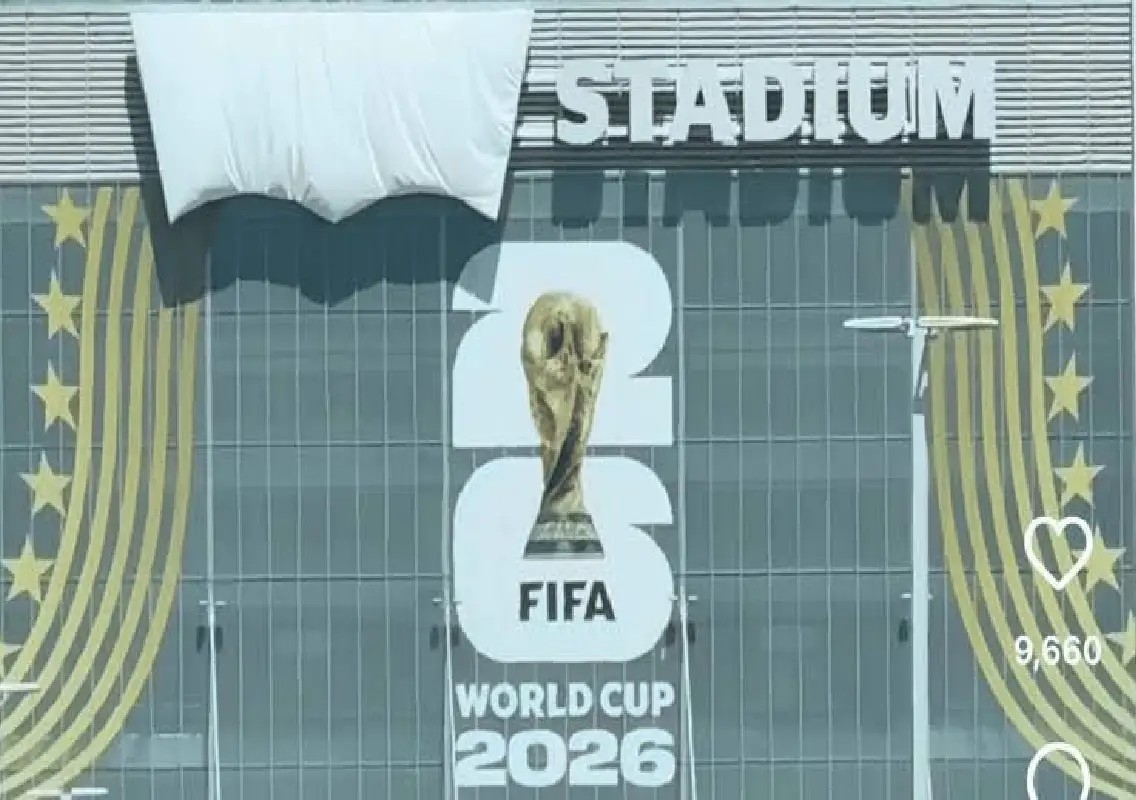


Santa Clara: A creative branding move by Levi’s has become an unexpected talking point during the 2026 FIFA World Cup after images of the company’s stadium makeover in California gained widespread attention on social media.
Under FIFA regulations, stadiums hosting World Cup matches are required to remove commercial names and branding that are not associated with official tournament sponsors. As a result, Levi’s Stadium in Santa Clara has been temporarily renamed the San Francisco Bay Area Stadium for the duration of the tournament.
While the Levi’s name was removed from the venue, the company adopted a unique approach that allowed it to retain a subtle connection to its identity without violating FIFA rules.
Batwing logo outline catches public attention
Instead of completely concealing all visual references to the brand, the stadium’s exterior makeover retained the distinctive outline of the Levi’s Batwing logo, one of the company’s most recognisable design elements.
Although the company name is no longer visible on the venue, the familiar shape remains evident on the stadium façade. Images of the modified structure quickly circulated online, with many users praising the company’s creative handling of the situation.
Marketing and advertising commentator Matthieu Lamoureux shared photographs of the stadium on social media, where the makeover attracted significant attention and discussion among football fans and branding professionals.
FIFA rules require neutral venue names
The rebranding is part of FIFA’s long-standing policy governing tournament venues. Stadiums carrying commercial names that are not linked to official World Cup sponsors must temporarily adopt neutral identities during the competition.
The regulations are designed to protect the interests of FIFA’s commercial partners and ensure a consistent sponsorship environment across all host venues.
As a result, several major stadiums across the United States are operating under temporary names during the tournament.
Levi’s Stadium has become San Francisco Bay Area Stadium, while MetLife Stadium is operating as New York New Jersey Stadium. Similarly, SoFi Stadium is being referred to as Los Angeles Stadium and AT&T Stadium has been renamed Dallas Stadium for World Cup purposes.
Branding changes across host cities
The impact of FIFA’s branding regulations has been visible throughout host cities in the United States. In Atlanta, Mercedes-Benz branding was removed from the stadium exterior to comply with tournament requirements.
However, reports indicate that FIFA allowed the large Mercedes-Benz star on the stadium roof to remain in place after determining that removing or covering it could potentially interfere with the operation of the retractable roof structure.
At Gillette Stadium near Boston, temporary installations have reportedly been erected to conceal commercial branding. In Houston, organisers are said to have allocated more than $1 million towards signage removal and logo concealment work at NRG Stadium.
These measures illustrate the extensive preparations required to transform existing sports venues into FIFA-compliant World Cup facilities.
Marketing experts praise subtle strategy
The attention generated by Levi’s approach highlights how brands can maintain visibility through design recognition even when direct advertising is restricted.
Marketing observers have noted that the Batwing silhouette remains instantly recognisable to consumers despite the absence of the company’s name. The strategy has been widely discussed as an example of effective brand identity and visual recognition.
As the FIFA World Cup continues across the United States, Canada and Mexico, the stadium makeover has emerged as one of the tournament’s more unusual off-field stories, demonstrating how branding and sport often intersect in unexpected ways.