







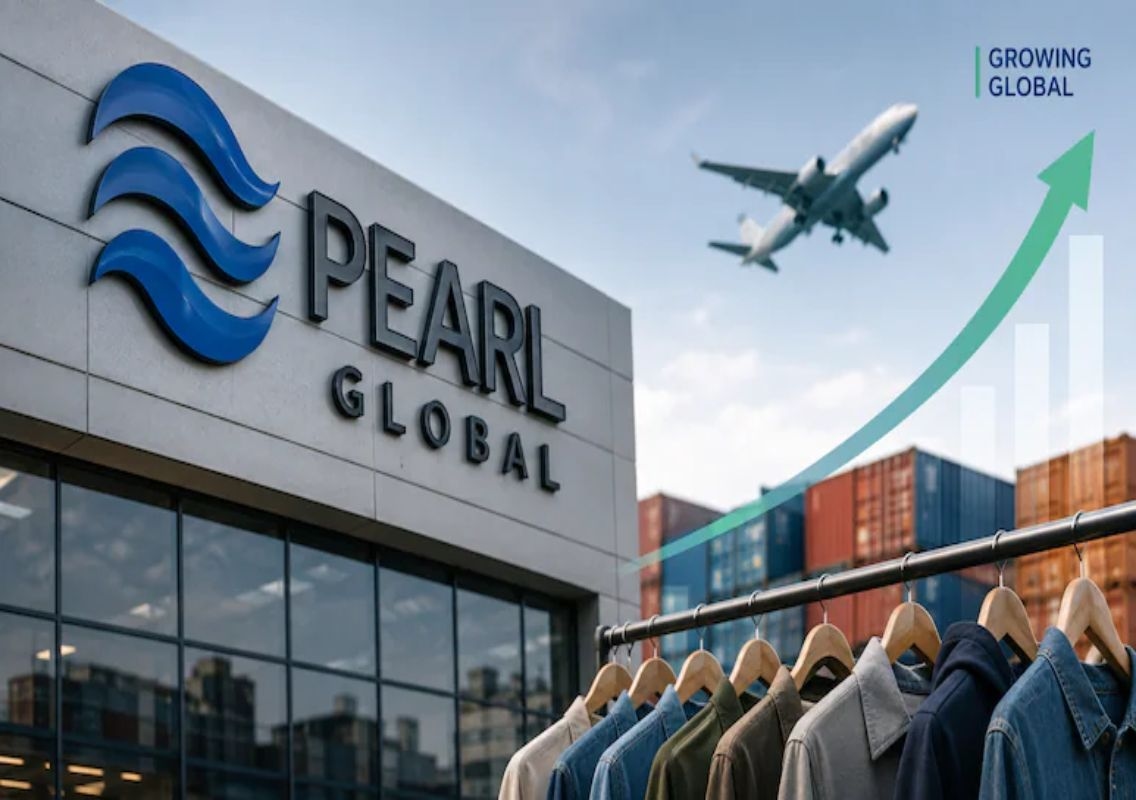


Gurugram: Pearl Global Industries Ltd. has emerged as one of the notable gainers in the apparel manufacturing space, with its shares rising 75% over the past year as investors increasingly factor in the company’s premiumisation strategy, capacity expansion and opportunities arising from free trade agreements.
The clothing manufacturer is targeting revenue of ₹6,000 crore by FY28 and plans to invest ₹200–250 crore across its facilities during FY27. The company also aims to increase its annual installed capacity from 100.8 million pieces in FY26 to around 108 million pieces by October 2026, followed by a further increase to 125–130 million pieces by FY28.
The expansion comes at a time when Pearl Global is attempting to improve its product mix by increasing the contribution of higher-value garments while expanding production across India and overseas manufacturing hubs.
However, after the sharp rally in the stock, investors are now faced with a key question: can the company’s growth plans translate into enough revenue, earnings and margin expansion to justify its current valuation?
Strong Q1FY27 performance supports the growth story
Pearl Global’s latest financial performance provides some support for the optimism surrounding the company.
Revenue increased 24.5% year-on-year to ₹1,528 crore in the first quarter of FY27, while volumes grew 20.9%. Average realisation per piece also increased 2.8% to ₹735 from ₹715 in the corresponding period a year earlier.
Profitability improved at an even faster pace. Adjusted EBITDA increased 44.1% to ₹164 crore, while the EBITDA margin expanded by 140 basis points to 10.7%. Net profit rose 51.4% to ₹99 crore.
The numbers indicate that Pearl Global is not relying solely on volume growth. The increase in average realisation and profitability suggests that its strategy of moving towards higher-value products is beginning to contribute to financial performance.
The company will, however, need to sustain this improvement as additional manufacturing capacity becomes operational.
Premiumisation becomes a key growth driver
One of Pearl Global’s major strategies is to increase the proportion of premium and higher-value products in its portfolio.
Woven products accounted for 74% of export revenue in Q1FY27, compared with 55% in FY23. At the same time, the contribution from knit products declined to 26%.
The company is focusing on products such as premium woven outerwear, parkas, puffers and down jackets. These products typically command higher realisations than more basic garments, providing an opportunity to improve revenue per piece and profitability.
This shift is important because simply adding production capacity does not necessarily guarantee stronger earnings. If the company can use its additional capacity to manufacture products with better realisations and margins, the impact on profitability could be more significant.
Pearl Global’s recent financial performance suggests that this transition is already beginning to have an effect.
However, maintaining the premiumisation trend will require the company to continue winning orders in higher-value categories while ensuring that its manufacturing facilities can efficiently handle the additional production.
Long-term relationships with global brands provide stability
Pearl Global’s relationships with international fashion brands are another important part of its business model.
The company works with more than 30 global brands, including Tommy Hilfiger, Calvin Klein, Ralph Lauren and Zara. Customers that have maintained relationships with Pearl Global for more than five years contributed 78.1% of revenue in FY26.
Such long-standing relationships can provide greater visibility for future orders and reduce the risk associated with constantly having to acquire new customers.
Pearl Global offers services covering design, product development, material sourcing, manufacturing, finishing and logistics. Its product portfolio spans seven categories, giving the company opportunities to expand its business with existing clients.
According to management, these categories account for around 70–75% of a clothing retailer’s inventory, excluding sweaters and undergarments.
The company typically starts relationships with new customers through two or three product categories before attempting to expand into additional categories.
This strategy could allow Pearl Global to increase revenue from existing customers without having to proportionately increase its customer acquisition efforts.
Bangladesh remains the largest manufacturing hub
Bangladesh continues to be Pearl Global’s largest manufacturing base, with annual capacity of 59.7 million pieces across knitted, woven and denim products.
The company is adding another 6–7 million pieces of annual capacity in Bangladesh, with completion scheduled for September 2026.
Vietnam is another important manufacturing location, with annual capacity of 7.2 million units. The country serves as the group’s hub for technical outerwear and fashion-oriented woven products.
Indonesia has capacity of 4.8 million units and focuses on higher-value woven garments. However, management has indicated that the Indonesian facilities remain underutilised.
Pearl Global is targeting customers requiring specialised garments, including woven dresses, women’s professional wear and activewear, to improve utilisation at the Indonesian plants.
The company also has a manufacturing facility in Guatemala with annual capacity of 3.3 million pieces. The facility produces polos as well as heavyweight and lightweight knit products.
Guatemala remains loss-making, although losses are declining, and Pearl Global is targeting break-even in FY27.
India could become an important growth engine
India is emerging as another significant opportunity for Pearl Global.
The company’s standalone India business recorded 27.4% year-on-year revenue growth to ₹340 crore in Q1FY27. This follows a 9.6% decline during FY26, when revenue stood at ₹1,081 crore.
The company is changing its product mix in India to improve capacity utilisation.
Historically, the Indian business was more focused on seasonal and high-fashion products. While these products can command attractive realisations, their seasonal nature can result in uneven utilisation of manufacturing facilities.
Pearl Global is now adding higher-volume core products to create a more consistent production cycle.
Its Bihar facility is also being ramped up. The first 450 machines, focused on woven garments, are already operational. A second shed dedicated to knitted garments is scheduled to begin production by November 2026.
Once the facility reaches full operation, monthly production is expected to increase from around 1.2–1.3 lakh pieces to 4–5 lakh pieces over the following quarters.
Pearl Global has said that its existing Indian infrastructure could support revenue of ₹1,700–1,800 crore at full utilisation without requiring significant greenfield capital expenditure.
Free trade agreements offer another opportunity
Free trade agreements could provide an additional growth catalyst for Pearl Global.
The India-UK Free Trade Agreement came into effect on July 15, 2026. The UK currently contributes around 5% of Pearl Global’s revenue, but the company expects this business to grow two to three times over the next one to two years.
The company is also preparing for the India-EU FTA, which is expected to take effect in January 2027.
These agreements could improve India’s competitiveness in international apparel markets and potentially encourage global brands to source more products from Indian manufacturers.
Pearl Global’s geographically diversified manufacturing network could also provide an advantage as international companies continue to pursue China+1 supply-chain strategies.
The company operates across India, Bangladesh, Vietnam, Indonesia and Guatemala, allowing it to shift production between markets depending on customer requirements and geopolitical conditions.
However, the benefits from FTAs will depend on actual order flows and the company’s ability to convert improved market access into higher production and revenue.
Capacity expansion is central to the next phase
Pearl Global’s overall installed capacity stood at 100.8 million pieces in FY26.
The company plans to take this figure to around 108 million pieces by October 2026 and subsequently to 125–130 million pieces by FY28.
The planned ₹200–250 crore investment in FY27 will support this expansion across its manufacturing network.
The challenge will be ensuring that new capacity is absorbed by customer demand.
Capacity additions can improve operating leverage when utilisation rises, because fixed costs are spread across a larger production base. But if new facilities remain underutilised, the expected improvement in profitability may not materialise.
This makes order visibility, customer additions and utilisation levels important indicators for investors to track over the coming quarters.
Valuation leaves less room for execution errors
Pearl Global’s 75% share-price gain over the past year has significantly increased investor expectations.
The stock currently trades at around 36 times trailing 12-month earnings, compared with its three-year median valuation of 25 times. It is valued broadly in line with Arvind at 33 times, while Gokaldas Exports trades at a higher 57 times.
The valuation suggests that the market is already pricing in continued earnings growth from premiumisation, capacity expansion and improved operating leverage.
This creates a higher execution requirement for Pearl Global.
The company needs to progress towards its ₹6,000 crore FY28 revenue target while maintaining EBITDA margins in the 10–12% range.
Any significant delay in commissioning new capacity, weaker demand, tariff-related pressures or slower progress in premium products could affect the expected earnings trajectory.
After a 75% rally, the stock may therefore require strong execution rather than merely additional growth announcements to sustain its momentum.
Risks investors need to watch
While Pearl Global has several potential growth drivers, its outlook is not without risks.
The first is execution. The company has ambitious targets for both capacity and revenue, and delays in commissioning new facilities could affect the pace of growth.
The second is utilisation. Some overseas facilities, particularly in Indonesia and Guatemala, still have room for improvement. Guatemala is currently loss-making, although the company expects to reach break-even in FY27.
The third risk comes from international trade conditions. Apparel manufacturers are exposed to changes in tariffs, shipping costs, currency movements and demand in major global markets.
Finally, valuation itself is a risk. With the stock already trading above its three-year median valuation, any earnings disappointment could result in greater pressure on the share price.
Conclusion
Pearl Global has built a strong growth narrative around premiumisation, capacity expansion, customer relationships and free trade agreements. Its Q1FY27 performance provides evidence that the strategy is beginning to translate into stronger revenue and profitability, with revenue rising 24.5% and net profit increasing 51.4% year-on-year.
The company’s ₹6,000 crore FY28 revenue target and planned capacity increase to 125–130 million pieces provide a sizeable runway for expansion. India, Bangladesh and other overseas facilities are expected to play important roles in achieving these targets.
However, the 75% rise in the stock over the past year means much of the optimism is already reflected in the valuation. At around 36 times trailing earnings, investors will increasingly expect consistent delivery on revenue growth, capacity utilisation and margins.
For Pearl Global, therefore, the next leg of growth may depend less on announcing new opportunities and more on converting premiumisation, new capacity and trade agreements into sustained earnings growth.