


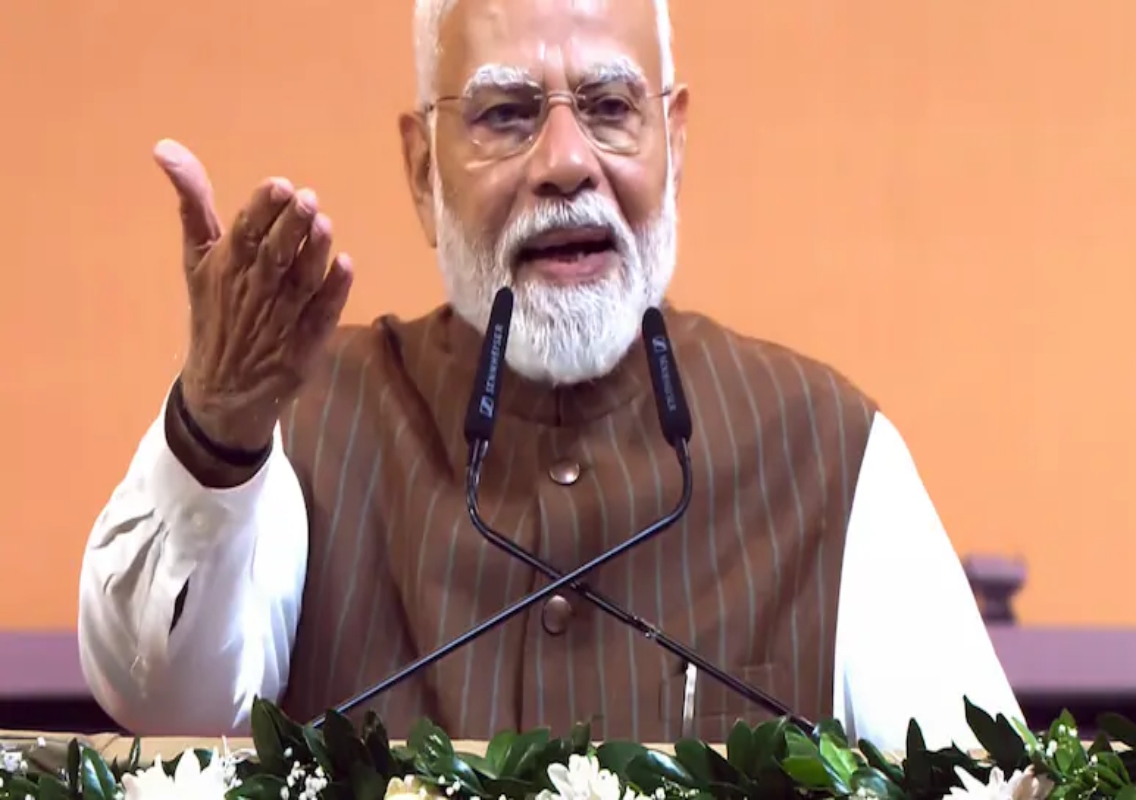


Lucknow: Prime Minister Narendra Modi has credited Indians with helping bring down gold prices by responding to his appeal to avoid non-essential purchases of the precious metal for one year. Addressing the fifth National Skill Convocation in Lucknow on Saturday, November 21, Modi said people who followed his advice were now telling him that they had saved money.
The Prime Minister compared the public response to former Prime Minister Lal Bahadur Shastri’s appeal during the food shortage of the 1960s, when citizens were asked to skip one meal to conserve food.
“Just as Lal Bahadur Shastri ji had asked the countrymen to skip one meal, and this country obeyed his call; my country still holds that same character,” Modi said.
Recalling his appeal, he said he had asked citizens not to buy gold for a year unless it was necessary. He added that people had reduced their purchases and that gold prices had subsequently fallen.
The remarks were made at the fifth National Skill Convocation, also known as the Kaushal Deekshant Samaroh, held at Indira Gandhi Pratishthan in Gomti Nagar, Lucknow. The Prime Minister’s comments have brought renewed attention to the relationship between household gold purchases, India’s import bill and the recent correction in bullion prices.
What Modi said about his May appeal
Modi first made the appeal at a public meeting in Hyderabad on May 10, 2026. At the time, he urged people to avoid buying gold for one year if the purchase was not essential.
The appeal was part of a broader set of suggestions intended to encourage restraint in spending and conserve foreign exchange amid pressure on India’s external finances. He also called on citizens to reduce fuel consumption and postpone non-essential foreign travel.
Gold is a significant component of India’s import bill, and purchases of the metal require foreign exchange. A reduction in imports can therefore help ease pressure on the country’s external account.
Modi repeated the message in a video address on September 1, linking reduced gold purchases to his wider emphasis on domestic products and the Swadeshi approach.
His latest remarks in Lucknow suggest that he views the public response as an example of collective participation in a national economic objective.
Gold prices have fallen from their May levels
Gold prices have undergone a substantial correction since the Prime Minister made his appeal. According to the figures cited in the report, domestic gold was trading at around Rs 1.52 lakh per 10 grams on May 11. It was around Rs 1.22 lakh per 10 grams at the end of trading on Friday, November 20.
That represents a decline of approximately 20%, or about Rs 30,000 per 10 grams. On that comparison, a buyer who postponed purchasing 10 grams of gold in May would face a substantially lower quoted price in November.
International prices have also fallen sharply. The figures cited in the report put spot gold at around $4,724 an ounce on May 11 and approximately $3,538 on Saturday. The decline is around 25%.
Gold has also retreated significantly from its record levels in January. The correction has been linked to changes in expectations about US monetary policy, a stronger dollar and rising bond yields.
These factors are important when assessing the Prime Minister’s remarks. Although he credited lower Indian buying with helping prices fall, the international decline indicates that the movement cannot be attributed to Indian consumers alone.
Global market factors have weighed on bullion
International gold prices came under renewed pressure during the week ending November 20. Reuters reported that spot gold touched a 14-month low, with expectations of a more hawkish US Federal Reserve, a stronger dollar and persistent inflation weighing on the metal.
Higher interest rates and bond yields can make gold less attractive because the metal does not provide regular interest income. When investors expect interest rates to rise, some shift money towards interest-bearing assets, putting pressure on bullion.
The recent technology-led stock market sell-off also contributed to gold’s weakness. Investors facing losses in other assets sold some gold holdings to raise cash, adding to the downward pressure.
These international developments are relevant because domestic gold prices are influenced by global bullion rates, the rupee-dollar exchange rate, import duties and local market conditions.
Consequently, the fall in Indian prices reflects several influences rather than a single factor. Reduced domestic demand may have affected imports and the local market, but the global correction has also played a major role.
Gold imports decline in the first seven months
Official trade figures indicate that India’s gold imports fell substantially during April-October 2026.
According to the Commerce Ministry’s provisional trade data, gold imports during the seven-month period stood at $24.78 billion, compared with $41.24 billion in the corresponding period a year earlier. This represents a decline of 39.9%.
October imports alone fell 62.6% year-on-year to $5.51 billion, compared with $14.72 billion in October 2025.
The figures indicate a significant reduction in the value of gold entering the country. However, import values are influenced by both the quantity imported and the price of gold. They should not be treated as a direct measure of how much less gold Indian households purchased.
The government also increased the effective import duty on gold and silver to approximately 15% from May 13, 2026. The duty increase made imported bullion more expensive and was another factor affecting the domestic market.
World Gold Council data points to weaker demand
The World Gold Council’s third-quarter report also recorded a decline in Indian gold demand compared with the same period in 2025.
India’s total gold demand stood at approximately 162.5 tonnes in July-September 2026, down 29% year-on-year. Jewellery demand declined 20% to around 100 tonnes, while bar and coin demand fell 40% to 55 tonnes.
The Council identified elevated prices and affordability pressures as important reasons for weaker buying. Average domestic gold prices during the quarter were around Rs 1,48,891 per 10 grams, approximately 45% higher than a year earlier.
The report also highlighted the difference between the quantity of gold purchased and the money spent on it. Despite the fall in demand by volume, the value of India’s gold consumption increased 3% year-on-year to Rs 2,419 billion, or about Rs 2.42 lakh crore.
This suggests that consumers spent more money overall even though they bought less gold by weight. Higher prices were a major reason for that difference.
A complex picture behind the fall in gold prices
Modi’s remarks in Lucknow have highlighted the role of public participation in efforts to reduce non-essential gold purchases and conserve foreign exchange. The decline in imports and the fall in consumer demand recorded by the World Gold Council show that India’s gold market has experienced a significant slowdown.
However, the available data does not establish that the Prime Minister’s appeal alone caused gold prices to fall. International market movements, changes in US interest-rate expectations, currency movements and India’s higher import duty have also influenced prices.
The Prime Minister’s appeal was aimed at discouraging unnecessary purchases for a year. The latest figures show that demand and imports have weakened, while gold prices have corrected sharply from their earlier highs.
For Indian consumers, the fall has meant lower quoted prices compared with May. For policymakers, the continuing challenge is to balance household demand for gold with the country’s need to manage imports and foreign exchange outflows.