









Luxury brand partners with Indian artisans after backlash
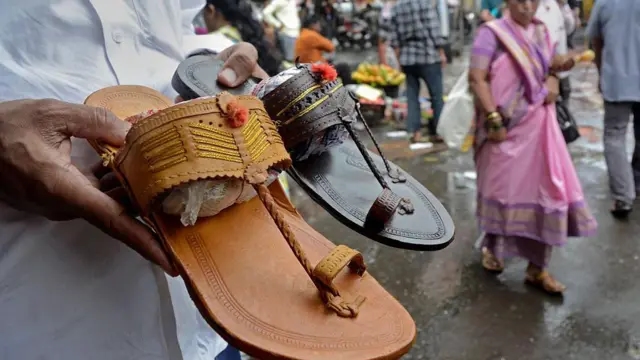
Global luxury fashion house Prada has announced a limited-edition footwear line inspired by Kolhapuri chappals, months after it faced criticism in India over alleged cultural appropriation of the traditional design.
According to Reuters, Prada will produce 2,000 pairs of sandals in Maharashtra and Karnataka, under an agreement with two state-backed entities. The collection will be sold from February 2026, both online and across 40 Prada stores worldwide. Each pair is expected to retail at around $939 (₹84,000).
The agreement was signed during the Italy–India Business Forum 2025.
Acknowledging Kolhapuri roots
The move follows controversy in June, when Prada showcased open-toe braided leather sandals that closely resembled Kolhapuri chappals but were described only as “leather footwear”, without acknowledging their Indian origin. This triggered widespread criticism from artisans, designers and cultural commentators in India.
Prada later acknowledged the Indian roots of the design. “We’ll mix the original manufacturer’s standard capabilities with our manufacturing techniques,” said Lorenzo Bertelli, Prada’s head of Corporate Social Responsibility.
Training and support for artisans
Maharashtra Social Justice Minister Sanjay Shirsat told BBC Marathi that the initiative will be officially branded “Prada Made in India – Inspired by Kolhapuri Chappals”.
Under the agreement:
- Selected artisans will receive specialised training from Prada and LIDCOM, a Maharashtra government-backed leather industry body
- Around 200 Kolhapuri artisans will undergo three years of training in Italy
- The state government will provide financial assistance to participating artisans
The agreement has been signed for five years, with the possibility of extension.
Heritage meets global fashion
Kolhapuri sandals, named after the city of Kolhapur in Maharashtra, date back to the 12th century and are traditionally handcrafted from leather, often using natural dyes. They are also widely produced by artisan communities in parts of north Karnataka, forming an important source of livelihood.
Following the earlier controversy, many Kolhapuri artisans had expressed disappointment over the lack of credit given to their craft. The new collaboration is being seen as a partial course correction, though questions remain about pricing, profit-sharing and long-term benefits for artisan communities.