


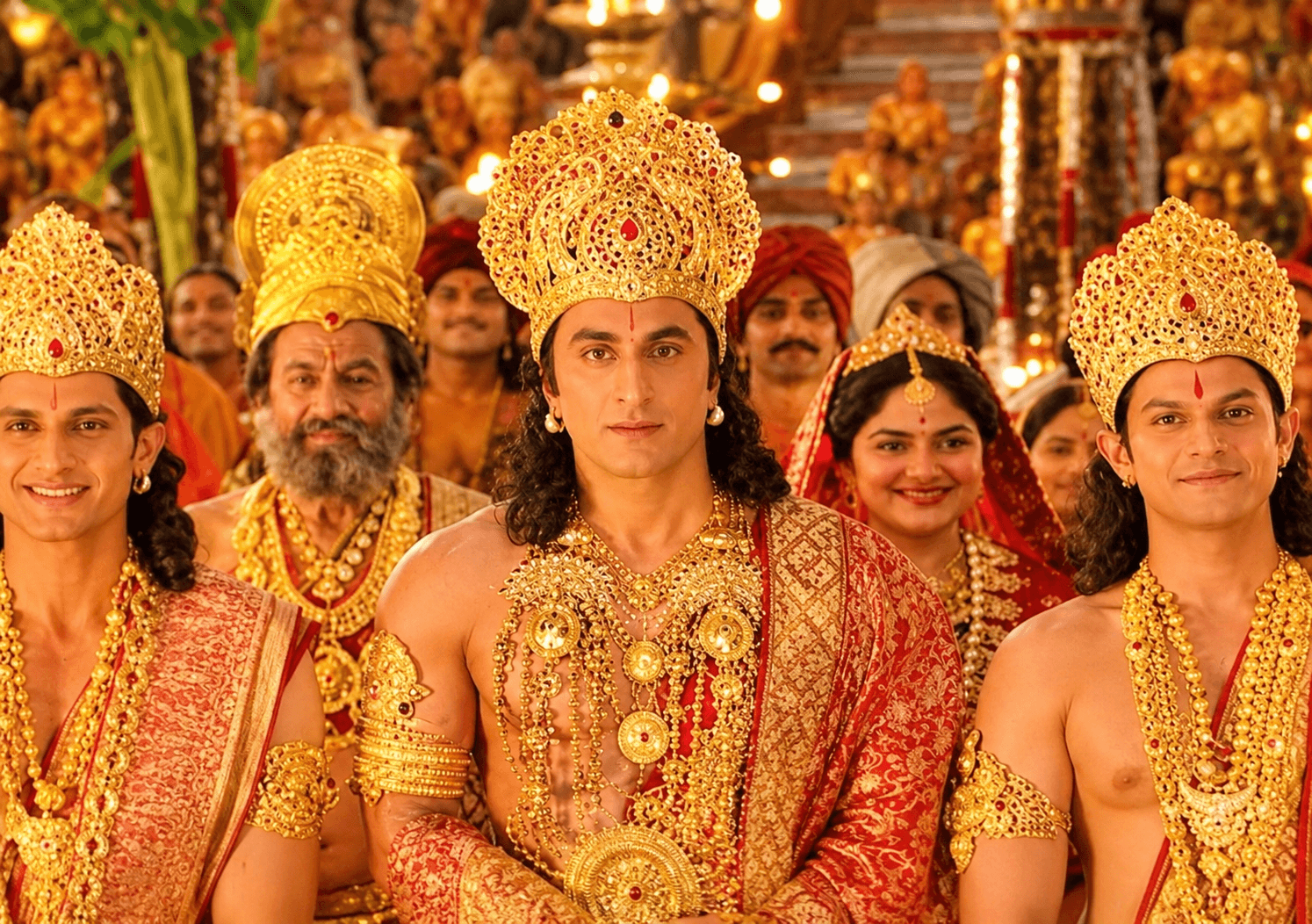


Mumbai: Ramayana: Part 1 crossed the Rs 1,000-crore worldwide box-office mark within eight days of its release, but the film’s biggest financial challenge may still lie ahead. Despite the milestone, the ambitious production could need around Rs 5,000 crore in worldwide theatrical collections to recover its estimated share of the reported budget through cinema earnings alone.
The film had collected an estimated Rs 1,033.55 crore worldwide by November 12, including Rs 358.50 crore from overseas markets. The achievement places it among a select group of Indian films to cross the Rs 1,000-crore milestone.
However, box-office collections do not translate directly into money received by the producer. Cinemas retain a share of ticket sales, while distributors and other intermediaries also receive their portions. A broad trade estimate puts the producer’s theatrical share at around Rs 400–450 crore so far, although the actual figure has not been disclosed.
For producer Namit Malhotra, the film is more than a major cinematic undertaking. It is a high-stakes investment involving his production company, visual-effects business, technology ambitions and plans to build a larger entertainment franchise.
Why Rs 5,000 crore has become the target
The Rs 5,000-crore figure is based on assumptions about the production cost and the theatrical revenue required to recover it.
Reports have placed the combined budget of the two Ramayana films at around Rs 4,000 crore. If Part 1 accounts for approximately half that amount, its assumed budget would be Rs 2,000 crore.
A commonly used trade estimate suggests that a film may need worldwide theatrical collections of around 2.5 times its production budget to reach theatrical break-even, depending on distribution arrangements and other costs.
Applying that rough calculation to an assumed Rs 2,000-crore budget produces a target of approximately Rs 5,000 crore in worldwide gross collections.
At an estimated Rs 1,033.55 crore after eight days, the film had covered roughly one-fifth of that theoretical target.
However, this is not an officially disclosed break-even figure. The actual amount needed to recover the investment will depend on the final production cost of Part 1, marketing expenditure, distribution agreements and revenue from digital, satellite, music and other rights.
Malhotra had made the scale of his personal commitment clear before the release. “It’s all my money … I’m going all in,” he had said.
The film’s opening performance has demonstrated considerable audience interest, but sustaining collections over the coming weeks will be crucial.
DNEG’s role makes the investment more complex
One of the biggest components of Ramayana is its visual-effects work. The film features elaborate fantasy settings, large-scale battles, mythical creatures and detailed environments, all of which require extensive computer-generated imagery.
An important part of this work is being handled within Malhotra’s own business group.
Malhotra heads Prime Focus and its visual-effects arm DNEG, the London-based studio known for its work on films such as Dune, Interstellar and Blade Runner 2049. DNEG has won eight Academy Awards for its visual-effects work.
Prime Focus Studios produced Ramayana in association with DNEG. The visual-effects business reportedly contributes more than 80% of Prime Focus’s consolidated revenue.
This creates an unusual business arrangement. The film’s production requires substantial visual-effects expenditure, while DNEG benefits from the work and the opportunity to deploy its artists and technology on a large-scale project.
However, the fact that the work is handled within the same business group does not automatically mean that the production investment has been recovered. The amount spent on visual effects and the revenue recognised by the studio are separate financial considerations.
Prime Focus has not disclosed how much of the film’s reported budget has been allocated to DNEG.
From Brahmastra to an integrated production model
Malhotra has previously experimented with arrangements in which DNEG went beyond its conventional role as a visual-effects vendor.
During the production of Brahmastra, DNEG took a financial stake in the project because its involvement was “going beyond the scope of just being a vendor”, according to Malhotra.
With Ramayana, the group has taken on a larger production risk through its own involvement in the film.
Malhotra has also discussed his preferred allocation of film expenditure. According to him, around 20% of the budget goes towards the writer, director and cast, while the remaining 80% is spent on production and marketing.
The strategy reflects the scale of the visual-effects work and the importance of building a convincing cinematic world for an epic such as the Ramayana.
English release showcases Brahma AI technology
The international and English-language versions of Ramayana also serve as a showcase for technology developed within the Prime Focus group.
Brahma AI, a DNEG Group company reportedly valued at $2 billion, is involved in the technology behind the film’s AI-assisted lip-sync dubbing.
Malhotra has said that developing the dubbing process took more than a year and cost millions of dollars.
The technology is intended to help adapt performances for audiences speaking different languages while retaining the appearance and timing of the original actors.
For the production group, this offers a business opportunity beyond the film itself. If the technology proves effective, it could attract interest from other studios looking to release films in multiple languages.
Malhotra has previously spoken about financing projects for Western clients when he was running a smaller business and borrowing money in India at interest rates of around 20%.
He has described Ramayana as a comparatively controlled risk, saying: “I’d rather take a risk that I control.”
Streaming deal and other rights could improve recovery
The film’s revenue strategy extends beyond theatrical collections.
In April, Malhotra reportedly turned down a post-theatrical digital rights offer of Rs 700 crore for both films. The offer was described in reports as one of the largest of its kind for an Indian production.
His team was reportedly seeking Rs 1,000 crore.
By October, the arrangement had taken a different direction. After its theatrical run, Ramayana is expected to reach JioHotstar through a pay-per-view rental model, which allows viewers to pay separately to watch the film.
This is different from a conventional streaming arrangement in which a platform acquires rights for a fixed payment. Under a rental model, the film can potentially generate revenue each time a viewer pays to watch it.
The financial terms of the JioHotstar agreement have not been disclosed, including whether it includes a minimum guarantee.
Malhotra has emphasised the importance of the theatrical experience, saying the film “should be experienced on the biggest screen possible, in IMAX 3D”.
The digital rental window is expected to provide another opportunity to earn revenue after the theatrical run.
Other reported rights arrangements include a digital and satellite package involving Star Group and JioHotstar, said to be worth around Rs 450 crore. However, the reported amount and scope of the agreement remain unconfirmed.
T-Series reportedly paid a refundable advance of Rs 75 crore for the music rights to both parts.
Sony Pictures has taken on international distribution, including the English-language version, while Dharma Productions is handling the Hindi-speaking market. The financial terms of these distribution arrangements have not been made public.
The two reported rights figures of Rs 450 crore and Rs 75 crore total Rs 525 crore. However, the first remains unconfirmed and the second is described as refundable. They should therefore not be treated as confirmed, non-refundable earnings for the producer.
Prime Focus shares rallied ahead of release
The film’s ambitions have also influenced investor interest in Prime Focus.
Between June 25 and July 1, 2025, around the unveiling of the film’s first look, Prime Focus shares reportedly climbed more than 30%, rising from Rs 113.47 to Rs 149.69.
Following the release of the teaser on July 3, the shares reportedly touched a record Rs 175. The company’s market capitalisation increased by more than Rs 1,000 crore within days.
Actor Ranbir Kapoor, who plays Lord Rama, also invested in Prime Focus through a preferential share issue at Rs 120 per share. His investment was reported at Rs 15 crore, although some accounts put it at Rs 20 crore.
Investors including Madhusudan Kela, Ramesh Damani and Utpal Sheth were also reported to have taken fresh positions in the company.
The rally created significant paper wealth for existing shareholders. A higher market valuation can also improve a company’s ability to raise equity and strengthen its position with lenders.
However, the financial position of Prime Focus remains an important consideration.
The company reportedly had gross debt of Rs 5,062 crore as of March 31, 2026, an increase of nearly 20% over the previous year. It had also reported revenue of Rs 3,599 crore and a loss of Rs 458 crore in FY25.
These figures underline why the performance of Ramayana matters beyond its box-office standing. The project is closely connected to the group’s wider production and technology ambitions.
Malhotra wants to build a Ramayana entertainment universe
At a pre-release event in Hyderabad, Malhotra described Ramayana as the foundation for a much larger entertainment franchise.
“Ramayana is a universe,” he said, referring to the potential to develop a range of projects around the epic.
His vision includes video games, toys, apparel, gadgets, home furnishings, origin films, television series and animated features. He has also spoken about possible theme-park attractions, a Broadway musical and virtual and augmented reality experiences.
The plans are ambitious, but no confirmed production dates or greenlights have been announced for these proposed projects.
The performance of the two films is likely to influence how much of this larger vision moves forward. Strong audience interest could create opportunities for licensing, merchandise and additional entertainment formats.
For now, the two-part film series remains the central project.
Part 2 postponed to Diwali 2028
The second instalment of Ramayana has been moved from its earlier expected Diwali 2027 release to Diwali 2028.
Malhotra said the response to the first film had encouraged the team to spend more time working on the finale.
The postponement gives the production more time to develop the concluding chapter, although it also extends the period during which the company must carry the financial commitments associated with the project.
Malhotra has previously indicated that the story was initially considered as a trilogy, with the possibility of a third film depending on audience response.
The revised schedule means the franchise’s long-term commercial prospects will remain tied to the reception of Part 1 and the eventual performance of Part 2.
Could China provide another major market?
China remains a significant opportunity, but a release of Ramayana in the country has not yet been confirmed.
The market’s importance can be understood through the performance of Nitesh Tiwari’s earlier film Dangal. The film earned a substantial portion of its worldwide collections in China, which contributed nearly two-thirds of its global gross.
Dangal continues to hold the record for the highest-grossing Indian film worldwide.
A successful Chinese release could potentially expand the international audience for Ramayana and add to its box-office earnings. However, without confirmation of a release, any such contribution remains speculative.
The film’s overseas collections will therefore depend on its performance in markets where it has already secured distribution, as well as any additional territories that may be opened later.
Day 8 slowdown puts sustained collections in focus
Despite crossing Rs 1,000 crore worldwide, Ramayana recorded a reported 24.3% decline in collections on Day 8 compared with Day 7.
A weekday drop is not unusual for a major theatrical release, but the pace of collections will matter given the scale of the reported investment.
The film also reached the Rs 1,000-crore milestone more slowly than Pushpa 2 and Dhurandhar 2, according to the supplied trade comparison.
The budget remains another uncertainty. While reports have put the combined cost of the two films at Rs 4,000 crore, an earlier estimate had placed the production cost at Rs 835 crore. Without an official breakdown, the exact financial commitment for Part 1 cannot be established.
At the current estimated theatrical share of Rs 400–450 crore, the film still has a considerable distance to cover against the assumed Rs 2,000-crore cost of the first instalment.
Other rights arrangements could help narrow that gap, but their actual value will depend on the final agreements and payments.
The Rs 1,000-crore milestone is only the beginning
Ramayana: Part 1 has achieved a major box-office milestone in its first eight days, demonstrating strong demand for the big-screen adaptation of the epic.
But the Rs 5,000-crore figure is not an official target announced by the producers. It is a rough trade calculation based on an assumed production budget and a general theatrical break-even formula.
Malhotra’s larger bet involves more than ticket sales. It includes visual-effects capabilities, AI-assisted dubbing, streaming rentals, international distribution and the possibility of building a franchise around the epic.
The project has already created work for DNEG, offered a showcase for Brahma AI and attracted investor attention towards Prime Focus. Yet each of these potential benefits operates on a different financial ledger and cannot automatically be counted as box-office recovery.
The real test will be whether the film can sustain its theatrical momentum, convert its additional rights into revenue and build enough audience interest to support the second instalment and the wider entertainment plans.
For now, the first Rs 1,000 crore is a significant achievement. Whether it becomes the foundation of a Rs 5,000-crore success story remains an open question.