









Mumbai: The Reserve Bank of India (RBI) could resume its rate-hike cycle at the Monetary Policy Committee (MPC) meeting on October 7, with inflation, rupee weakness, strong economic growth, excess liquidity and global monetary tightening emerging as key factors behind expectations of a 25 basis points increase in the repo rate.
The repo rate currently stands at 5.25 per cent. A 25 basis points increase would take it to 5.5 per cent.
The RBI has not raised its benchmark lending rate for around three-and-a-half years. However, a combination of domestic price pressures and external risks has changed the policy environment, prompting economists to consider a shift away from the central bank’s accommodative approach.
Around 60 per cent of economists polled by Reuters expect the RBI to raise the repo rate by a quarter percentage point.
Ajitabh Bharti, co-founder and executive director of CapitalXB, said the MPC was meeting at an important point for the economy, with inflation increasing and global central banks tightening monetary policy.
He said India’s underlying economic conditions remained resilient and that any policy adjustment was likely to be measured, with a maximum 25 basis points hike appearing the most likely outcome.
Five factors are particularly important in assessing the case for a rate increase.
Broad-based inflation raises concern
Inflation is one of the most important considerations for the MPC as it assesses its next policy move.
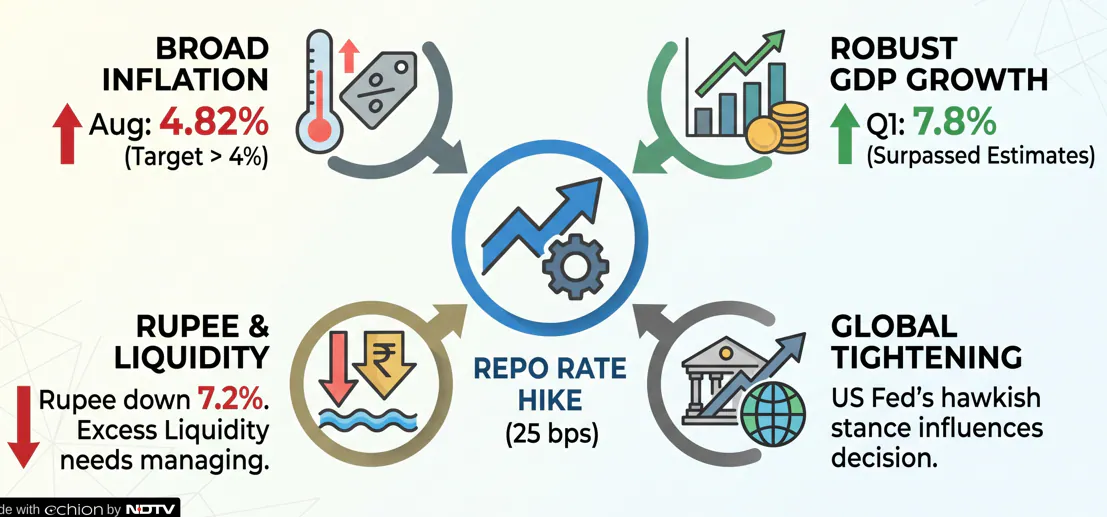
Consumer price inflation has remained above the RBI’s 4 per cent target for three consecutive months and accelerated to 4.82 per cent in August.
The concern is not limited to the headline number. Price pressures have also become broader across the consumer basket, with nearly half of the CPI basket trading above the central bank’s target threshold.
A sustained increase in prices could make it harder for the RBI to bring inflation back towards its medium-term target.
There are also concerns about the inflation trajectory in the second half of financial year 2026-27. An unfavourable base effect could push headline inflation higher even if some individual components moderate.
Weather conditions are another source of uncertainty.
The impact of El Nino could put additional pressure on agricultural production, with experts warning that the weather phenomenon could affect Rabi crops. Kharif cultivation has already faced the effects of deficient monsoon rainfall.
Any significant reduction in agricultural output could put upward pressure on food prices. Food inflation has been an important contributor to recent movements in the overall consumer price index.
Global crude oil prices provide another source of risk. Oil remaining around $100 a barrel could increase India’s import bill and keep imported inflation pressures elevated.
For the MPC, the combination of domestic food-price risks and higher global commodity prices could strengthen the argument for acting before inflation becomes more persistent.
Strong GDP gives RBI room to act
The second factor is the strength of India’s economic growth.
India’s GDP expanded 7.8 per cent in the first quarter, exceeding expectations and demonstrating resilience despite challenging global conditions.
Strong economic activity gives the RBI greater room to prioritise price stability without immediately creating a severe growth shock.
A rate hike generally increases borrowing costs across the economy and can eventually moderate consumption and investment. Policymakers therefore need to balance inflation risks against the possibility that tighter monetary conditions could weaken economic activity.
The latest growth figures provide some cushion in that calculation.
With the economy expanding at a robust pace, the argument for a measured rate increase becomes stronger for policymakers who believe inflation risks need to be contained.
At the same time, a single strong quarterly GDP figure does not guarantee that growth will remain at the same pace. The MPC will therefore have to assess whether the underlying momentum is sufficiently broad-based and durable.
Rupee weakness adds imported inflation risk
The third trigger is the movement of the Indian rupee.
The rupee has weakened to around Rs 96.44 against the US dollar, representing a depreciation of approximately 7.2 per cent.
A weaker currency can increase the domestic cost of imported goods and commodities. This becomes particularly important for an economy that relies heavily on imports of crude oil and other essential inputs.
Higher import costs can feed into transportation, manufacturing and consumer prices, potentially adding to existing inflationary pressures.
A rate increase could also influence the interest-rate differential between India and other major economies. Higher domestic rates may make rupee-denominated assets relatively more attractive to global investors, potentially helping to reduce capital outflow pressures.
However, monetary policy is only one factor affecting the exchange rate. Global risk sentiment, capital flows, crude oil prices, trade conditions and movements in the US dollar can all influence the rupee.
The currency’s recent weakness nevertheless adds another layer to the inflation challenge facing the RBI.
Liquidity surplus could complicate policy transmission
Domestic liquidity is another factor that could influence the MPC’s decision.
Large foreign currency inflows through FCNR-B deposits have contributed to liquidity conditions in the banking system. According to Kotak Institutional Equities, the RBI’s strategic swap window increased the liquidity available to Indian lenders by $127 billion.
Excess liquidity can affect the transmission of monetary policy because banks have substantial funds available for lending.
If liquidity remains significantly higher than desired, changes in the policy rate may not immediately produce the intended effect across money markets and lending rates.
A tighter monetary stance could therefore be used alongside liquidity management measures to bring financial conditions more closely in line with the RBI’s inflation objective.
The liquidity situation is particularly relevant when economic activity is strong. Excess funds, if translated into stronger credit growth and demand, could add to existing price pressures.
The RBI will consequently have to consider not just the repo rate itself but also the broader liquidity conditions through which monetary policy operates.
Fed policy creates another external pressure
The fifth factor is the direction of monetary policy in the United States.
The US Federal Reserve’s hawkish policy signals have increased expectations that central banks around the world could move towards tighter monetary conditions.
The Fed’s decision to raise rates for the first time in three years, along with signals of two additional increases by the end of 2026, has implications for emerging markets such as India.
Higher US interest rates can make dollar-denominated assets more attractive, potentially increasing capital flows towards the US and putting pressure on emerging-market currencies.
For India, that could create an additional challenge for the rupee at a time when the currency is already under pressure.
It could also increase the importance of maintaining an appropriate interest-rate differential to limit excessive capital outflows and reduce pressure on the exchange rate.
The global backdrop is particularly important because supply-chain disruptions and elevated commodity prices continue to create inflationary risks.
A tighter monetary environment in the US could therefore reinforce the argument for the RBI to maintain a sufficiently firm policy stance.
Why a 25 basis points hike is being considered
The five factors do not operate independently.
Higher crude oil prices can increase inflation while simultaneously putting pressure on the rupee. A weaker rupee can then make imported commodities more expensive. Strong domestic growth can sustain demand, while excess liquidity can amplify credit and spending conditions.
At the same time, tighter US monetary policy can influence global capital flows and the exchange rate.
Together, these factors provide the backdrop against which economists are expecting a possible 25 basis points increase.
The relatively modest size of the expected move is also significant. A quarter-percentage-point increase would allow the RBI to signal greater concern about inflation without making an abrupt adjustment to borrowing conditions.
For households and businesses, however, even a 25 basis points increase could affect loan pricing if banks transmit the change to lending rates.
Borrowers with floating-rate loans could see their interest costs rise, while deposit rates could also change depending on how banks respond.
MPC decision will depend on inflation-growth balance
The RBI’s challenge is to determine whether the current combination of inflation and external risks warrants a change in policy while protecting economic growth.
The 7.8 per cent GDP growth rate suggests that the economy currently has momentum, while inflation at 4.82 per cent remains above the central bank’s 4 per cent target.
The rupee’s depreciation, elevated crude oil prices, liquidity conditions and the global monetary environment add further uncertainty.
The MPC will therefore have to assess whether inflation risks are temporary or becoming sufficiently broad and persistent to require a stronger policy response.
A 25 basis points hike would represent the first increase in the repo rate in around three-and-a-half years and would mark a significant change from the recent accommodative approach.
The October 7 decision will ultimately provide clarity on how the central bank weighs price stability against growth and external financial pressures.