










Mumbai: Silver has fallen below the $60-per-ounce mark after losing almost half its value from the record levels reached earlier in 2026, but analysts say the sharp correction has not erased the metal’s long-term industrial investment case.
Spot silver was trading at around $59.35 per ounce on Thursday, down 44 cents, or 0.74 per cent, as a stronger US dollar and elevated Treasury yields weighed on precious metals.
In India, silver futures on the Multi Commodity Exchange of India (MCX) were hovering around Rs 2.21 lakh per kg, well below the record levels of around Rs 4.2 lakh seen earlier this year.
The scale of the decline has raised questions over whether silver’s spectacular rally has run its course. However, commodity analysts argue that the factors supporting long-term demand remain largely intact.
Silver’s unusual position as both a precious metal and an industrial commodity means its price can be heavily influenced by investor sentiment in the short term while remaining supported by structural demand over a longer horizon.
Silver’s volatility does not erase its fundamentals
Max Baecker, president of American Hartford Gold, told NDTV Profit that speculative trading can significantly amplify silver’s price movements, but that does not necessarily undermine its underlying fundamentals.
“Silver’s volatility doesn’t erase its fundamentals, although speculative trading can amplify its price swings,” Baecker said in an emailed interaction.
He pointed to the metal’s use in electronics and solar power as important sources of demand.
“Its uses in electronics and solar power give it an additional source of demand while making it more sensitive to an economic slowdown,” Baecker said.
The smaller size of the global silver market compared with gold can also magnify price movements. Large institutional purchases or sales can therefore have a disproportionately large impact on prices.
Baecker said there remains a credible long-term case for silver, but investors should be prepared for a “bumpier ride”.
Nearly 50% wiped out from the 2026 peak
The scale of silver’s correction has been particularly striking because of the extraordinary rally that preceded it.
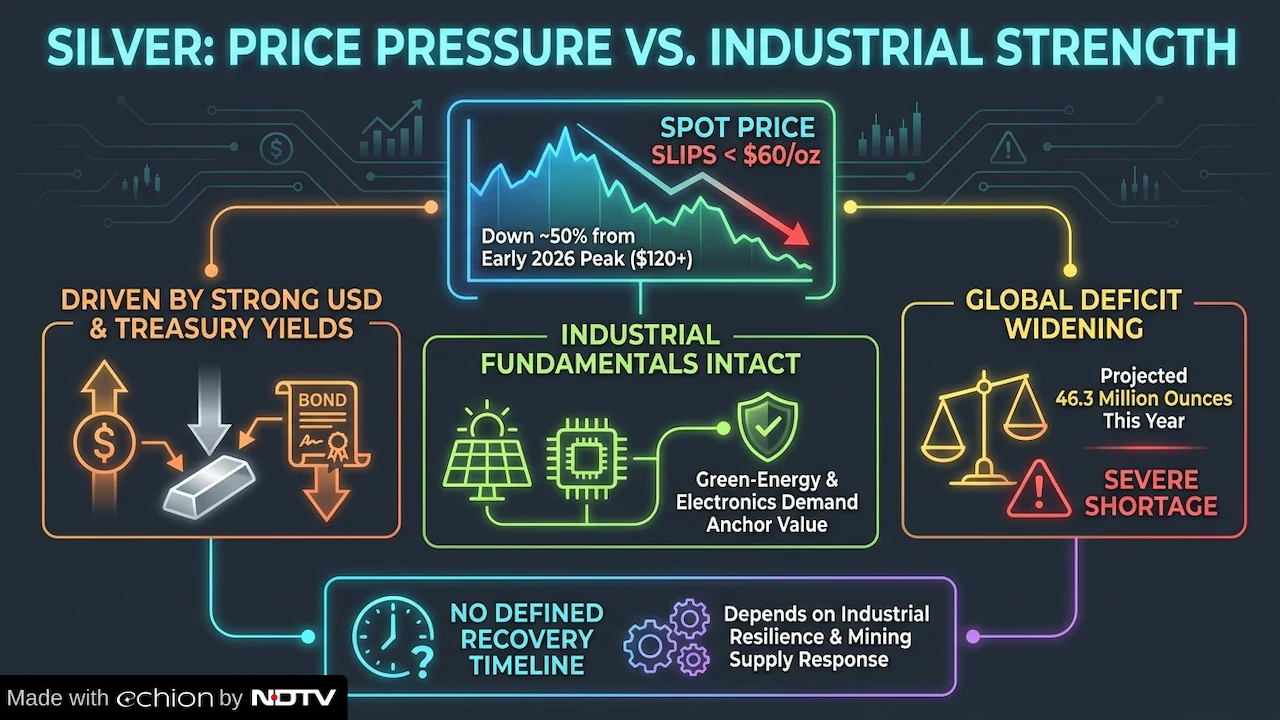
International silver prices had briefly climbed above $120 per ounce earlier in 2026. The subsequent decline has taken the metal below $60, representing a fall of almost 50 per cent from its peak.
The correction has also been visible in the Indian market, where silver futures have dropped substantially from their early-2026 record levels.
Such a steep fall can make the market appear fundamentally broken, but price movements in silver can also reflect changes in investor positioning, currency movements, interest rates and expectations about global economic growth.
The latest weakness has come at a time when the US dollar has strengthened and Treasury yields have remained elevated.
Why higher Treasury yields hurt silver
Silver, like gold, does not generate interest income.
When Treasury yields rise, investors have an alternative in dollar-denominated assets that provide a yield. This can reduce the attractiveness of non-yielding precious metals.
A stronger US dollar can add another layer of pressure because silver is traded internationally in dollars. A stronger dollar makes the commodity relatively more expensive for buyers using other currencies.
These factors can be particularly important for silver because its industrial exposure also makes it sensitive to expectations about economic activity.
A slowdown in manufacturing, electronics or construction can reduce demand, while concerns about economic growth can encourage investors to reduce exposure to cyclical commodities.
Industrial demand remains a major support
Silver’s long-term investment case differs from gold because a significant portion of its demand comes from industrial applications.
The metal’s high electrical and thermal conductivity makes it useful in electronics, electrical systems, automotive applications and renewable-energy technologies.
Solar power has been an especially important source of demand.
Silver is used in photovoltaic cells because of its electrical conductivity, and the expansion of renewable-energy capacity has helped strengthen the metal’s industrial role.
However, there is an important qualification to the solar story.
Manufacturers have been reducing the quantity of silver used in individual solar cells as high prices encourage them to use less of the metal or seek alternatives. This process, commonly referred to as thrifting and substitution, has reduced the amount of silver required per unit of solar capacity.
As a result, rising solar installations do not necessarily translate into an equivalent increase in silver consumption.
Silver market remains in deficit
Despite the moderation in some areas of industrial demand, commodity researchers continue to point to a supply-demand imbalance in the physical silver market.
Philip Newman, managing director at Metals Focus, has highlighted a projected global silver deficit of 46.3 million ounces this year.
The deficit is significant because silver supply cannot necessarily respond quickly to higher prices.
Much of the world’s silver is produced as a by-product of mining other metals, including lead, zinc, copper and gold. This means miners cannot simply increase silver production whenever prices rise.
Developing new mines can take years, while expanding existing operations requires significant investment.
Recycling can provide additional supply, but it too tends to respond with a delay to changes in prices and demand.
Physical market remains vulnerable to liquidity pressures
Newman has also pointed to the possibility of renewed tightness in the physical market.
While London silver lease rates have normalised from earlier periods of stress, Newman has warned that another liquidity squeeze could emerge.
Such episodes can have an outsized effect on silver because of the metal’s relatively small market size.
When physical availability becomes tight at the same time that investment demand rises, prices can move sharply. Conversely, when speculative positions are unwound, the same market characteristics can accelerate a decline.
The recent move from above $120 to below $60 demonstrates how quickly sentiment can change.
No fixed timeline for silver’s recovery
Despite the long-term industrial argument, analysts remain cautious about predicting when silver could recover its previous highs.
Baecker has pushed back against assigning a fixed five-year timeline for a complete recovery or setting a precise price target for 2027.
The future path of silver will depend on several factors, including global industrial demand, monetary policy, currency movements, investment flows and the ability of mining companies to increase supply.
A prolonged global economic slowdown could delay a recovery by reducing industrial orders and demand for manufactured goods.
At the same time, a change in interest-rate expectations or a weaker US dollar could improve the investment environment for precious metals.
This makes the timing of any potential recovery particularly difficult to predict.
Silver’s dual role makes it different from gold
Silver’s appeal comes partly from its dual identity.
As a precious metal, it can attract investment during periods of economic or financial uncertainty. As an industrial commodity, it benefits from long-term demand in sectors such as electronics, renewable energy and electrical infrastructure.
The same characteristic can also make silver more volatile than gold.
During periods of strong economic growth and rising industrial demand, the industrial component can provide additional support. During an economic slowdown, however, concerns about manufacturing demand can weigh on prices even when investors continue to view silver as a monetary asset.
This dual exposure is one reason silver can experience larger price swings than gold.
What the correction means for investors
The fall below $60 may appear attractive to investors who believe the metal will eventually return to its previous highs. However, the correction should not automatically be interpreted as proof that silver is undervalued.
A lower price does not guarantee a recovery.
Investors also need to consider the possibility that silver could remain volatile or decline further if the dollar stays strong, Treasury yields remain elevated or industrial demand weakens.
The metal’s long-term supply constraints and industrial uses provide a structural argument, but they do not eliminate short-term market risks.
For investors considering silver exposure, the distinction between a long-term thesis and a short-term price prediction is therefore important.
Long-term shine remains, but the ride could be bumpy
Silver’s collapse from above $120 to below $60 represents one of the sharpest corrections in the metal’s recent history.
Yet analysts say the decline does not necessarily invalidate its long-term fundamentals.
Industrial applications in electronics, solar power and other technologies continue to provide sources of demand, while the physical market remains vulnerable to supply deficits and liquidity pressures.
At the same time, silver’s smaller market size, sensitivity to interest rates and exposure to industrial activity mean that investors should expect substantial volatility.
Baecker’s warning about a “bumpier ride” therefore captures the central issue facing silver investors.
The metal may retain a credible long-term case, but there is no defined timeline for a return to its earlier peak. Its future trajectory will depend on the interaction between industrial demand, mine supply, investment flows, interest rates and the global economic cycle.