







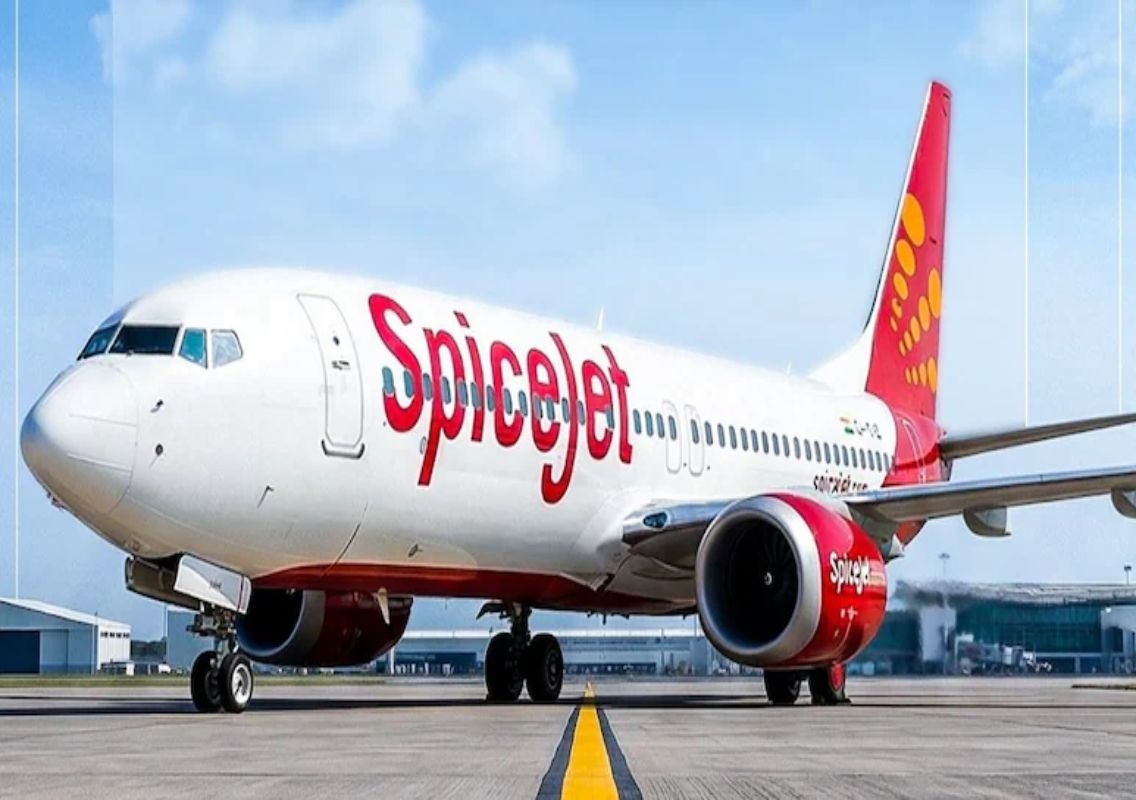


The decline came even as India’s domestic airlines carried around 1.2 crore passengers in July, with overall traffic falling nearly 5% year-on-year. IndiGo retained its overwhelming leadership with a 67.4% market share, while the Air India Group remained the country’s second-largest airline operator with a combined 24% share.
SpiceJet’s weak market position was accompanied by a significant gap in operational performance. Its on-time performance stood at just 34.5% in July, far below IndiGo’s 91.2% and Akasa Air’s 90.8%. Air India recorded an on-time performance of 86.5%.
The latest numbers underline the scale of the challenge facing SpiceJet as it attempts to rebuild its operations and compete more effectively in India’s increasingly concentrated aviation market.
IndiGo strengthens its domestic market dominance
IndiGo continued to command the largest share of India’s domestic aviation market in July, carrying 80.82 lakh passengers and accounting for 67.4% of total domestic traffic.
The airline’s position is significantly ahead of its competitors. Its market share means that roughly two out of every three domestic passengers travelled with IndiGo during the month.
The airline’s dominance has been supported by its extensive domestic network, large fleet and high aircraft utilisation. Its strong operational performance was also reflected in its 91.2% on-time performance in July, the highest among the major airlines cited in the DGCA data.
The latest figures show that IndiGo continues to set the benchmark for passenger volumes and operational reliability in India’s domestic market.
However, shares of IndiGo’s parent InterGlobe Aviation fell more than 1% on Friday despite the airline’s market leadership, according to the report.
The stock movement indicates that airline share prices can respond to factors beyond monthly market-share data, including valuations, costs, fuel prices, capacity and broader market conditions.
Air India Group holds second position
The Air India Group remained the second-largest airline operator in India in July, with a 24% combined market share and 28.75 lakh passengers carried during the month.
The group’s position reflects the scale of the Tata Group’s airline consolidation strategy.
With Air India and its associated operations accounting for nearly one-fourth of the domestic market, the group has emerged as the main challenger to IndiGo in terms of overall scale.
The gap between the two remains substantial, however. IndiGo’s 67.4% share was nearly three times the Air India Group’s 24% share.
The July numbers therefore suggest that India’s domestic aviation market remains heavily concentrated, with the two largest operators accounting for more than 90% of passenger traffic when their combined shares are considered.
For smaller airlines, gaining meaningful market share in such an environment requires a combination of aircraft availability, competitive fares, reliable operations and a sufficiently broad network.
SpiceJet carries 1.87 lakh passengers
SpiceJet’s July market share slipped to 1.6%, with the airline carrying approximately 1.87 lakh passengers.
The figure places SpiceJet well behind the country’s largest operators and illustrates the airline’s reduced presence in the domestic passenger market.
The airline’s current share is also important because market share is closely linked to capacity deployment. An airline needs sufficient operational aircraft and available seats to maintain or expand its position.
SpiceJet has faced operational challenges in recent years, and its July passenger numbers show that it has yet to return to the scale it once commanded in India’s aviation industry.
The airline’s immediate challenge is therefore not simply to attract more passengers, but also to establish reliable capacity that can support sustained network growth.
On-time performance remains a major concern
One of the most striking figures in the latest DGCA data is SpiceJet’s 34.5% on-time performance in July.
The figure is significantly lower than the performance recorded by its larger competitors.
IndiGo achieved an on-time performance of 91.2%, while Akasa Air recorded 90.8%. Air India’s on-time performance stood at 86.5%.
The difference is particularly important for an airline attempting to rebuild customer confidence.
Punctuality affects passenger experience, aircraft utilisation and network efficiency. Persistent delays can also have a knock-on effect because late aircraft can disrupt subsequent departures and arrivals across the network.
For SpiceJet, improving operational reliability could therefore be an important part of any effort to rebuild its market share.
Domestic passenger traffic falls nearly 5%
The July data also showed that India’s overall domestic aviation market experienced a year-on-year decline.
Domestic airlines carried around 1.2 crore passengers, representing a fall of nearly 5% compared with the same period a year earlier.
The decline means SpiceJet’s performance needs to be viewed against a broader reduction in domestic passenger traffic rather than an expanding market.
Even in a softer market, however, the distribution of passengers remained heavily tilted towards the largest operators.
IndiGo retained its dominant position, while the Air India Group held second place. The smaller airlines therefore continued to compete for a comparatively limited share of the market.
For SpiceJet, improving its position in such an environment could prove difficult unless it can increase operational capacity while maintaining competitive fares and reliable service.
Why market share matters for SpiceJet
Market share is one of the most closely watched indicators of an airline’s competitive position.
A decline to 1.6% means SpiceJet currently accounts for only a small fraction of India’s domestic passenger traffic. That can affect the airline’s ability to generate scale across its network.
Higher passenger volumes can help airlines spread fixed costs across more seats and improve aircraft utilisation. Conversely, lower capacity and passenger numbers can make it harder to achieve operating efficiencies.
The July figures therefore provide investors with an indication of the scale of SpiceJet’s recovery challenge.
The airline needs to increase its passenger volumes meaningfully if it wants to regain a larger share of India’s aviation market.
The gap with IndiGo remains enormous
The contrast between SpiceJet and IndiGo is particularly stark.
While SpiceJet carried 1.87 lakh passengers in July, IndiGo carried 80.82 lakh, according to DGCA data.
That difference reflects the vast disparity in network scale and operational capacity between the two airlines.
IndiGo’s 67.4% market share also gives it a strong competitive advantage in terms of network connectivity and passenger reach.
For SpiceJet, competing directly with IndiGo on scale would be challenging. A more realistic path would involve rebuilding capacity, strengthening selected routes and improving reliability.
The airline could then seek to gradually increase its share rather than attempting to close the gap immediately.
Air India Group adds to competitive pressure
The Air India Group’s 24% market share adds another layer of competitive pressure.
The Tata Group-backed airline businesses have substantial resources and are undergoing a broader transformation aimed at creating a stronger full-service aviation group.
With the group already accounting for 28.75 lakh domestic passengers in July, SpiceJet faces competition not only from IndiGo but also from a significantly larger Air India operation.
This makes the market increasingly difficult for smaller operators.
At the same time, the presence of multiple airlines gives passengers more options and keeps pressure on carriers to offer competitive prices and dependable service.
Operational recovery will be crucial
For SpiceJet, the July data suggest that operational recovery remains a key priority.
The airline’s 34.5% on-time performance is particularly notable because punctuality is closely associated with passenger satisfaction and aircraft productivity.
Improving this metric would help the airline strengthen its reputation while potentially allowing it to utilise its available fleet more efficiently.
Market-share recovery would then depend on whether the airline can translate improved operations into higher capacity and passenger volumes.
Without sustained improvements, the gap between SpiceJet and the leading operators could remain difficult to narrow.
Investors watch airline stocks closely
The latest DGCA data also had an impact on airline stocks.
Shares of InterGlobe Aviation, IndiGo’s parent company, fell more than 1% on Friday despite the airline retaining its dominant market position.
This highlights an important distinction between operational performance and stock-market performance.
An airline can report strong passenger numbers and market share while its stock reacts negatively because investors may already have high expectations built into the valuation.
Similarly, weaker market-share figures for an airline do not automatically determine its future stock performance.
Investors typically consider a wider set of factors, including profitability, fuel costs, aircraft availability, capacity expansion, competition and demand.
What the July data mean for Indian aviation
The latest numbers reinforce the increasingly concentrated structure of India’s domestic airline market.
IndiGo’s 67.4% share gives it a commanding lead, while the Air India Group’s 24% share places it firmly in second position. Together, they accounted for more than 90% of the domestic market in July.
SpiceJet’s 1.6% share demonstrates how much smaller its current position is compared with the country’s two leading airline groups.
The data also show that operational reliability remains an important differentiator. The large gap between SpiceJet’s 34.5% on-time performance and the figures reported by IndiGo, Akasa Air and Air India illustrates the challenge facing the airline.
Conclusion
SpiceJet’s 1.6% domestic market share in July highlights the airline’s continuing struggle to rebuild its position in India’s aviation industry. The carrier flew 1.87 lakh passengers during the month, while overall domestic passenger traffic stood at around 1.2 crore, down nearly 5% year-on-year.
IndiGo remained the clear market leader with a 67.4% share and 80.82 lakh passengers, while the Air India Group held second place with a 24% share and 28.75 lakh passengers.
The most significant concern for SpiceJet may be its operational performance. Its 34.5% on-time performance was far below IndiGo’s 91.2%, Akasa Air’s 90.8% and Air India’s 86.5%.
For SpiceJet, regaining market share will require more than attracting passengers. The airline will need to strengthen operational reliability, deploy sufficient capacity and rebuild customer confidence. With IndiGo maintaining a dominant lead and the Air India Group expanding its presence, the road back to a stronger position in India’s domestic aviation market remains challenging.