







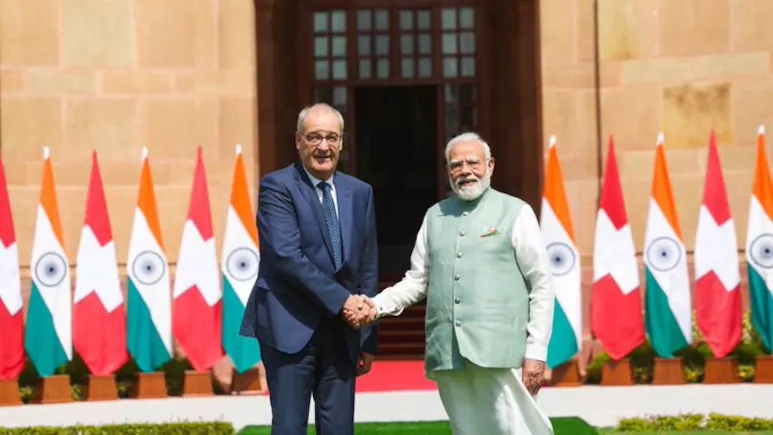


New Delhi: Swiss businesses see India as a “serious long-term partner” rather than simply a market for a handful of industries, Switzerland President Guy Parmelin has said, highlighting the growing scope of economic ties between the two countries.
Speaking to NDTV during his three-day state visit to India, Parmelin said trade, investment, technology, innovation and mobility were among the key areas discussed with Prime Minister Narendra Modi.
Parmelin arrived in New Delhi on Monday and received a ceremonial welcome at Rashtrapati Bhavan before holding talks with Modi. He described bilateral relations as going “from strength to strength”.
His visit comes as India and the European Free Trade Association (EFTA) mark a year of the Trade and Economic Partnership Agreement (TEPA), which includes Switzerland, Iceland, Norway and Liechtenstein. The agreement came into force in October 2025.
Swiss companies expanding across sectors
Parmelin said Swiss companies have already invested, or are planning investments, in a range of sectors in India.
These include transport and logistics, financial services, manufacturing, pharmaceuticals and biotechnology, as well as technology and electronics.
He said the breadth of these investments was encouraging because it showed that Swiss businesses were looking at India as a long-term partner rather than limiting their interest to individual sectors.
“What I find encouraging is how broad that list is. It tells me that Swiss businesses see India as a serious long-term partner, not just a market for one or two industries,” Parmelin told NDTV.
The comments come as both countries seek to deepen economic engagement following the implementation of TEPA.
Parmelin expects TEPA to boost trade
The Swiss President said it was still too early to assess the full impact of TEPA because tariff reductions under the agreement will be phased in over several years.
However, he expressed confidence that the pact would significantly strengthen bilateral trade.
“I expect TEPA to give a significant boost to trade between Switzerland and India in the years ahead,” he said.
The India-EFTA agreement includes commitments linked to investment and employment generation in India. EFTA countries have committed to facilitating USD 100 billion in investments in India over 15 years, along with the potential creation of one million direct jobs.
For Switzerland, the agreement is expected to provide greater opportunities for businesses in areas ranging from advanced manufacturing and financial services to pharmaceuticals and technology.
AI cooperation ahead of Geneva summit
Artificial intelligence is another important area of India-Switzerland cooperation.
Parmelin was in New Delhi in February for the AI Impact Summit and said India would remain an important partner as Switzerland prepares to host the next global AI summit in Geneva in 2027.
“As we prepare to host the next summit in Geneva in 2027, India is a key partner for us,” he said.
The Swiss President also praised India’s role in bringing the concerns of developing countries into international discussions on artificial intelligence and technology.
He said India had demonstrated leadership in amplifying the voices of countries and communities that are underrepresented in global technology discussions, particularly those from the Global South.
Switzerland seeks wider AI participation
Switzerland intends to build on this approach through the International Computation and AI Network, or ICAIN.
The initiative is aimed at promoting wider access to the benefits of advanced technology while encouraging research cooperation and knowledge sharing across regions.
Parmelin said Switzerland looked forward to India’s participation in the initiative and to continued cooperation ahead of the 2027 summit in Geneva.
The focus reflects a broader convergence between the two countries on issues surrounding AI governance, innovation and the need to ensure that technological progress benefits a wider range of countries.
India and Switzerland had also discussed AI and innovation during Parmelin’s earlier visit to New Delhi for the 2026 AI Impact Summit.
Switzerland backs efforts against terror financing
Countering terrorism financing was another issue addressed by Parmelin.
Switzerland, he said, attaches importance to maintaining the integrity of both its domestic financial system and the international financial system.
He said Switzerland was “firmly committed” to collective efforts to combat the financing of terrorism and to implementing international standards, including recommendations issued by the Financial Action Task Force (FATF).
The Swiss authorities also work with international partners and the private sector to address terrorism financing through newer channels, including virtual assets and underground banking networks.
The comments come against the backdrop of India’s longstanding concerns about cross-border terrorism and the financing of terrorist activities.
New agreements aim to improve mobility
Mobility between India and Switzerland was another focus of the discussions.
Parmelin pointed to two agreements — the Migration and Mobility Partnership and the Young Professionals Agreement — as important developments in bilateral cooperation.
He said the agreements were intended to make legal migration and mobility easier while also strengthening cooperation on matters such as return and readmission.
Indian students and professionals have frequently raised concerns about visa restrictions and work-permit requirements in Switzerland.
Parmelin said Indian nationals are covered by a separate work-permit system in Switzerland, but around 1,500 to 1,900 permits are issued to Indians every year.
Around 19,000 Indians live in Switzerland
The Swiss President also highlighted the contribution of the Indian community in Switzerland.
According to Parmelin, around 19,000 Indian nationals currently live in the country.
He said they contribute to Swiss society and the economy while also strengthening the relationship between the two countries.
The Migration and Mobility Partnership and Young Professionals Agreement are expected to provide an additional framework for people-to-people exchanges and professional mobility.
The agreements are part of a wider effort to make bilateral relations more comprehensive, extending beyond trade and investment into education, skills and movement of people.
Switzerland says financial information exchange is working
India’s efforts to identify undeclared wealth held overseas have historically included scrutiny of accounts linked to Swiss financial institutions.
Parmelin said the financial information-sharing mechanism between India and Switzerland was functioning smoothly.
He said the automatic exchange of financial account information between the two countries had been operating since the first exchange in 2019.
The exchange of information on request was also described by Parmelin as working well.
“India is an important partner for Switzerland, and we value the good cooperation with the Indian authorities,” he said.
The automatic exchange mechanism enables tax authorities in the two countries to receive financial account information under agreed international standards.
Cooperation to expand to crypto-assets
Switzerland also plans to continue discussions with India and other international partners on tax information exchange.
Parmelin said this would include the upcoming automatic exchange of information relating to crypto-assets.
The expansion reflects efforts by governments and international organisations to ensure that tax authorities have access to relevant financial information as investment and wealth increasingly move through digital assets and newer financial channels.
For India, greater information sharing remains important in efforts to identify undisclosed overseas financial assets and improve tax compliance.
India-Switzerland ties broaden beyond trade
Parmelin’s visit highlights the increasingly broad nature of India-Switzerland relations.
While trade and investment remain central to the partnership, the discussions have expanded into artificial intelligence, technology, innovation, mobility, counter-terrorism financing and financial transparency.
TEPA provides an important economic framework, while the migration agreements offer a separate mechanism for strengthening people-to-people and professional links.
The two countries are also looking ahead to Switzerland’s hosting of the next global AI summit in Geneva in 2027, with India expected to remain an important partner in discussions around inclusive technology and AI governance.
Parmelin’s assessment that Swiss businesses view India as a serious long-term partner reflects the wider direction of the relationship. With tariff reductions under TEPA still being phased in and cooperation expanding across several new areas, both countries are looking to deepen ties in the years ahead.