







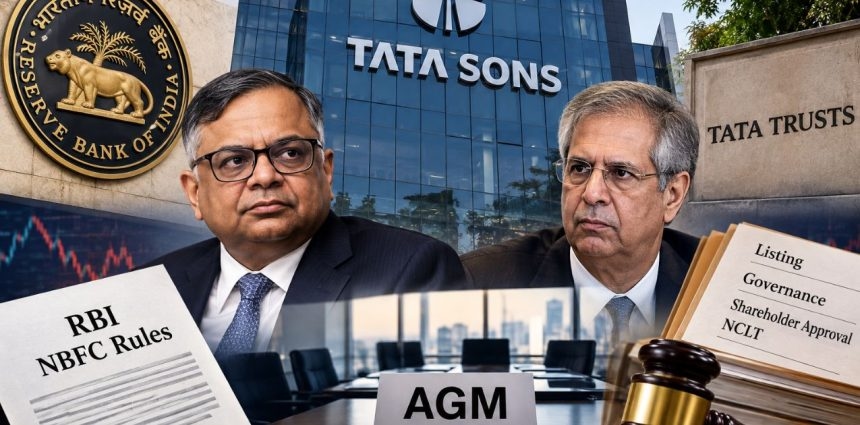


Mumbai: Tata Sons has told the Bombay High Court that postponing its November 30 board meeting could jeopardise its compliance with the Reserve Bank of India‘s (RBI) December 10 deadline for submitting a listing plan, intensifying the ongoing legal battle with Tata Trusts over affirmative voting rights.
Appearing on behalf of Tata Sons on Friday, senior advocate Harish Salve argued that there was no legal basis to defer the scheduled board meeting, pointing out that none of the applications filed by Tata Trusts specifically sought such a direction.
Salve submitted that the RBI’s listing requirement had been in place for some time and that Tata Sons had not challenged the regulator’s directive. He warned that postponing the meeting could prevent the company from complying with the regulatory timeline.
“If the meeting is deferred, we will not be able to comply with RBI regulation,” the company’s counsel submitted before the court.
Salve also argued that if the listing process proceeded without complications, Tata Sons could potentially become a listed company by the autumn of 2027.
Tata Trusts challenges chairman’s casting vote
The legal dispute centres on Tata Trusts’ challenge to the use of Tata Sons Chairman N. Chandrasekaran‘s casting vote during the September 17 board meeting.
The casting vote was reportedly used to pass resolutions, including Chandrasekaran’s reappointment, despite the absence of an affirmative vote from Tata Trusts’ nominee directors.
Tata Trusts has argued that Article 121 of Tata Sons’ Articles of Association (AoA) requires affirmative voting by a majority of its nominee directors before certain decisions can be taken. According to the Trusts, the chairman’s casting vote cannot override this requirement.
The Trusts have maintained that the affirmative voting provision is a safeguard against decisions being taken without their nominees’ approval. They have also argued that the September 17 resolutions could undermine these rights if subsequently confirmed without the required affirmative votes.
The dispute has placed the company’s governance structure and the interpretation of its Articles of Association at the centre of the proceedings.
Harish Salve counters Tata Trusts’ arguments
Salve countered the Trusts’ position, arguing that they were seeking to have Tata Sons operate according to Noel Tata’s wishes.
He pointed out that Tata Trusts had appointed only two nominee directors, despite the Articles of Association allowing them to appoint up to five. According to Salve, the Trusts could not now rely on the absence of a majority of their nominees to argue that the board was unable to function.
He also submitted that confirming the minutes of the September 17 board meeting on November 30 would not automatically validate the resolutions or prevent Tata Trusts from challenging their legality later.
Tata Sons argued that any decision to take the company public would ultimately require shareholder approval, with Tata Trusts holding a 66% stake in the company.
The company also questioned why the Trusts were opposing the convening of an extraordinary general meeting (EGM), which could be relevant to the broader governance and listing discussions.
RBI listing mandate adds urgency to the dispute
The RBI’s listing requirement has emerged as a significant factor in the legal proceedings, with Tata Sons arguing that the November 30 board meeting is important for addressing the regulatory process.
The company has maintained that deferring the meeting could complicate its ability to submit the listing plan by December 10. Salve told the court that the company had not challenged the regulator’s directive and needed to proceed with the scheduled meeting.
Tata Sons also indicated that the listing process could potentially culminate in the company becoming publicly listed by the autumn of 2027, provided the process moved forward without disruptions.
However, the proposed listing remains subject to the company’s internal decision-making process, shareholder approval and regulatory requirements.
Tata Sons raises objections to maintainability of suit
Salve also raised objections to the maintainability of the suit filed by Tata Trusts, arguing that permission from the Charity Commissioner might be necessary under Section 60 of the Maharashtra Public Trusts Act.
Counsel representing Harish Manwani and Venu Srinivasan also presented arguments during the hearing.
Srinivasan’s counsel argued that the Articles of Association should be interpreted pragmatically, in a manner that allows the company to function without being trapped in a governance deadlock.
The arguments reflected differing interpretations of the company’s governance framework and the extent of authority exercised by its chairman and nominee directors.
Tata Trusts says dispute is about AoA interpretation
Representing Tata Trusts, senior advocate Abhishek Manu Singhvi argued that the dispute was not about Noel Tata but about the interpretation and implementation of Articles 104B and 121 of Tata Sons’ Articles of Association.
Singhvi accused Salve of mischaracterising the Trusts’ arguments and maintained that the matter concerned the enforcement of their affirmative voting rights under the company’s governing documents.
Tata Sons sought 10 days to file its reply in the proceedings.
The Bombay High Court has yet to decide on the interim relief sought by Tata Trusts, leaving the November 30 board meeting and the contested resolutions at the centre of the ongoing legal battle.