







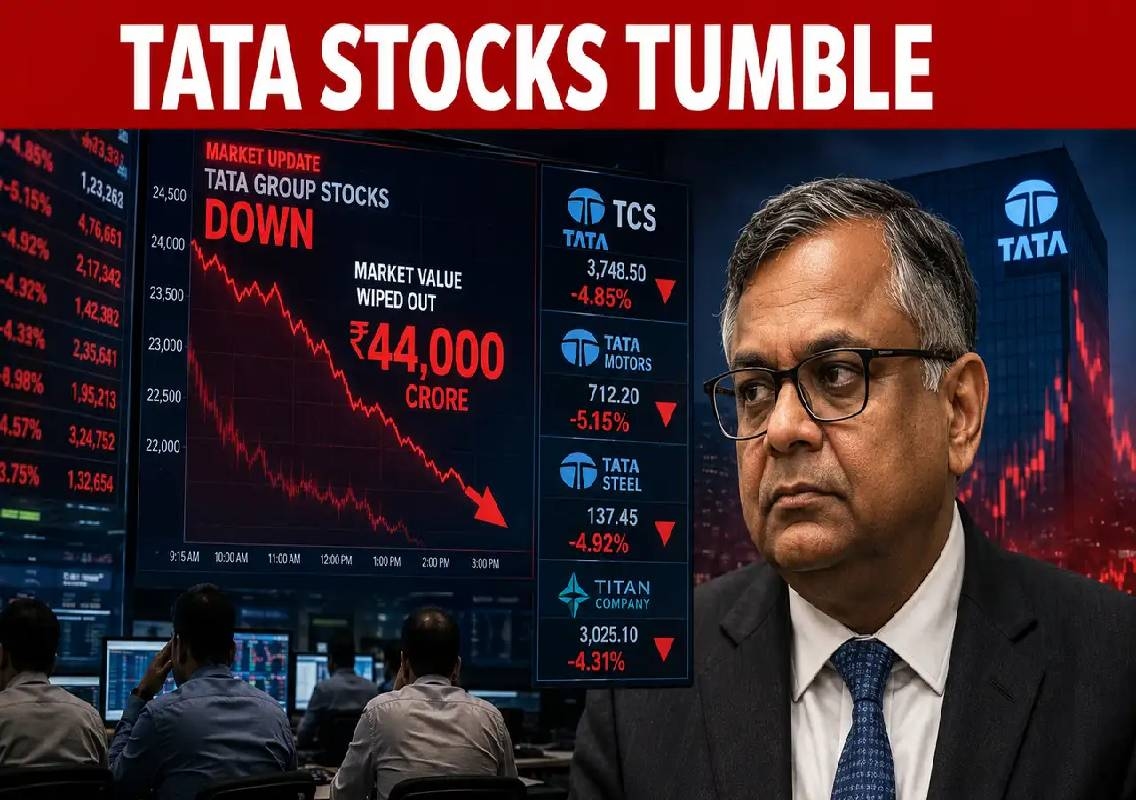


Mumbai: Tata Group stocks came under heavy selling pressure on Wednesday after N Chandrasekaran announced his decision to step down as chairman of Tata Sons, triggering concerns over leadership continuity at one of India’s largest business conglomerates. Shares of several listed Tata companies fell sharply, with losses reaching around 4% in early trading.
The market reaction erased nearly ₹44,000 crore in combined market value across major Tata Group companies, according to the report cited by Times Now News. Tata Consultancy Services (TCS), Titan, Tata Motors and Tata Steel were among the stocks under pressure.
Chandrasekaran’s announcement came just days before the Tata Sons annual general meeting scheduled for August 18, adding to investor uncertainty over the group’s future leadership.
TCS leads Tata stock sell-off
Tata Consultancy Services was among the biggest casualties of the market reaction.
TCS shares fell sharply, with Reuters reporting a decline of about 4.2%, while other reports put the intraday fall at close to 5%. Tata Motors dropped around 2.5%, while Titan and Tata Steel also declined by roughly 2%.
TCS is particularly important to the Tata Group because it is its largest listed company by market capitalisation. A significant movement in TCS therefore has an outsized impact on the combined market value of the group’s listed businesses.
The selling pressure also reflected broader investor concerns rather than a change in the fundamental operations of each individual Tata company.
Why Chandrasekaran’s exit matters
Chandrasekaran has been one of the central figures in the Tata Group’s recent transformation.
He joined the group in 1987 and rose through the ranks of TCS before becoming its chief executive. He was appointed chairman of Tata Sons in 2017, succeeding Ratan Tata.
During his tenure, the group expanded its presence across areas including technology, electric vehicles, semiconductors, aviation and consumer businesses.
His departure therefore represents more than a routine leadership change. Investors are now assessing whether the next Tata Sons chairman will maintain the same strategic direction.
Chandrasekaran will continue until his term ends
Although Chandrasekaran has submitted his resignation, he is not leaving Tata Sons immediately.
Reuters reported that he will continue in the chairman’s role until the end of his current term in February 2027.
This means there will be a transition period rather than an abrupt change in operational leadership.
However, the announcement itself has created uncertainty because the identity and timing of the next chairman will influence the group’s future strategy.
Tata Sons AGM adds to the uncertainty
The development comes ahead of the Tata Sons AGM on August 18.
Chandrasekaran’s reappointment had already been the subject of uncertainty. Reports earlier indicated differences between Tata Sons and Tata Trusts over his proposed continuation.
Tata Trusts holds a 66% stake in Tata Sons, making the relationship between the holding company and the trusts particularly important for leadership decisions.
The leadership question has therefore been closely watched by investors and other Tata Group stakeholders.
Investors worry about leadership continuity
Markets generally dislike uncertainty, particularly when it involves the leadership of a large diversified conglomerate.
Tata Sons oversees a group with businesses spanning information technology, automobiles, steel, consumer products, hotels, aviation, electronics and other sectors.
A change at the top could potentially affect capital allocation, expansion plans and the pace at which the group pursues new businesses.
Investors will consequently be watching for clarity on who succeeds Chandrasekaran and whether the incoming leadership maintains existing strategic priorities.
Several challenges already face the group
The leadership change comes at a time when some Tata businesses are facing their own challenges.
Reuters noted several issues affecting the conglomerate, including regulatory scrutiny following the Air India crash, pricing pressures in the IT services industry and difficulties affecting Jaguar Land Rover following a cyberattack.
These issues have increased the importance of strategic decision-making at the group level.
For investors, the question is therefore not simply who will occupy the chairman’s office, but how the next leadership team will respond to these challenges.
Tata’s diversification offers some cushion
Despite the sharp fall in several shares, the Tata Group remains highly diversified.
Its listed companies operate across multiple sectors, meaning weakness in one business does not necessarily translate into a similar deterioration across the entire group.
TCS remains a major global IT services company, Tata Motors has a substantial automobile business and Titan has a strong presence in jewellery and consumer retail.
Tata Steel, Tata Consumer Products and other listed entities add further diversification.
This means the immediate market reaction should not automatically be interpreted as a deterioration in the underlying performance of every Tata company.
Market reaction reflects uncertainty
The sell-off appears to be driven largely by uncertainty surrounding the leadership transition.
Tata Group stocks were already being influenced by broader market conditions, global economic concerns and sector-specific challenges. Chandrasekaran’s announcement added another layer of uncertainty.
The sharp decline in TCS and other large Tata stocks consequently reflects investors reassessing risk following the leadership development.
What investors will watch next
The biggest question for the market is likely to be the succession process at Tata Sons.
Investors will look for clarity on:
- Who will succeed Chandrasekaran
- Whether the succession plan maintains strategic continuity
- How Tata Trusts and Tata Sons approach the transition
- Whether major expansion projects remain on track
- How the group handles challenges at TCS, Tata Motors and Air India
- Whether the current stock-market reaction continues or reverses
The August 18 AGM could provide further information about the direction of the group.
A significant leadership transition
Chandrasekaran’s departure marks the end of a major phase for the Tata Group.
He took charge after Ratan Tata’s second stint as chairman and oversaw a period in which the conglomerate made major investments in emerging businesses while strengthening existing operations.
His continuation until February 2027 should provide some time for an orderly transition, but investors are likely to remain focused on the succession process.
Conclusion
Tata Group stocks fell sharply on Wednesday after N Chandrasekaran resigned as chairman of Tata Sons, with several major listed companies declining between 2% and 4% and the group’s combined market value falling by nearly ₹44,000 crore, according to reports.
TCS led the decline, while Tata Motors, Titan and Tata Steel also came under pressure. Chandrasekaran will continue as chairman until the end of his current term in February 2027, meaning the development is expected to result in a transition rather than an immediate leadership vacuum.
For investors, the immediate concern is leadership uncertainty. The upcoming Tata Sons AGM on August 18 and the eventual announcement of Chandrasekaran’s successor could therefore remain key triggers for Tata Group stocks in the coming months.