


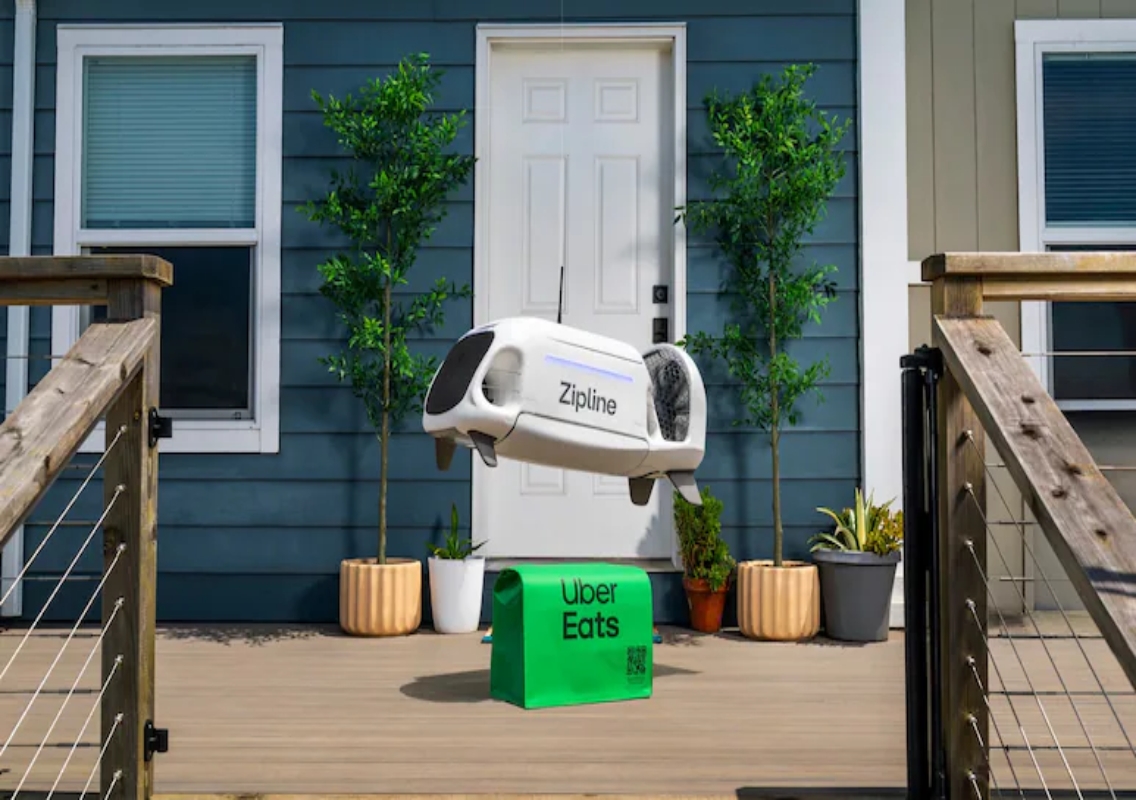


Spring, Texas: Uber Eats has launched commercial food deliveries using autonomous drones in partnership with drone technology company Zipline, introducing a new approach to last-mile delivery in the United States. The aircraft do not land at customers’ homes or buildings. Instead, they hover above the designated delivery area and lower the food in a protective pod attached to a tether.
The service began on November 17 in Spring, a suburb of Houston, Texas. Dallas is expected to be the next launch location as Uber and Zipline prepare to expand their partnership to dozens of additional US cities.
The rollout marks the first commercial launch under the companies’ partnership, announced earlier in 2026. Their longer-term ambition is to achieve one million drone deliveries every day by the end of 2029.
Unlike conventional food delivery, where a rider travels along roads to hand over an order, the new system uses autonomous aircraft to cover the aerial portion of the journey. The tether-based delivery mechanism allows the drone to remain airborne while the package is lowered safely towards the customer.
How the Uber Eats drone delivery system works
The process begins when a customer places an eligible order through the Uber Eats application. Customers living within the active service area can identify participating restaurants through a dedicated drone option on the app.
Once an order is prepared, it is transferred for loading onto a Zipline aircraft. The drone then follows its planned flight route towards the customer’s location.
The aircraft does not need to land at the destination. Instead, it hovers at an altitude of approximately 300 feet and lowers the food package using a tether. The meal is enclosed in a protective pod designed to carry the order down to the designated drop-off area.
After the package reaches the ground, the customer can collect it without the drone having to touch down.
This approach is intended to make deliveries more efficient while avoiding some of the challenges associated with landing aircraft in residential areas. It also reduces the need for a drone to find a suitable landing space at every destination.
Drones can carry orders weighing up to eight pounds
Zipline’s aircraft are designed to carry food orders weighing up to eight pounds, equivalent to approximately 3.6 kg.
According to the reported specifications, the drones can fly at speeds of up to 70 miles per hour and operate at around 300 feet above ground.
The aircraft are designed for longer-range autonomous delivery rather than simply transporting an order a short distance. Their capabilities allow Uber Eats to explore a delivery model in which restaurants and customers can be connected through an aerial network.
The system is not intended to replace every conventional delivery option. It is being introduced as an additional choice for eligible customers and participating restaurants in locations where the service is operational.
Customers can track their orders through the Uber Eats application, which provides information about the delivery process.
Which restaurants are part of the launch?
The initial rollout in the Houston area includes a combination of national restaurant chains and local businesses.
Participating names include Jersey Mike’s and Zaxby’s, along with local restaurants such as Urban Bird and Abu Omar Halal.
The availability of drone delivery depends on the customer’s location and the participating restaurant network. Therefore, not every Uber Eats customer in the Houston region will necessarily be able to select the option.
The dedicated drone icon in the application is intended to show customers whether the service is available to them and which restaurants can fulfil orders through the system.
The expansion to Dallas is expected to provide the companies with an opportunity to test the model in another major urban market before moving into additional US cities.
Uber and Zipline target one million daily deliveries
The commercial launch is part of a much larger ambition shared by Uber and Zipline. The companies aim to scale the service to one million drone deliveries per day by the end of 2029.
Achieving that target would require a substantial expansion of the aircraft fleet, restaurant partnerships, operational infrastructure and approved delivery routes.
Uber is bringing its food-ordering platform and network of restaurant partners to the arrangement, while Zipline provides the autonomous aircraft and delivery technology.
Uber has also invested in Zipline, although the financial details of the investment have not been disclosed.
Zipline recently raised $1.5 billion in a funding round that valued the company at $21.5 billion, reflecting investor interest in autonomous logistics and drone-based delivery networks.
For Uber, the partnership is part of a broader effort to explore technologies that can make deliveries faster and more efficient. The company can use drones alongside conventional couriers rather than relying exclusively on road-based transportation.
Zipline’s journey from medical deliveries to food
Zipline was founded in 2014 and initially focused on transporting medical supplies, including blood, to healthcare facilities.
Its early operations in Rwanda demonstrated how autonomous aircraft could help deliver essential supplies to locations where road transportation was difficult or time-consuming.
The company subsequently expanded its operations and entered the US market. It secured Federal Aviation Administration Part 135 certification in 2022, an important regulatory step for commercial drone delivery operations.
Its partnership with Uber represents a further move into consumer logistics, taking technology developed for time-sensitive deliveries into the restaurant and food services market.
The transition also illustrates how drone delivery companies are seeking to expand beyond specialised healthcare applications and build commercially viable services for everyday consumers.
Competition from Wing and Amazon
Uber and Zipline are entering a market where several major technology companies are developing or expanding drone delivery services.
Alphabet-backed Wing and Amazon’s Prime Air are among the prominent competitors pursuing commercial deliveries using autonomous aircraft.
These companies are exploring ways to reduce dependence on road-based delivery networks and shorten the time required to transport products to customers.
However, the commercial success of drone delivery will depend on more than aircraft speed and payload capacity. Companies must also establish reliable operating networks, secure regulatory permissions and gain public acceptance.
The expansion of drone services into residential neighbourhoods has already raised concerns about noise, privacy, safety and possible disruption to wildlife.
Residents in areas where drone operations are introduced may have questions about aircraft flying over homes, the sound produced by repeated flights and the potential risks associated with equipment operating above populated areas.
These concerns could influence how quickly companies are able to expand their networks.
A new phase for food delivery
The Uber Eats and Zipline rollout demonstrates how autonomous aircraft could become part of the delivery infrastructure used by large online platforms.
The system’s tether-based mechanism is particularly important because it allows food to reach customers without requiring the aircraft to land. It offers a different solution to the challenge of completing the final stage of a delivery in residential areas.
For now, the commercial service is limited to eligible customers in the initial launch region, with Dallas next in line. Its expansion to dozens of cities will depend on operational performance, regulatory requirements and public acceptance.
The target of one million daily deliveries by 2029 is ambitious, but the launch in Texas gives Uber and Zipline an opportunity to test the technology in a live commercial environment.
If the model can be expanded reliably, drone-based food delivery could become another option alongside conventional riders, offering customers a different way to receive restaurant orders.