







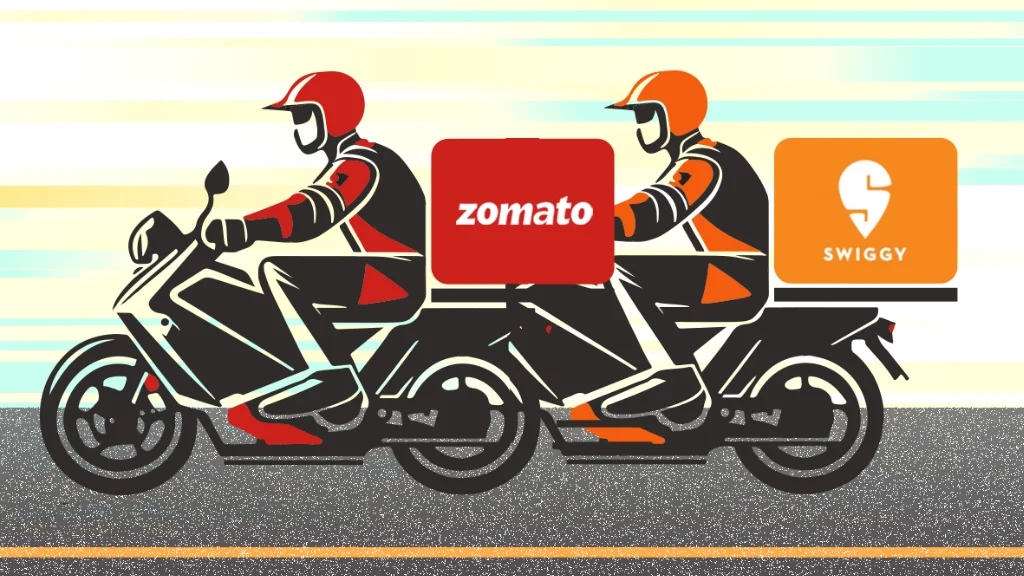


India’s rapidly evolving food delivery ecosystem has once again drawn global attention, after an American entrepreneur publicly expressed astonishment at the speed and efficiency of services offered by platforms such as Swiggy and Blinkit.
For many international travellers, India’s food culture is revealed not only through restaurants, street food, and regional cuisines, but also through the near-instant arrival of meals and daily essentials at their doorstep. This hyper-efficient system, now commonplace in Indian metros, continues to surprise visitors from countries where delivery remains comparatively slower.
‘Blown away’ by six-minute delivery
During his recent visit to India, US-based entrepreneur James Blunt took to social media platform X to share his experience after receiving an order in just six minutes.
“Every time I visit India, the same as when I travel across Europe or the Middle East, there’s one thing that always stands out: the delivery speed is insane in India,” he wrote, tagging Swiggy and Blinkit. “You order something, and it’s at your door in six minutes. I was blown away!”
Blunt contrasted this with his experience in the United States, where he said an Uber Eats order “routinely takes an hour”, prompting him to ask what factors enable such dramatic differences in delivery timelines.
Internet reacts with pride and debate
The post quickly gained traction, sparking thousands of reactions from Indian users and global observers alike. Many Indians responded with pride, noting that ultra-fast delivery has become an integral part of urban life.
“Blinkit has nicely optimised their operations,” one user commented. “They can’t be late even if they wanted to.”
Others, however, highlighted the complexities behind the system. Some users pointed to labour intensity, dense urban clusters, and regulatory conditions as contributing factors, while critics questioned whether such speed is sustainable in the long term.
“Insanely cheap, readily available labour and exploitation-friendly regulations,” one user argued, adding that the model is largely limited to major cities and not reflective of India as a whole.
Questions over freshness and sustainability
A few sceptics also raised concerns about food quality, suggesting that ultra-fast delivery might sometimes rely on pre-prepared meals rather than freshly cooked food.
“The obvious reason is that food is not always prepared after the order,” one comment claimed, suggesting that some kitchens cook in advance to meet time targets.
Others encouraged the entrepreneur to look beyond delivery speed and explore India’s broader cultural and culinary offerings, from traditional cuisine to handicrafts, textiles, and spices.
India’s food-tech edge
Industry experts note that India’s delivery speed advantage stems from a combination of factors:
- High population density, especially in cities like Bengaluru
- Dark stores and micro-fulfilment centres located close to consumers
- Advanced route optimisation algorithms
- A large network of delivery partners enabling rapid order fulfilment
Bengaluru, in particular, has emerged as a testing ground for hyperlocal innovation, with food-tech and quick-commerce platforms continuously refining operations to shave minutes off delivery times.
A defining feature of urban India
While debates over worker welfare, sustainability, and long-term viability continue, ultra-fast delivery has undeniably become a defining feature of India’s urban consumer experience. For visitors, it often serves as a striking symbol of how technology, scale, and operational intensity intersect in Indian cities.
As platforms such as Swiggy and Blinkit expand and experiment further, India’s food delivery ecosystem is likely to remain under global scrutiny—praised for its efficiency, questioned for its costs, and closely watched as a glimpse into the future of hyperlocal commerce