







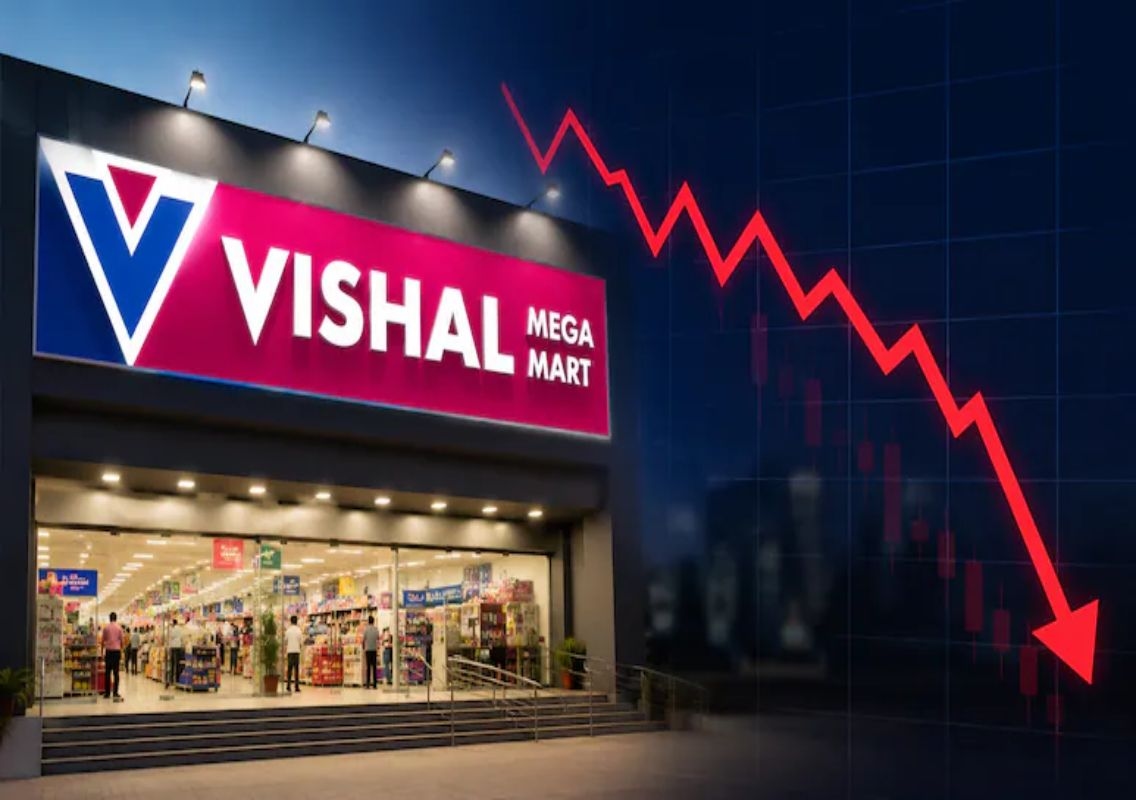


Mumbai: Vishal Mega Mart shares have fallen sharply from their peak despite the value retailer reporting strong growth in revenue and profit during the first quarter of FY27. The stock has declined about 35% from its peak of Rs 158 and is now trading close to its listing price of Rs 104, highlighting a growing disconnect between the company’s operating performance and investor sentiment.
Vishal Mega Mart reported an 18.7% year-on-year increase in revenue to Rs 3,727 crore in Q1FY27, while net profit rose 26% to Rs 259 crore. Same-store sales increased 10%, the company’s own brands continued to account for the bulk of sales and its store network expanded further.
Yet, investors remain concerned about issues beyond the latest quarterly numbers. Promoter selling, uncertainty over the company’s eventual ownership structure and questions surrounding management continuity have weighed on the stock.
Strong Q1 performance fails to lift the stock
Vishal Mega Mart’s June quarter was operationally strong.
Revenue from operations rose 18.7% year-on-year to Rs 3,727 crore, supported by 10% same-store sales growth. The company added new customers at a rate of around 7%-8%, while purchase volumes from existing customers increased 3%.
Profitability also improved.
Gross margin increased 30 basis points to 28.7%. Operating EBITDA rose 19.3% to Rs 387 crore, while the operating EBITDA margin expanded 10 basis points to 10.4%.
Net profit climbed 26% to Rs 259 crore, with net profit margin increasing 30 basis points to 6.9%. However, investors also need to look beneath the headline profit number. Other income almost doubled, rising 94.9% to Rs 33 crore from Rs 17 crore. Excluding the increase in other income, profit growth was around 18%, suggesting that underlying earnings growth was somewhat lower than the reported 26%.
Private labels remain a major strength
One of Vishal Mega Mart’s biggest advantages is its high private-label contribution.
Own brands accounted for 75.2% of revenue during the quarter, with sales from these brands rising 18% to Rs 2,803 crore.
Private labels account for the entire apparel business, around 75% of general merchandise revenue and about 60% of FMCG volumes.
This gives the retailer greater control over sourcing, pricing and margins. It can also help the company compete effectively with national brands, particularly when consumers become more price-conscious.
Apparel remains Vishal Mega Mart’s largest category, contributing 47.4% of revenue, or Rs 1,766 crore. The category recorded same-store sales growth of 13.9% during Q1FY27.
The retailer also has a large loyalty database, with 17.5 crore customers. Around 95% of revenue comes from customers in this database, providing a substantial base for repeat purchases.
Store expansion remains on track
Vishal Mega Mart operated 819 stores across 559 cities as of June 2026.
The company has a particularly strong presence in smaller markets, with 423 stores located in Tier III markets. Its geographical expansion is also continuing, with South India emerging as its fastest-growing region during the quarter.
Revenue from South India increased 33.5% in Q1FY27. The region accounted for 23.4% of the company’s overall revenue, compared with 39.5% from North India and 28.5% from East India.
During the quarter, Vishal Mega Mart opened 27 gross stores, including 10 in South India, resulting in 24 net additions.
Management plans to add around 105-115 net stores every year, indicating that physical expansion remains a central part of its growth strategy.
Smaller stores could open another growth avenue
The company is also testing a smaller store format aimed at towns where a conventional large-format outlet may not be economically viable.
These stores are roughly half the size of its standard outlets, with 16 already operational.
Management believes the format could eventually support as many as 3,000 stores across India. Importantly, the smaller outlets currently generate revenue per square foot and returns on capital comparable with the company’s larger stores.
If those economics remain intact as the format expands, Vishal Mega Mart could potentially reach more markets without significantly compromising returns.
Quick commerce is becoming increasingly important
The company is also building its presence in quick commerce.
Its quick-commerce network had expanded to 767 stores across 520 cities, serving more than 1.4 crore users. Depending on the maturity of individual locations, quick commerce contributes between 2% and 9% of store revenue.
Mature stores generate more than 5% of revenue through the channel, while the best-performing locations reach around 9%-10%.
The average basket value is around Rs 800, broadly similar to the company’s offline stores.
Another potentially important factor is customer acquisition. Around 20% of quick-commerce customers are new to Vishal Mega Mart, meaning the platform is not merely shifting existing customers from physical stores to online ordering. It can also introduce new consumers to the brand.
Promoter selling is a major investor concern
The biggest reason for the stock’s weak performance may lie outside the company’s operating numbers.
Promoter ownership declined significantly, falling from 54.2% in June 2025 to 40.1% in June 2026. The expiry of the lock-in period in July has increased investor focus on the possibility of further selling.
Institutional investors are also concerned about what the company’s ownership structure could look like after private equity investors eventually exit.
This creates uncertainty even when the underlying business is performing well.
Large promoter or private-equity share sales can increase the supply of shares available in the market, potentially putting pressure on the stock price.
The market is therefore looking beyond quarterly earnings and assessing who will own the business and how the shareholder structure will evolve.
Management succession concern gets clarity
Management continuity had also been an overhang for investors.
The long-standing MD and CEO’s previous term had been due to expire in June 2027, raising questions about succession.
However, a significant development has now reduced that uncertainty. Vishal Mega Mart has extended the CEO’s tenure for another five years, through August 2031.
This provides greater visibility over management continuity and removes the immediate succession concern.
The development could therefore help address one of the issues that had previously weighed on investor sentiment.
However, promoter ownership and the eventual exit of private equity investors remain important factors for the stock.
Valuation is still not cheap
Another factor investors are considering is valuation.
Vishal Mega Mart currently trades at around 53.8 times earnings, according to the NDTV Profit analysis. That is below Avenue Supermarts at 84 times and Baazar Style at 122 times, but above or broadly comparable with other value-retail peers such as V-Mart and V2 Retail.
The valuation suggests that the stock is not necessarily being punished simply because investors believe the business is weak.
Instead, the discount compared with some premium retail peers appears to reflect concerns about ownership, promoter selling and the future structure of the company.
For investors, the key question is whether Vishal Mega Mart’s growth can continue strongly enough to compensate for those uncertainties.
What the market may be missing
The contrast between the company’s operations and its share price is striking.
On one side, Vishal Mega Mart has delivered double-digit revenue growth, 10% same-store sales growth, strong private-label penetration, expanding stores and a growing quick-commerce business.
On the other, the stock remains well below its peak.
This suggests that the market is assigning significant importance to shareholder and governance-related factors rather than focusing exclusively on quarterly earnings.
The business also faces the broader challenges of Indian retail, including intense competition, changing consumer behaviour and the rapid expansion of quick-commerce platforms.
Vishal Mega Mart’s ability to maintain store-level economics while expanding rapidly will therefore remain important.
Its private-label model could support margins, but the company will need to demonstrate that growth remains sustainable as its store base becomes larger.
Outlook for investors
The stock’s future performance is likely to depend on whether the company’s strong operating momentum continues and whether the ownership overhang gradually clears.
Continued same-store sales growth, successful store additions and stronger contribution from smaller formats could support earnings.
The quick-commerce network provides another potential growth engine, particularly if the company can continue attracting new customers through the platform.
At the same time, further promoter selling could keep the stock under pressure.
The recent extension of the CEO’s tenure through August 2031 is a positive development because it removes near-term succession uncertainty. But investors will continue to monitor the eventual ownership structure and private equity exits.
Conclusion
Vishal Mega Mart’s falling share price does not appear to reflect a deterioration in its core business. The retailer delivered 18.7% revenue growth and 26% reported profit growth in Q1FY27, while same-store sales, private-label sales and store expansion remained strong.
The market’s caution instead appears to be centred on promoter selling, ownership uncertainty and valuation. Promoter holding has already fallen considerably, while investors remain watchful of further changes in the shareholder structure.
The extension of the MD and CEO’s tenure through August 2031 provides welcome clarity on management continuity.
For the stock to regain investor confidence, strong operating growth will need to continue while concerns over ownership gradually ease. The central question is no longer simply whether Vishal Mega Mart can grow, but whether it can sustain that growth strongly enough to overcome the market’s concerns about its shareholder structure.