







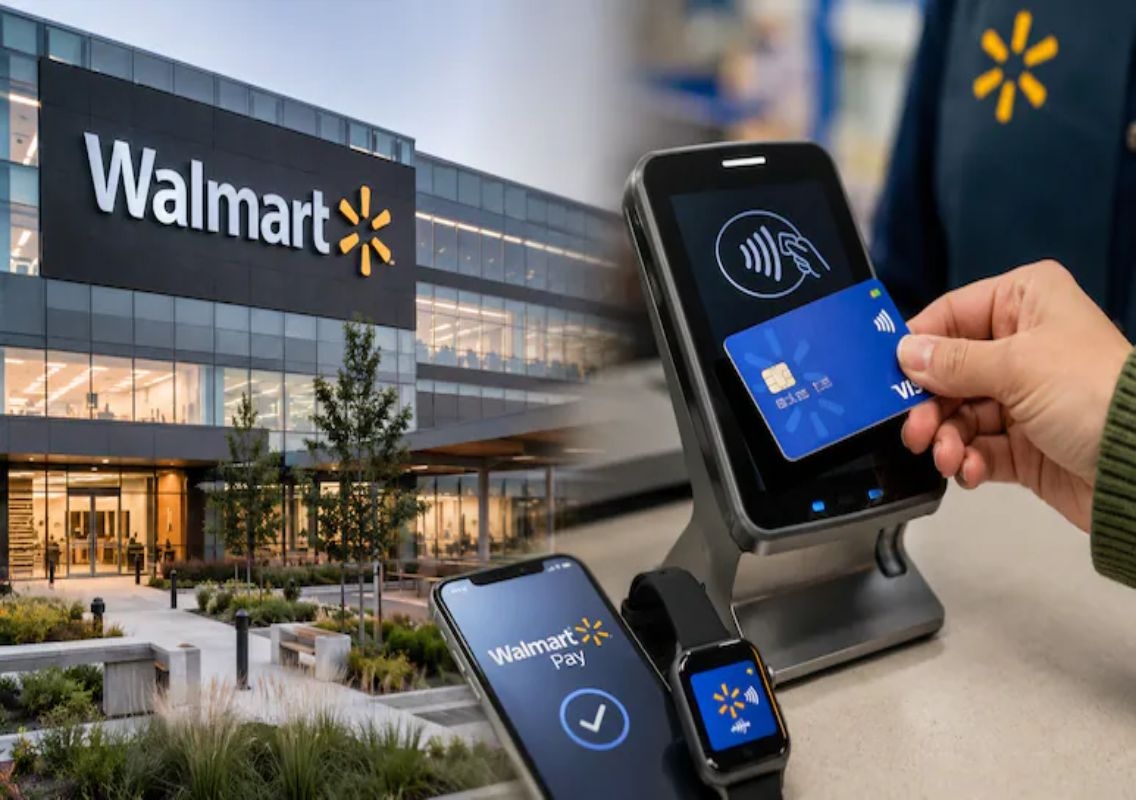


Bentonville: Walmart is set to introduce tap-to-pay facilities across its stores in the US, allowing customers to make purchases using contactless cards, smartphones and smartwatches. The retail giant will begin rolling out the feature at select Walmart and Sam’s Club locations from August 24, with the service expected to reach all US stores and clubs by the end of 2026.
The move marks a significant expansion of Walmart’s payment options as the retailer looks to make checkout faster and more convenient. Customers will be able to tap eligible contactless cards, phones and smartwatches at checkout instead of inserting or swiping a physical card.
Walmart will also allow customers to add eligible Walmart, Sam’s Club and OnePay cards to supported digital wallets, further expanding the ways shoppers can pay for purchases.
Tap-to-pay rollout begins in August
The new contactless payment facility will start appearing at selected Walmart and Sam’s Club locations from August 24.
The rollout will then expand gradually, with Walmart targeting coverage across all its US stores and clubs by the end of 2026. The company has not indicated that the initial launch will replace any of its existing payment methods.
Instead, tap-to-pay will operate alongside options such as cash, traditional credit and debit card payments and Walmart Pay.
Customers with compatible contactless cards will simply be able to tap their cards against the payment terminal. Those using smartphones or smartwatches can similarly use supported digital wallets to complete transactions.
The change is expected to be particularly useful for shoppers who prefer mobile payments or routinely carry digital versions of their cards.
Smartphones and smartwatches get a bigger role
One of the key aspects of Walmart’s new system is its support for smartphones and smartwatches.
Contactless payments have become increasingly common among consumers who use digital wallets instead of carrying physical cards. By supporting these devices, Walmart is aligning its in-store checkout experience with the payment habits of customers who increasingly rely on connected devices.
Eligible Walmart, Sam’s Club and OnePay cards can also be added to digital wallets, giving customers another way to access their payment credentials while shopping.
The facility could also reduce the time customers spend at checkout, particularly at busy stores where queues can build up during peak shopping periods.
For Walmart, faster payments fit into a wider strategy focused on convenience across its physical stores and digital platforms.
Walmart to retain existing payment options
Despite the introduction of tap-to-pay, Walmart is not eliminating its existing payment methods.
Customers will continue to have access to cash, credit cards and Walmart Pay, among other options. This means shoppers can choose the payment method that best suits them instead of being required to use contactless technology.
The approach could also help Walmart manage the transition towards greater adoption of contactless payments without disrupting customers who prefer traditional methods.
The retailer’s strategy effectively adds another layer to its existing payment ecosystem rather than replacing it entirely.
Tap-to-pay coming to fuel stations
Walmart also plans to expand the contactless payment facility beyond store checkouts.
The company expects to introduce tap-to-pay at its fuel stations by the middle of 2027.
The move could be particularly significant for customers making quick fuel purchases, where reducing the number of steps required at payment terminals can make the overall experience more convenient.
The planned fuel-station rollout also indicates that Walmart sees contactless payments as a broader part of its retail infrastructure rather than simply a feature for supermarket checkouts.
Convenience becomes a bigger focus
Walmart’s decision comes as the retailer continues to invest heavily in speed and convenience across its physical and online businesses.
The company’s US e-commerce sales rose 24% in the second quarter, helped by store-fulfilled delivery, advertising and its online marketplace. Sam’s Club US e-commerce sales increased 26%, supported by growth in pickup and delivery.
Walmart International also recorded a 19% increase in e-commerce sales during the quarter, driven by store-fulfilled pickup and delivery.
The figures underline the importance of convenience in Walmart’s strategy. The company is increasingly combining its extensive physical store network with digital services to make shopping faster and more flexible.
Tap-to-pay fits naturally into that strategy by reducing friction at one of the final stages of the shopping journey.
Walmart reports strong second-quarter revenue
The payment expansion comes after Walmart reported strong financial performance for its second quarter.
The retailer reported revenue of $187.9 billion, representing a 5.9% increase from the same period a year earlier. Walmart also raised its fiscal-year outlook following the quarterly performance.
Walmart President and CEO John Furner said the company’s online growth demonstrated that customers were responding to its focus on price, speed and convenience.
The strong performance of its e-commerce operations provides an important backdrop to the company’s investment in new payment technology.
As more customers use Walmart’s online and omnichannel services, the company is looking for ways to make the entire shopping journey more seamless, from product discovery and ordering to collection, delivery and payment.
Financial services form another part of Walmart’s strategy
Walmart’s payment push is also connected to its wider expansion into financial services.
The retailer is developing financial products and services designed to help customers save money, build credit and pay for purchases over time.
Sam’s Club members already have access to services such as Sam’s Cash and Sam’s Club credit.
The addition of contactless payments could therefore strengthen an ecosystem in which Walmart is not only selling products but also providing customers with more ways to manage and complete their purchases.
The ability to add eligible Walmart, Sam’s Club and OnePay cards to digital wallets is another example of this integration.
Competition in digital payments
Walmart’s move also reflects the broader growth of digital and contactless payments in the US retail sector.
Consumers increasingly expect retailers to support payment methods that are quick and easy to use. Contactless cards and mobile wallets have become an important part of this shift, particularly as smartphones and smartwatches have become everyday payment devices.
For major retailers, payment convenience can influence the overall shopping experience.
A customer may spend considerable time selecting products, only to face a long checkout process. Reducing the payment time can therefore improve the final stage of the customer journey.
Walmart’s large US store network gives the company an opportunity to make contactless payments available to millions of shoppers once the rollout is complete.
A wider digital retail strategy
The tap-to-pay launch should be viewed as part of Walmart’s wider digital transformation rather than as an isolated payment update.
The company has been investing in e-commerce, store-fulfilled delivery, pickup services, advertising and its marketplace. Its international operations are also increasingly connected to digital shopping and fulfilment.
By adding contactless payments to its physical stores, Walmart is effectively bringing another part of the in-store experience in line with the speed customers have come to expect from digital services.
The expansion could also make Walmart’s physical stores more competitive with retailers that have already embraced widespread contactless payment technology.
What customers can expect
For shoppers, the main change will be a simpler payment process.
Once the feature becomes available at a particular location, customers with eligible contactless cards will be able to tap their cards at checkout. Those using compatible smartphones and smartwatches will also be able to make payments through supported digital wallets.
Customers will not have to abandon Walmart Pay or other existing payment methods. The new facility will simply provide an additional option.
The rollout will begin at selected locations before expanding to Walmart and Sam’s Club stores across the US by the end of 2026.
Fuel stations are expected to receive the capability later, with Walmart targeting the middle of 2027 for that expansion.
Conclusion
Walmart is preparing to bring tap-to-pay payments to its US stores, allowing customers to use contactless cards, smartphones and smartwatches at checkout. The rollout will begin at selected Walmart and Sam’s Club locations from August 24 and is expected to reach all US stores and clubs by the end of 2026.
The retailer will continue supporting cash, traditional cards and Walmart Pay, meaning contactless payments will be an additional choice rather than a replacement for existing methods. Walmart also plans to support its eligible cards through digital wallets and introduce tap-to-pay at fuel stations by mid-2027.
The move comes as Walmart focuses increasingly on speed and convenience across its physical and digital businesses. With US e-commerce sales rising 24% in the second quarter and total quarterly revenue reaching $187.9 billion, the company is continuing to invest in technologies that can make shopping more seamless.