







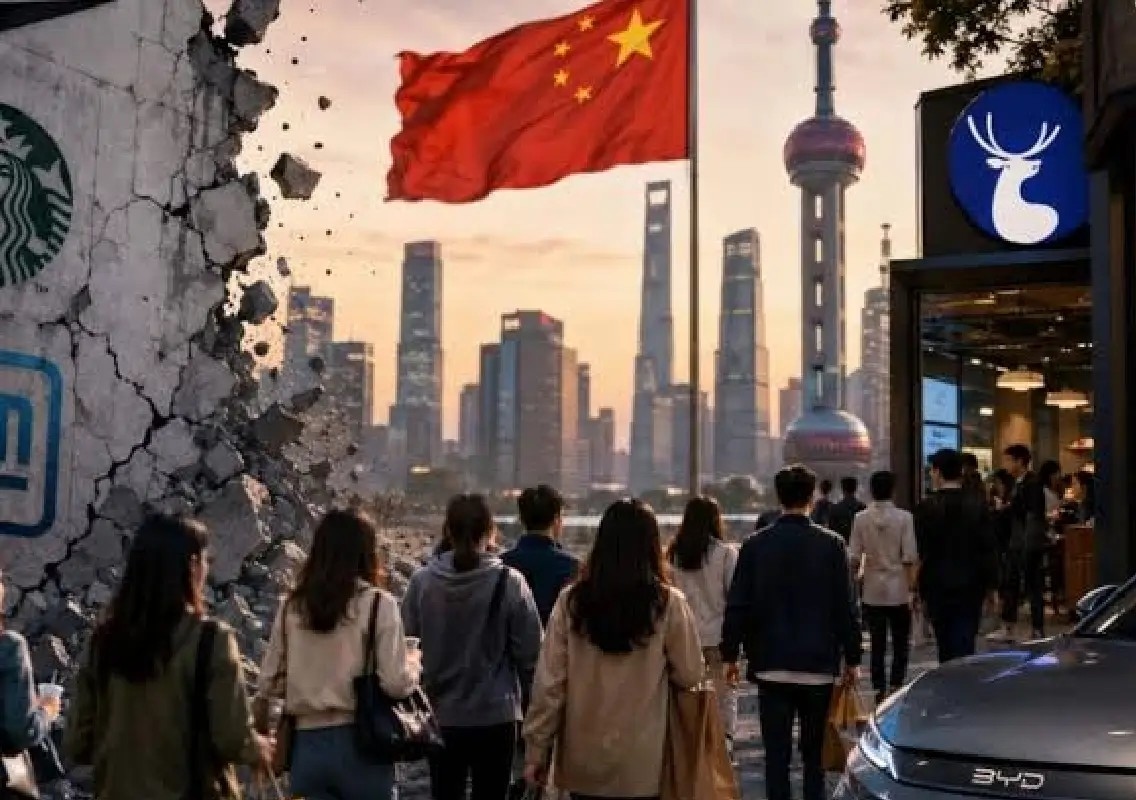


China was once a dependable growth engine for major American consumer companies, with rising incomes and demand for international brands helping businesses expand rapidly. That formula, however, is becoming less reliable as domestic Chinese companies grow more competitive and consumers become increasingly conscious of value.
The shift is visible across industries. Nike is struggling against local sportswear brands, Starbucks faces aggressive competition from Chinese coffee chains, and General Motors has been hit by the rapid rise of domestic electric vehicle makers.
Chinese brands are moving faster
Weaker consumer confidence and the prolonged property downturn have made Chinese shoppers more cautious. As spending slows, consumers are increasingly questioning whether international brands offer enough value to justify premium prices.
Local companies often have an advantage through faster product development, strong distribution networks and a deeper understanding of changing consumer preferences.
Nike faces growing pressure
Nike’s China business has reportedly contracted by about 30 per cent since 2021, even as the country’s sportswear market has expanded substantially over the past decade.
Domestic rivals Anta and Li Ning have benefited from agile supply chains, extensive retail networks and products tailored to Chinese consumers. Nike’s Greater China revenue has declined for six consecutive quarters, although the market still accounts for roughly 15 per cent of its global revenue.
Adidas, meanwhile, has returned to sustained growth after increasing locally designed products and adapting its strategy to Chinese preferences.
Starbucks confronts a new coffee economy
Starbucks is facing similarly strong competition. Luckin Coffee now has more than three times as many stores in China as Starbucks, using lower prices and a digital-first model to attract consumers.
The pressure has led Starbucks to agree to sell control of its China operations to Boyu Capital, which will hold a 60 per cent stake. The company has described the new approach as an effort towards greater “hyper-localization”.
China’s car market shows a bigger shift
The transformation is even more pronounced in automobiles. General Motors’ earnings from China have fallen from around $2 billion annually in 2018 to losses in 2024 and 2025.
Chinese electric vehicle companies such as BYD and Geely have rapidly expanded, with new-energy vehicles accounting for more than 65 per cent of new passenger car sales in July, according to the figures cited in the source.
Chinese manufacturers are now also expanding overseas, turning competition in China into a global challenge for established Western carmakers.
Some foreign brands are still finding success
The changing market does not mean foreign companies cannot succeed. Lululemon expects around 20 per cent growth in China this year, while Ralph Lauren recently reported 40 per cent growth.
The difference appears to lie in localisation. Companies that employ strong local teams, develop products specifically for Chinese consumers and adapt quickly can still find opportunities.
China remains one of the world’s largest consumer markets. But international reputation alone is no longer enough. Increasingly, success depends on how well a brand understands local consumers, delivers value and responds to one of the world’s most competitive markets. #China #AmericanBrands #Nike #Starbucks #GM #ChineseEconomy #Business