







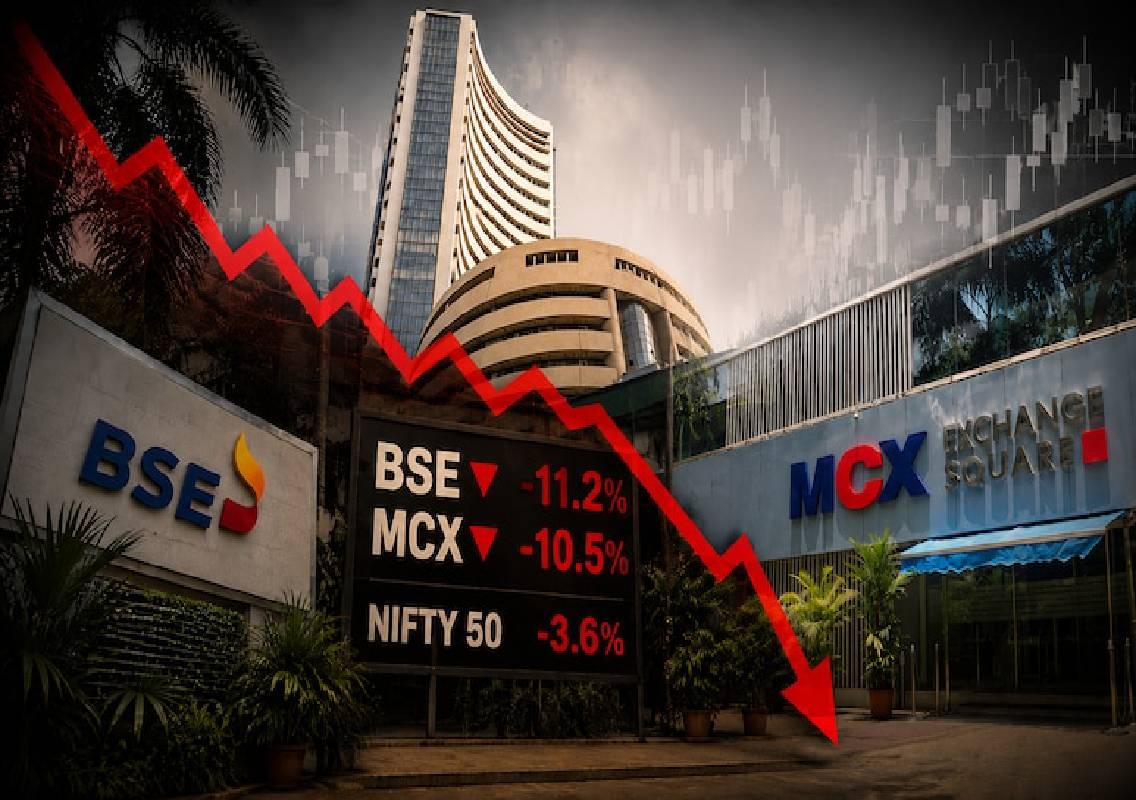


Mumbai: Shares of BSE Ltd. and Multi Commodity Exchange of India Ltd. (MCX) have underperformed the broader market since June as concerns grow over declining derivatives trading volumes following the Reserve Bank of India’s (RBI) new funding framework.
Since June, BSE shares have fallen 11.2 per cent, while MCX has declined 10.5 per cent, compared with a 3.6 per cent drop in the Nifty 50 index. The weakness follows a sharp fall in options premium turnover after the RBI’s revised rules came into effect on July 1.
RBI framework tightens liquidity
The RBI’s new framework introduced significant changes to funding for brokerages. Banks are no longer permitted to finance proprietary trading desks of brokers, while all trading exposures now require 100 per cent collateral.
These measures have tightened liquidity in the market, forcing algorithmic and high-frequency traders to reduce leverage. As a result, derivatives trading activity has slowed considerably.
Premium turnover records sharp decline
The slowdown is reflected in trading data across major exchanges.
On BSE, expiry-day premium turnover declined 11.4 per cent in July to Rs 54,702 crore from Rs 61,729 crore in June. Compared with the average turnover of Rs 69,411 crore in the first quarter of FY27, July’s figure was down 21.2 per cent.
The National Stock Exchange (NSE) also witnessed a 14.3 per cent month-on-month decline, with expiry-day premium turnover falling to Rs 33,309 crore from Rs 38,873 crore in June.
During the first week of July, BSE’s premium turnover dropped 10 per cent from June levels and 20 per cent compared with the quarterly average. NSE recorded declines of 24 per cent and 27 per cent, respectively, while MCX witnessed the sharpest fall, with premium turnover down 43 per cent from June and 39 per cent from the Q1 average.
Why investors are concerned
Derivatives have become the primary revenue driver for Indian stock exchanges. According to brokerage Jefferies, derivatives contributed nearly 70 per cent of the operating revenue of Indian exchanges during FY26.
With transaction charges from options trading accounting for a significant share of earnings, any sustained decline in trading volumes could directly impact revenue growth for listed exchanges such as BSE and MCX.
Jefferies also noted that India’s options market has expanded rapidly in recent years, making derivatives increasingly important to exchange profitability. However, tighter regulations and reduced liquidity are now slowing the pace of growth.
Market outlook
Investors are closely monitoring how trading volumes evolve in the coming months. If liquidity conditions remain tight and leveraged participation continues to decline, exchange earnings could face further pressure despite stable broader equity markets.
While the long-term outlook for India’s capital markets remains positive, analysts believe listed exchange stocks may remain volatile until derivatives trading activity shows signs of recovery.