







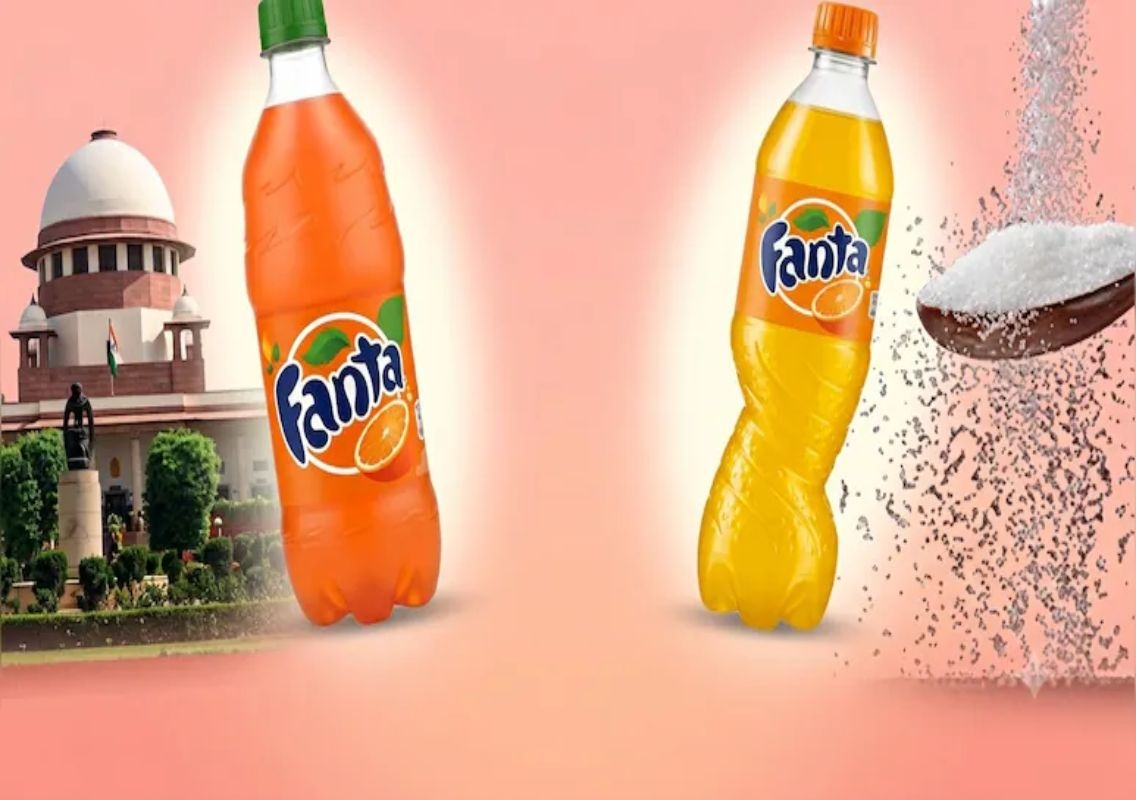


New Delhi: Fanta sold in India has reportedly been found to contain around three times as much sugar as its UK counterpart, once again drawing attention to differences in the formulation of packaged food and beverages across countries. Food Safety Educator Urvashi Agarwal has explained that the difference is not simply about the ingredients chosen by manufacturers, but also about the regulatory environment in which products are sold.
A key factor, according to Agarwal, is the UK’s Soft Drinks Industry Levy, commonly referred to as the UK’s sugary drinks or “cold drink” tax. The levy creates a direct financial incentive for manufacturers to reduce the amount of sugar in beverages because products with higher sugar levels attract higher tax.
The comparison has also renewed questions about whether Indian consumers receive packaged products with different nutritional compositions from those sold in markets such as the UK and Australia.
UK’s sugary drinks tax encourages reformulation
Agarwal said the difference in sugar content needs to be understood in the context of taxation and regulation.
Under the UK’s soft drinks levy, manufacturers have a financial reason to reduce sugar in beverages. The higher the sugar content, the greater the tax liability, creating an incentive to reformulate products with less sugar.
This does not necessarily mean that manufacturers are making healthier products purely out of consumer interest. Instead, taxation can influence the economics of formulation.
When reducing sugar helps a manufacturer avoid a higher levy, lowering sugar can become commercially attractive while also changing the nutritional profile of the product.
India does not currently have an equivalent tax structure that creates the same direct financial incentive for beverage makers to reduce sugar levels, according to the expert quoted by NDTV Profit.
Fanta India reportedly contains three times more sugar
The immediate comparison involves Fanta.
According to the NDTV Profit report, Fanta sold in India has reportedly been found to contain around three times the sugar content of its UK counterpart. The Indian product also contains an artificial colourant that is disclosed in the product’s fine print.
The difference has prompted wider discussion about how multinational brands formulate products for different markets.
A product carrying the same or a similar brand name does not necessarily have an identical recipe in every country. Manufacturers can alter ingredients and nutritional composition depending on local regulations, taxation, consumer preferences, ingredient availability and production requirements.
Therefore, the comparison between Fanta in India and the UK illustrates a broader issue surrounding global packaged food products.
It’s not only about Fanta
Agarwal pointed out that differences in product formulation extend beyond soft drinks.
She cited Maggi as another example. Maggi sold in India uses palm oil, while some India-made Maggi products exported to the UK carry front-of-pack warnings highlighting high salt content. Differences have also been highlighted in KitKat sold in India and Australia, including variations in cocoa content.
Such differences can lead consumers to question why products from the same international brands may have different ingredients or nutritional profiles depending on where they are sold.
However, the presence of a different formulation does not by itself mean that a product is illegal or non-compliant in India.
Products sold in India are required to comply with the country’s food safety and labelling regulations. The larger concern raised in the debate is whether consumers are being given sufficiently clear information to understand what they are buying.
Affordability is another challenge
The debate over healthier formulations also involves the issue of affordability.
Agarwal noted that some brands are introducing products with better ingredients and cleaner labels, but questioned whether such products are affordable for a large section of Indian consumers.
This creates a difficult policy challenge.
Stricter nutritional standards or clearer warning labels can help consumers identify products containing high levels of sugar, salt or fat. However, if healthier alternatives are significantly more expensive, lower-income consumers may have fewer practical choices.
Therefore, improving food quality and transparency cannot be considered only as a regulatory issue. Price and accessibility also play an important role.
India reviews front-of-pack warning labels
The Fanta comparison comes at a time when India’s food labelling framework is facing renewed scrutiny.
The Supreme Court has asked the Food Safety and Standards Authority of India (FSSAI) to examine stronger front-of-pack warning labels. Such labels could make information about high levels of sugar, salt and fat more visible to consumers.
Currently, consumers often need to turn a packaged product around and examine the nutritional information and ingredient list to understand its composition.
Front-of-pack warnings would make important nutritional information more prominent.
For example, instead of requiring shoppers to study a detailed nutrition panel, a prominent warning could immediately indicate that a product contains a high level of a particular nutrient.
Food industry raises concerns
The proposed changes have also faced opposition from the food industry.
Industry representatives have argued that prominent warning labels could influence how consumers perceive products and potentially affect sales.
For manufacturers, changes to labelling requirements can also increase compliance and packaging costs.
For regulators, however, the objective is to make nutritional information easier for consumers to understand and compare.
The debate therefore involves competing priorities: consumer awareness, public health, industry costs and freedom of choice.
Why the UK model matters
The UK’s soft drinks levy offers an example of how government policy can influence product formulation without directly banning sugary beverages.
Manufacturers remain free to sell products, but the tax structure changes the financial calculation associated with different sugar levels.
That can encourage companies to reformulate products below certain sugar thresholds.
From a consumer perspective, this can mean that products available on supermarket shelves contain less sugar than comparable products in countries where similar incentives do not exist.
However, taxation is only one part of the UK’s wider approach to food and nutrition policy. Product labelling, consumer awareness and industry reformulation also contribute to the overall environment.
What Indian consumers should check
Until stronger front-of-pack warnings are introduced, consumers in India can use the information already provided on packaged products.
Checking the nutrition panel and ingredient list can help identify the amount of sugar and other nutrients in a beverage.
Consumers should also remember that brand names alone do not guarantee identical formulations across countries. The same product category can have different ingredients and nutritional values depending on the market.
The Fanta comparison is therefore a reminder to check the label rather than assume that an international brand has exactly the same formulation everywhere.
A wider debate over packaged food
The controversy surrounding Fanta is part of a much larger conversation about packaged food in India.
As consumers become more aware of sugar, salt, fat and additives, differences between products sold in India and overseas are attracting greater attention.
Regulators are under increasing pressure to ensure that consumers can make informed decisions without having to decipher complicated ingredient lists.
At the same time, manufacturers are likely to weigh the cost of reformulation, taxation and labelling requirements against consumer demand and competitive pressures.
The eventual policy direction could influence how beverages and packaged foods are formulated and marketed in India.
Conclusion
The reported difference in sugar levels between Fanta sold in India and the UK has highlighted how regulation and taxation can influence the formulation of popular packaged beverages. According to Food Safety Educator Urvashi Agarwal, the UK’s Soft Drinks Industry Levy gives manufacturers a financial incentive to reduce sugar because higher-sugar drinks face a higher tax burden.
Fanta sold in India has reportedly been found to contain around three times the sugar of its UK counterpart, while differences have also been highlighted in products such as Maggi and KitKat. These variations do not automatically indicate that products are illegal in India, as they must comply with Indian food safety and labelling rules.
The issue comes as India considers stronger front-of-pack warning labels for products high in sugar, salt and fat. If implemented effectively, such warnings could make nutritional information easier for consumers to understand and compare.
Ultimately, the debate is not simply about why one bottle of Fanta contains more sugar than another. It raises broader questions about taxation, food regulation, affordability, transparency and how governments can encourage healthier choices while ensuring consumers have clear information.