







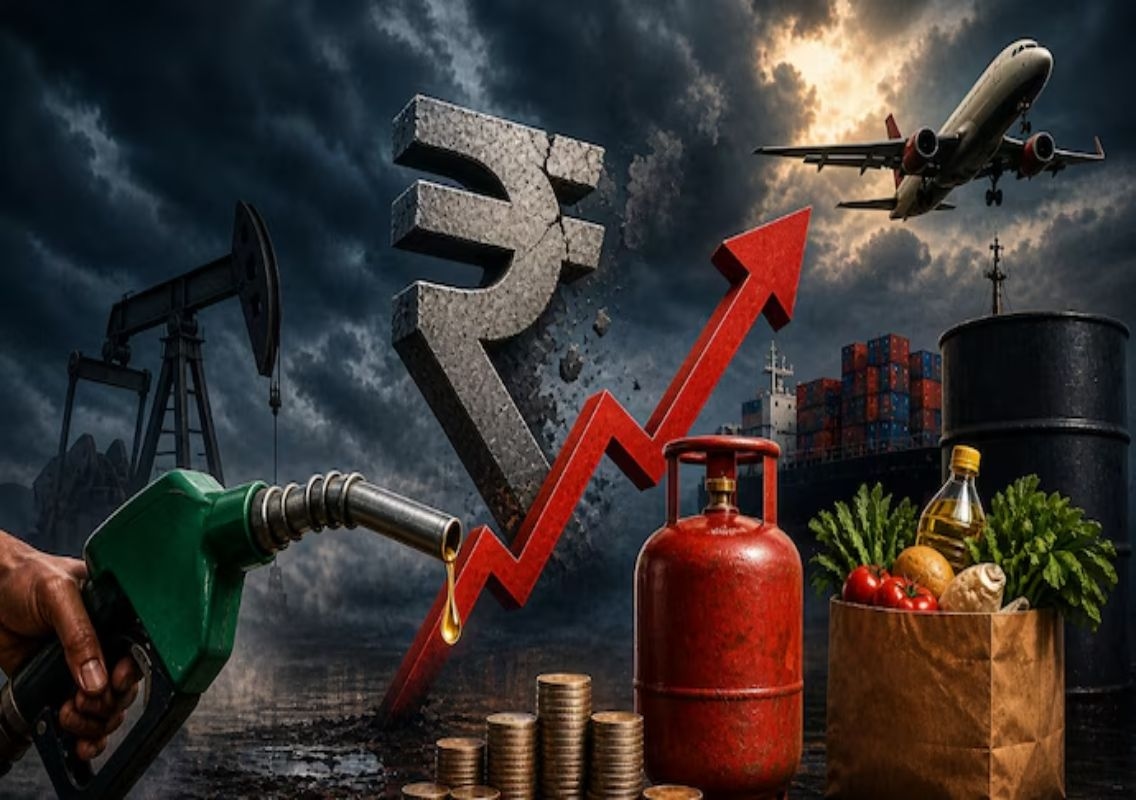


New Delhi: A combination of rising global oil prices, a weakening rupee and uncertain monsoon prospects is creating a challenging economic environment for India. While there has been no immediate sharp spike in retail fuel prices, underlying pressures are building across sectors, raising concerns that household expenses could rise simultaneously in the coming months.
Experts caution that it is not a single factor but the convergence of multiple risks that makes the current situation significant. This overlap could push up inflation, limit policy flexibility and even raise concerns of a mild stagflation scenario.
Multiple pressures are converging at once
India has faced oil shocks, currency depreciation and weak monsoons in the past. However, economists point out that the current concern lies in these factors occurring at the same time.
Rising crude oil prices are increasing India’s import bill, while the rupee’s decline is making imports more expensive. At the same time, any shortfall in monsoon rainfall could disrupt agricultural output and tighten food supply.
These factors do not operate independently. Instead, they reinforce each other, creating a cycle where inflationary pressures spread across sectors.
How rising oil prices affect daily costs
Oil prices play a central role in India’s inflation dynamics. Even when petrol and diesel prices remain stable for consumers, higher crude prices impact the economy in multiple indirect ways.
Transport costs increase, leading to higher prices for goods, including food items and packaged products. Industries that depend on fuel also pass on higher costs to consumers over time.
Signs of this are already visible. Commercial LPG prices have been raised significantly, and sectors like aviation are warning of higher fuel costs. This indicates that the pressure is gradually moving through the system.
Weak rupee adds another layer of inflation
The depreciation of the rupee further complicates the situation. A weaker currency increases the cost of imports, including crude oil, fertilisers and edible oils.
As import costs rise, businesses often pass on the additional burden to consumers. This contributes to broader inflation, affecting everything from fuel to household goods.
Currency weakness can also impact investor sentiment and capital flows, adding to economic uncertainty.
Monsoon risks could push food prices higher
Agriculture remains heavily dependent on the monsoon in India. Any shortfall or uneven distribution of rainfall can reduce crop output and disrupt supply chains.
If the monsoon underperforms, food inflation could rise sharply. This would particularly affect essential items such as vegetables, cereals and pulses, which form a significant part of household expenditure.
The combination of higher fuel costs and food inflation could create a situation where overall living costs increase across the board.
Is stagflation a real concern?
Economists are closely watching the possibility of a mild stagflation scenario — a situation where inflation rises while economic growth slows.
High oil prices can reduce consumer demand, while a weak rupee may discourage investment. At the same time, poor monsoon conditions can impact rural incomes and consumption.
While India is not currently in a stagflation phase, the risk is gradually increasing if these factors persist.
Limited policy options for the government
Managing such a situation is complex, as policy responses often involve trade-offs.
Raising interest rates can help control inflation but may slow down economic growth. Reducing taxes or increasing subsidies can ease the burden on consumers but may strain government finances.
Supporting the rupee requires the use of foreign exchange reserves, which are finite. As a result, policymakers must strike a careful balance between controlling inflation and sustaining growth.
What it means for households
For consumers, the impact is likely to be gradual rather than sudden. Household budgets may come under pressure as essential expenses increase over time.
Rising costs of fuel, food and daily necessities could reduce disposable income, forcing families to cut back on discretionary spending or shift to more affordable alternatives.
This “slow squeeze” may not feel like a crisis initially, but its cumulative effect can significantly impact financial well-being.
Oil remains the biggest risk factor
Among all the variables, crude oil prices remain the most critical. India is heavily dependent on oil imports, making it vulnerable to global price fluctuations.
Higher oil prices not only drive inflation but also widen the current account deficit and weaken the rupee, creating a chain reaction across the economy.
With geopolitical tensions still influencing global energy markets, oil prices will be a key factor to watch in the coming months.
Not a crisis, but a phase to watch closely
Despite these challenges, India’s economy retains certain strengths, including steady domestic demand, ongoing government spending and a relatively stable financial system.
However, economists warn that the margin for error is narrowing. The current situation requires careful monitoring and calibrated policy responses.
Conclusion
The possibility of petrol, food and other essentials becoming costlier together stems from a rare convergence of economic pressures rather than a single trigger.
While the situation is not yet a crisis, the combined impact of rising oil prices, a weaker rupee and monsoon risks could lead to a broad-based increase in living costs. For households, this may translate into a gradual tightening of budgets in the months ahead.