


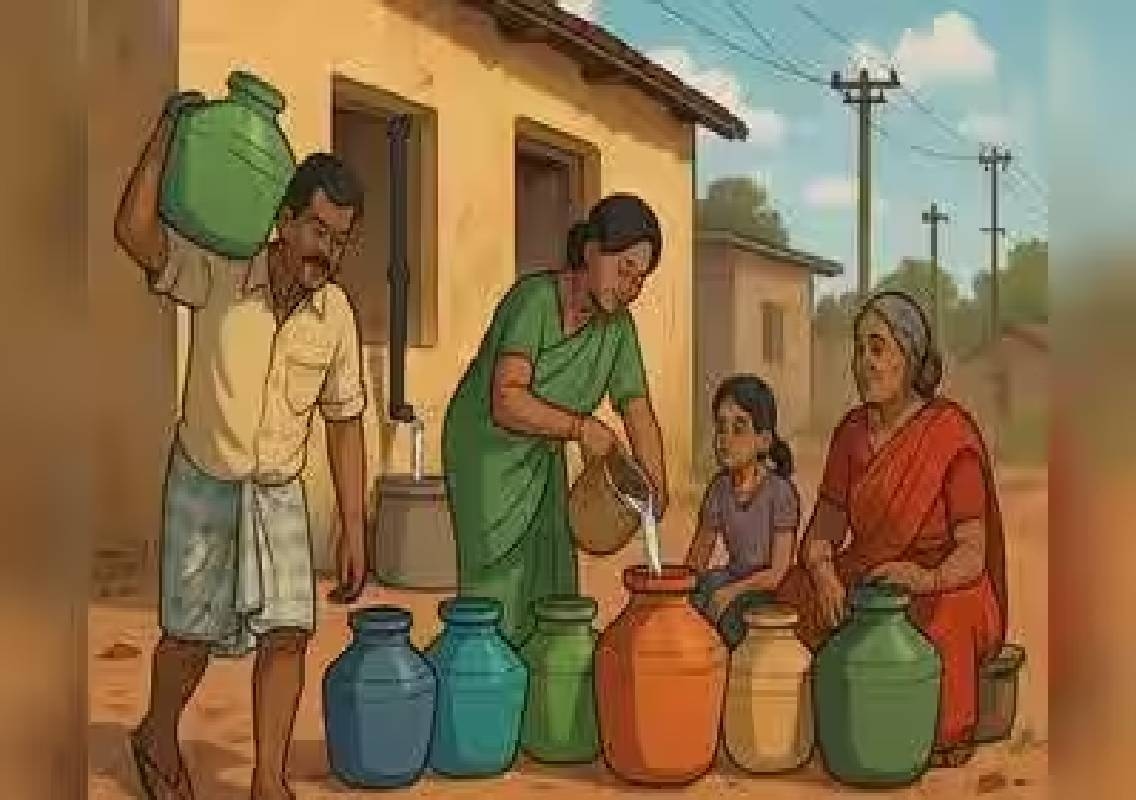


Chamarajanagar: Residents of several wards in Chamarajanagar town are facing an acute drinking water shortage, with water supply reduced to just once a week in some areas. The irregular schedule has forced families to store water for cooking, bathing and sanitation, raising concerns over hygiene, contamination and mosquito breeding. Households with children, elderly members and working professionals say managing daily needs has become increasingly difficult.
The situation has persisted despite efforts by the Chamarajanagar City Municipal Council (CMC) to repair damaged pipelines, plug leakages, reduce distribution losses and rectify problems at pumping stations. Residents have also sought increased tanker supply and clearer information from authorities on measures being taken to address the shortage.
Several wards receive water only once a week
The crisis is particularly severe in densely populated Ward No. 26, where residents say they currently receive water only once a week. According to residents, water is sometimes released only after repeated complaints and the supply lasts for just a day or two before being stopped again.
The shortage has also affected elevated areas and several other wards of the district headquarters. Families in these localities have increasingly been forced to depend on private water tankers to meet their basic requirements.
Private tanker water is adding to the financial burden on households. Residents in affected areas are reportedly paying around Rs 500 for a 1,500-litre tanker and Rs 1,000 for a 3,000-litre tanker. For families already struggling with an unpredictable supply, the additional expense has become a recurring concern.
Residents have repeatedly approached the district administration, the CMC, the local MLA and district in-charge minister CS Puttarangashetty, seeking a reliable water supply. They have urged the authorities to restore a regular distribution schedule and increase tanker arrangements wherever required.
Cauvery supply under pressure
The CMC and district administration currently draw drinking water from the Cauvery near T. Narasipura in Mysuru district through a pipeline network serving around 16,000 households. The civic body pumps nearly nine lakh litres of water every day to meet the requirements of a population of about one lakh spread across 31 wards.
However, rapid urban expansion has placed additional pressure on the existing system. New residential layouts have emerged on the outskirts of Chamarajanagar, while population growth has increased demand for drinking water.
The dependence on a limited water distribution network has become more challenging as the town expands. Although the CMC has taken steps to address infrastructure-related problems, residents continue to report irregular supply.
The civic body has also supplemented the municipal supply through 284 borewells located across different wards. However, several of these borewells have gone dry this year because of falling groundwater levels. Others have recorded reduced yields following a weak monsoon, further worsening the shortage.
Storage infrastructure adds to the problem
CMC water supply staff have identified inadequate storage infrastructure as another factor behind the recurring shortages. The absence of sufficient overhead tanks in several wards makes it difficult to maintain an even distribution of available water across the town.
This problem becomes more pronounced in elevated areas, where residents can face additional difficulties when water pressure is inadequate. The combination of limited storage capacity, declining borewell output and increasing demand has left several neighbourhoods vulnerable to supply disruptions.
The irregular availability of water is also creating concerns beyond inconvenience. Families are being compelled to store water for extended periods, which can increase the risk of contamination if storage containers are not properly maintained. Residents have also expressed concerns about hygiene and mosquito breeding.
Hosamalangi project expected to provide long-term relief
Authorities have pointed to the Rs 286-crore Hosamalangi Drinking Water Project as the long-term solution to Chamarajanagar’s water shortage.
Chamarajanagar Additional Deputy Commissioner T Javaregowda said district in-charge minister CS Puttarangashetty had directed the CMC to address the city’s immediate water requirements until the project is completed. According to Javaregowda, the project is expected to provide round-the-clock drinking water to residents in Chamarajanagar and its outskirts once completed. The project is likely to be completed within one and a half years.
The proposed project assumes significance as the existing system is struggling to keep pace with the town’s expansion. A sustained increase in water availability could reduce dependence on private tankers and borewells while improving the reliability of municipal supply.
Until then, however, residents remain dependent on the existing Cauvery supply, borewells and emergency tanker arrangements.
Residents seek immediate relief
For people in Ward No. 26 and other affected parts of Chamarajanagar, the long-term project offers hope, but the immediate need remains a dependable supply of drinking water.
Residents have sought regular distribution, adequate tanker arrangements and timely information about repairs and corrective measures. They also expect the civic administration to ensure that available water is distributed equitably among all affected wards.
The continuing shortage highlights the pressure placed on Chamarajanagar’s water infrastructure by urban growth, declining groundwater availability and inadequate storage capacity. While the Hosamalangi project is expected to strengthen the town’s water security in the longer term, residents say immediate measures are essential to ensure that households do not have to wait a week for their next supply.
Conclusion:
Chamarajanagar’s water crisis has become a pressing civic issue, with several wards struggling to receive water more than once a week. Until the Hosamalangi project is completed, effective tanker supply, better storage and consistent municipal distribution will remain crucial to providing relief to affected residents.