







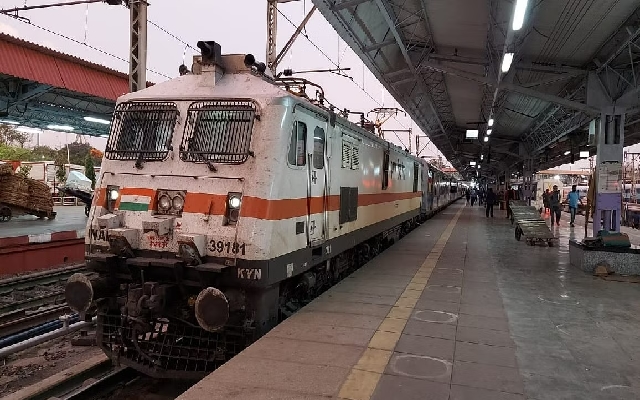


Kavach, a crucial safety mechanism aimed at preventing train accidents, has yet to be implemented in Karnataka, raising concerns about safety on several “critical sections” and busy routes operating at over 100% capacity.
The South Western Railway (SWR), responsible for a majority of Karnataka’s railway routes spanning 3,390 km, manages a heavy traffic load of 380 to 400 passenger trains and 200 to 300 goods trains daily.
Kavach, an automatic train protection system effective against head-on and rear collisions, remains absent in key sections within the state. Instead, SWR relies on Automatic Emergency Braking to mitigate mishaps, despite recent incidents like the Kanchanjunga Express collision in West Bengal.
Besides the absence of Kavach, vacancies in critical safety positions exacerbate concerns. The SWR reports a significant shortfall, with a 28% vacancy rate among safety staff, including loco pilots and guards. Out of 5,200 sanctioned loco-pilot posts, 1,800 are unfilled (35%), while 325 out of 1,330 guard posts (25%) remain vacant.
The shortage compromises safety standards, with officials highlighting the Finance Ministry’s failure to allocate funds for new hires, forcing existing staff to cover expanding operations. Identified critical routes such as Miraj-Hubballi-Bengaluru and Bengaluru-Chennai operate at maximum capacity, while vulnerable sections like Castle Rock-Khanapur and Ghat areas face heightened risks from natural calamities.
Manjunath Kanamadi, SWR Chief Public Relations Officer, acknowledged the absence of Kavach, noting efforts to integrate the system on critical routes within the Golden Quadrilateral. Despite this, he assured that SWR employs Automatic Emergency Braking and other safety measures pending full Kavach deployment.
Kavach, developed domestically by the Research Designs & Standards Organisation, is celebrated for its cost-efficiency and efficacy in preventing collisions, utilizing RFID technology. While already operational across 1,465 km in North India, ongoing efforts extend its coverage by an additional 3,000 km nationwide.