







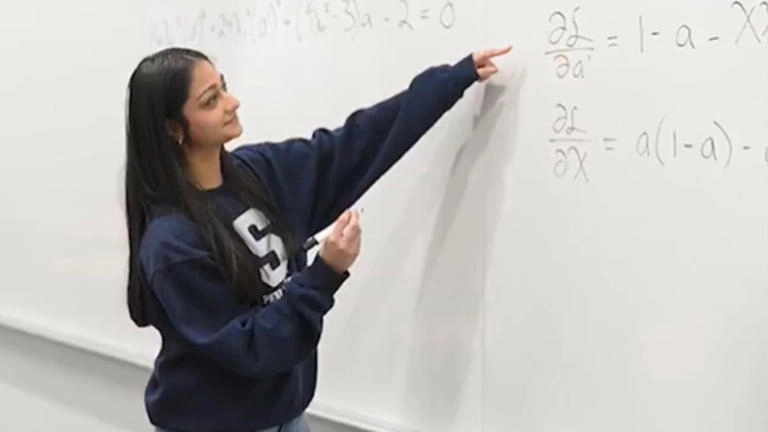


Divya Tyagi, an aerospace engineering graduate at Pennsylvania State University, has rewritten history by reimagining a century-old mathematical problem, offering groundbreaking insights in aerodynamics.
The problem, first proposed by British aerodynamicist Hermann Glauert nearly 100 years ago, has been pivotal in the study of aerodynamics. However, Tyagi’s fresh perspective simplifies the complex calculations, unlocking new avenues in wind turbine design, as shared by Penn State’s official website.
“I’ve added a new dimension to Glauert’s model—calculating ideal flow conditions to optimize wind turbine power output,” Tyagi explained.
Her adviser and co-author, Sven Schmitz, elaborated that Glauert’s original focus was purely on maximizing power efficiency. Crucially, Glauert overlooked how external forces, like wind thrust and blade bending, affect turbine performance. Schmitz likened it to resisting pressure on one’s outstretched palm—the turbine must endure such forces without compromising stability.
Tyagi’s approach, built on the calculus of variations, introduces a clear and elegant method for solving these complex interactions. By allowing constrained optimization, her model enables researchers to probe new facets of turbine mechanics previously untapped.
Schmitz praised Tyagi’s persistence, recalling that three students before her walked away from the challenge. “She cracked it where others hesitated. I foresee her work influencing classrooms and engineering labs globally,” he noted.
Beyond this, Tyagi continues her research in computational fluid dynamics, contributing to helicopter flight simulations and aviation safety through a U.S. Navy-backed project.
- Zerodha CEO Nithin Kamath’s Instagram struggles spark online buzz
- BJP Stages Protest in Mangaluru Over FIR Against MLA Vedavyas Kamath
#WomenInSTEM #RenewableEnergyInnovation #NextGenEngineering #MathSimplified