


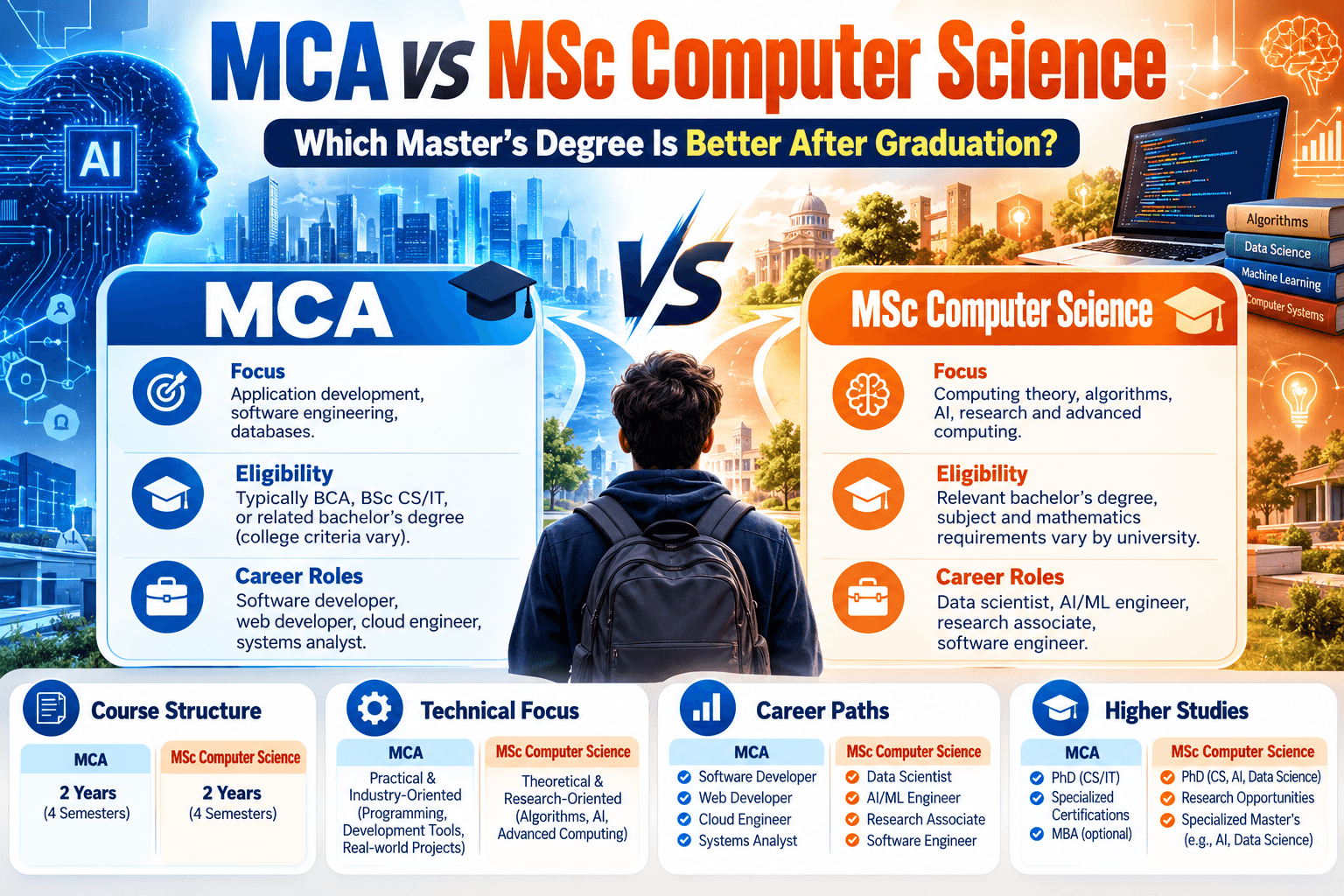


Whether you choose MCA or MSC in Computer Science depends on your career goals. Both can lead to technology careers, but differ in eligibility requirements, curriculum, and academic focus. MCA is more about software applications, and MSc Computer Science is more about computing theory. Understand the difference between the two to ensure you get the best out of your choice.
What Is a Master of Computer Applications (MCA)?
MCA course is a post-graduate program where students usually study programming, databases, software engineering, operating systems, and application development. Electives may include cloud computing, cyber security, or artificial intelligence.
What Is an MSc in Computer Science (MSc CS)?
MSc Computer Science covers principles of computing, including algorithms, data structures, computational theory, and advanced programming. Some programs include machine learning, mathematical foundations, and research methods. It is suitable for students who want to pursue technical specialisation, research, or further academic study.
Eligibility Criteria and Academic Prerequisites
There are different admission rules from university to university for these online postgraduate courses. Before applying, check accepted degrees, minimum marks, Mathematics requirements, and entrance exams.
Who Can Apply for MCA?
Generally, MCA is open to candidates who have a Bachelor’s degree in Computer Science, or a BSc/BTech in a related field. Graduates from other disciplines like BCom, BA, etc. may also be eligible if they have studied Mathematics in Class 12 or at the graduation level, as per university rules.
- Minimum marks: Generally 50% in graduation. Some institutions give relaxation to reserved categories.
- Mathematics: This is a requirement for many universities at the Class 12 or graduation level.
- Duration: 2 years.
- Admission: Depending on the institution, it is through the CUET-PG, university entrance exams, or on a merit basis.
Who Can Apply for MSc CS?
MSc Computer Science eligibility depends on the university. Typically, candidates need to have a bachelor’s degree in Computer Science, IT, Mathematics, or a related field. Some universities do accept graduates from other disciplines if they have studied mathematics and computer science at the undergraduate level.
- Minimum Marks: Generally 50%-60% in graduation, as per the university.
- Subject requirements: May require mandatory Mathematics and/or Computer Science at 10+2 or graduation level.
- Entrance tests: Some universities require CUET-PG or their own entrance test, while others admit students based on merit.
Check the eligibility criteria of the particular university before applying.
Curriculum Contrast: Application-Driven vs. Theory and Research
Generally, MCA is focused more on software development and applications, while MSc CS tends to be more oriented toward computing concepts, algorithms, and analytical foundations. The exact courses will depend on the university you choose.
MCA Syllabus Focus: Software Development and Enterprise Applications
Students of MCA study programming, database systems, software engineering, web technologies, and application development. Projects can be business applications or websites. Some programs include software testing, project management, cloud platforms, and enterprise systems.
MSc CS Syllabus Focus: Algorithms, Theory and Research
CS includes courses in algorithms, data structures, operating systems and advanced programming. Depending on the university, the curriculum may also include mathematical modelling, machine learning and research methodology, supporting specialised technical work or further study.
Course Duration and Structural Changes
Course length impacts the cost of study and when you can start working. Before you sign up, check the structure of the program you have chosen.
The Two-Year MCA Framework
The Master of Computer Applications (MCA) is a postgraduate degree program generally completed in two years across four semesters. It focuses on computer applications, software development, programming, database management, and related areas of information technology. Candidates must hold a bachelor’s degree from a recognised university, preferably with Mathematics at the Class 12 or graduation level.
MSc CS Structure and Academic Frameworks
MSc Computer Science is a PG (Post Graduate) degree. Typically a 2-year degree program following a bachelor’s degree. The program includes advanced topics in computing, algorithms, programming, databases, and other specialist areas of computer science. The universities offer different structures of courses, credits, electives, practical training, and dissertation opportunities.
Career Scope and Placement Opportunities
Both degrees can lead to careers in tech. Opportunities depend upon projects, internships, technical ability, institution, and interview performance.
Industry Preferences: Corporate Jobs and Software Development
MCA and MSc in Computer Science graduates can work as software developers, full-stack developers, application engineers, systems analysts, and software testers depending on their skills and experience. MCA program is geared more toward applied computing and software development. MSc Computer Science focuses more on computing theory and advanced concepts. Employers look at the candidate’s programming skills, problem-solving skills, project experience, and role-specific requirements.
Academic and Research Pathways
An MSc in Computer Science can be a gateway to further study and research in areas like artificial intelligence, data science, cybersecurity and theoretical computing. MCA graduates may also pursue research or doctoral studies, provided they meet the eligibility norms. Depending on the institution and the position, academic and research positions may require a PhD, qualifying exams, teaching experience, or other credentials.
Job Profiles and Expected Salary Range in India
Salary depends on skills, experience, location, and employer, not just degree title.
| Job Role | Salary Range |
| Software Developer | ₹5–11 LPA |
| Full-Stack Developer | ₹4–10 LPA |
| Systems Analyst | ₹6–15 LPA |
| Data Scientist | ₹8–22 LPA |
Common Roles for MCA Graduates
MCA graduates can become Software Engineers, System Analysts, Application Developers, Full Stack Developers, or Database professionals.
Common Roles for MSc CS Graduates
MSc CS graduates may get jobs as software developers, algorithm engineers, data scientists, or researchers. For jobs in AI research, qualifications in advanced maths, related projects, and further research can be required.
The Final Verdict: Which One Should You Choose?
Both degrees can lead to good career prospects in technology, but which one is right for you depends on your interests and career goals.
Choose MCA If
You want to specialise in software development, application programming, and practical IT projects.
Choose MSc CS If
You like algorithms, theory of computing, AI, data science, or research-oriented studies.
Conclusion
Choosing between an MCA and an MSc in Computer Science depends on whether you want to focus on industry-oriented IT careers, advanced computer science concepts, or research. However, these two courses have different eligibility, syllabus, and focus. Before applying, check the course structure, entry requirements, fees, placements & research opportunities. Choose the degree that’s right for your skills and career aspirations.