


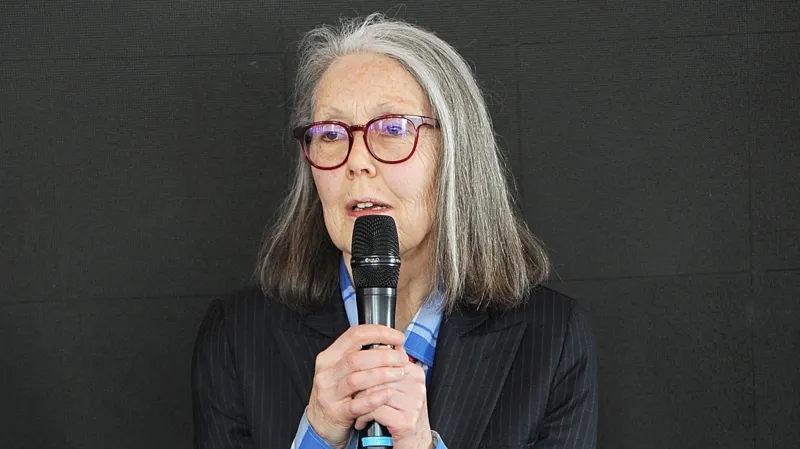


Stockholm: Canadian poet, essayist and translator Anne Carson has been awarded the 2026 Nobel Prize in Literature for a body of work that blends poetry, prose, classical scholarship and translation in unconventional ways.
The Swedish Academy announced the award on Thursday, praising Carson for her “bold and inventive oeuvre” that, in “playful dialogue with the classical tradition”, has created new forms for contemporary literature. The prize comes with an award of 12 million Swedish kronor, or about $1.2 million.
Carson, 76, has built a distinctive literary career by moving freely between genres. Her writing has included poetry, essays, verse novels, translations, literary criticism and works created for performance. Her long engagement with ancient Greek literature has been central to her approach, while her writing frequently brings classical stories and ideas into conversation with modern experiences.
Swedish Academy praises Carson’s literary innovation
The Nobel committee’s citation focuses on the unusual form and range of Carson’s writing rather than a single book or period of her career.
The Academy described her work as an “inventive oeuvre”, highlighting the way she engages with classical traditions while creating new literary forms for contemporary readers.
Carson’s writing has often resisted straightforward classification. Her books can combine elements of poetry, fiction, essay, translation and scholarship, making her one of the more distinctive voices in contemporary literature.
Her approach is closely connected to her training as a classicist. Rather than treating ancient literature simply as historical material, Carson has repeatedly used Greek myths, texts and language as starting points for exploring subjects such as love, desire, identity, loss and memory.
Carson was in Iceland when she received the news
Ingrid Carlberg, permanent secretary of the Swedish Academy, said she spoke to Carson by telephone shortly before the public announcement.
According to Carlberg, Carson was in Iceland at the time and said she was listening to the wind.
“She was very taken by surprise,” Carlberg said, describing Carson as happy after receiving the news.
Carson has a connection to Iceland beyond her time there. She became an Icelandic citizen in 2022 while retaining her Canadian identity, according to Reuters.
The Nobel announcement therefore arrived while the writer was in a country with which she has developed a personal connection.
Autobiography of Red made Carson internationally known
One of Carson’s best-known works is Autobiography of Red, published in 1998.
The book draws on the ancient Greek story of Geryon, a winged red monster associated with the myth of Heracles. Carson transforms the classical material into a contemporary coming-of-age story, combining elements of poetry, fiction and mythology.
The work has frequently been cited as an example of Carson’s ability to take an ancient narrative and reshape it through a modern literary form. Critics have highlighted its unusual structure and its movement between classical references and contemporary emotional experience.
The book helped establish Carson internationally as a writer whose work could move beyond conventional boundaries between literary genres.
A career built around poetry and classical literature
Carson’s interest in classical literature has shaped much of her career.
She has translated works from ancient Greek and has approached translation not simply as a technical exercise but as part of her wider literary practice. The Nobel-related account of her work notes that her translations of Classical Greek can themselves be viewed as independent literary works.
Her scholarship and poetry have therefore developed alongside each other.
That combination has allowed Carson to bring academic study of ancient texts into contemporary literary writing. Her work frequently explores the meanings and histories of words while experimenting with how those words can be arranged in new forms.
Carson’s work crosses traditional genres
Carson has published a wide range of books, including Plainwater, The Beauty of the Husband, Decreation, Red Doc> and Wrong Norma.
Her writing has also extended beyond conventional books of poetry. She has worked on opera-related projects, performance pieces, translations and adaptations of classical texts.
Norma Jeane Baker of Troy, for example, brings together the story of Helen of Troy from Euripides’ Helen with the life and image of Marilyn Monroe. The 2019 work demonstrates Carson’s interest in placing figures from different historical and cultural contexts alongside one another.
This tendency to connect apparently distant subjects is characteristic of her broader literary approach.
Carson’s writing combines scholarship with experimentation
Carson’s background as a classicist has distinguished her from many contemporary poets.
Her work is deeply informed by ancient Greek language and literature, but she has used that knowledge to experiment with contemporary literary forms rather than simply reproduce classical narratives.
The Swedish Academy highlighted this relationship between Carson’s interest in language and her creative practice.
According to the Academy, much of her literary production centres on the intersection between the philologist’s attention to words and the poet’s search for new meanings. Her interest in the origins and histories of words has consequently become an important part of her creative method.
This combination of scholarship and artistic experimentation has made her work particularly difficult to place within a single literary category.
A long career in academia
Alongside her literary career, Carson has spent decades teaching and working in the field of classics.
Her academic background has influenced both her translations and her creative writing. Her engagement with ancient Greek texts has remained a consistent thread throughout her career, even as the forms of her literary work have changed.
Carson’s career has consequently developed across two worlds that are often treated separately: academic scholarship and creative literature.
The Nobel recognition brings those two aspects of her work together, particularly through the Academy’s emphasis on the dialogue between classical tradition and contemporary literary invention.
A Nobel prize for a genre-defying writer
Carson’s selection continues the Nobel tradition of recognising writers whose work has expanded the possibilities of literature.
The Literature Prize has been awarded since 1901 and honours an author’s body of work rather than a single publication. The award is administered by the Swedish Academy, with the Nobel Foundation responsible for the wider Nobel system.
Carson joins a long list of internationally recognised literary figures to receive the honour.
Her selection also marks recognition for a writer whose career has consistently challenged conventional divisions between poetry, fiction, criticism and scholarship.
Anne Carson’s Nobel recognition
At 76, Carson receives the Nobel Prize in Literature after decades of literary and academic work.
Her career has been defined by an unusual combination of classical scholarship, translation and experimentation with literary form. From Autobiography of Red to later works that combine poetry, prose, performance and criticism, she has repeatedly explored ways of reshaping inherited stories and language for contemporary audiences.
The Swedish Academy’s citation places that experimentation at the centre of its decision.
By recognising Carson’s dialogue with classical literature and her creation of new contemporary forms, the 2026 Nobel Prize celebrates not only an individual writer but also the possibilities that emerge when scholarship, poetry and imagination intersect.