







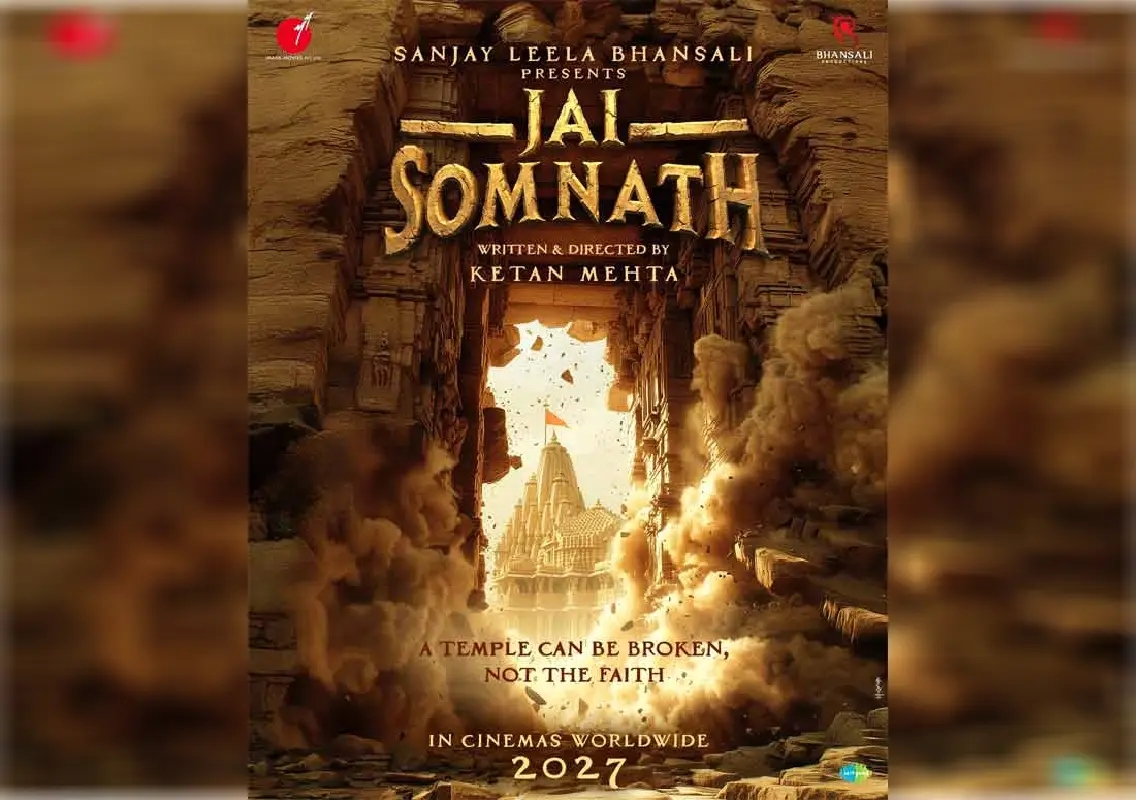


Mumbai: Filmmakers Sanjay Leela Bhansali and Ketan Mehta have joined hands for an ambitious historical film titled Jai Somnath, with the first poster unveiled on the occasion of Maha Shivratri. The project brings together two of Indian cinema’s most influential creative voices to narrate a defining chapter from India’s spiritual and civilisational history. The film is slated for a theatrical release in 2027 and is already drawing attention for both its subject and the rare collaboration behind it.
The announcement positions the film as a large-scale historical epic rooted in faith, resistance and cultural continuity. With Bhansali known for visually rich, grand narratives and Mehta recognised for bold, research-driven historical storytelling, the partnership is being seen as a significant cinematic event.
Story rooted in a defining historical chapter
Jai Somnath traces its narrative to the events of 1025–1026 CE, when the historic Somnath Temple was attacked and plundered by invader Mahmud of Ghazni. The episode occupies a major place in Indian historical and cultural memory, often cited as a symbol of both devastation and later revival.
According to the makers, the film will not be limited to the invasion alone but will also focus on the temple’s spiritual significance and its repeated reconstruction over centuries. The narrative is expected to explore themes of civilisational resilience, devotion and collective identity rather than functioning purely as a war chronicle.
The timing of the announcement is also notable, as the year marks roughly a millennium since the recorded attack on the shrine. The makers suggest that the film aims to revisit the episode with scale, sensitivity and cinematic depth.
A rare collaboration of two cinematic styles
The collaboration between Bhansali and Mehta stands out because both filmmakers are known for distinct but powerful storytelling approaches. Bhansali’s cinema is associated with operatic scale, elaborate set design, music-led narration and heightened emotional drama. Mehta, on the other hand, has built a reputation for politically and historically engaged films with strong research foundations and international festival presence.
Industry observers say Jai Somnath could benefit from this blend — pairing spectacle with substance. While Bhansali’s involvement is expected to shape the visual and emotional scale, Mehta is attached as writer and director, indicating that the narrative and screenplay will be driven by his historical perspective and structural control.
The makers describe the film as combining “historical depth with cinematic scale”, aiming to reach both mainstream audiences and viewers interested in heritage narratives.
Production banners and creative leadership
The film will be produced under Bhansali’s home banner Bhansali Productions along with Maya Movies. Mehta will helm the project as director and writer, overseeing the script, research and execution. Pre-production work is understood to be underway, including historical consultation, visual design and location planning.
Sources associated with the project indicate that extensive archival and textual references are being studied to shape the screenplay. The team is expected to balance documented history with dramatised storytelling suitable for a theatrical epic format.
Casting details have not yet been announced. Given the scale and subject, the film is expected to feature a mix of established stars and strong character actors. Official announcements regarding the cast and shooting schedule are likely closer to the production start date.
Cultural and emotional significance
The Somnath narrative holds deep emotional resonance for many, symbolising destruction followed by renewal. The temple has been rebuilt multiple times across centuries and is widely regarded as a symbol of endurance and faith. By choosing this subject, the filmmakers are stepping into material that is both culturally sensitive and historically weighty.
The makers suggest the film will aim for a respectful and layered portrayal rather than a one-dimensional retelling. The emphasis, they say, will be on civilisational continuity and spiritual strength, presented through character-driven storytelling and immersive world-building.
Both directors also share a cultural connection to Gujarat, which is expected to contribute to the authenticity of the setting, dialect choices and socio-cultural detailing in the film.
Conclusion
With Jai Somnath, the coming together of Sanjay Leela Bhansali and Ketan Mehta signals a major historical epic in the making. Backed by strong creative leadership and a subject rooted in Indian spiritual history, the film is positioned as a landmark project. If executed as envisioned, it could emerge as one of the most significant period dramas of its release year, blending scholarship with cinematic grandeur.