


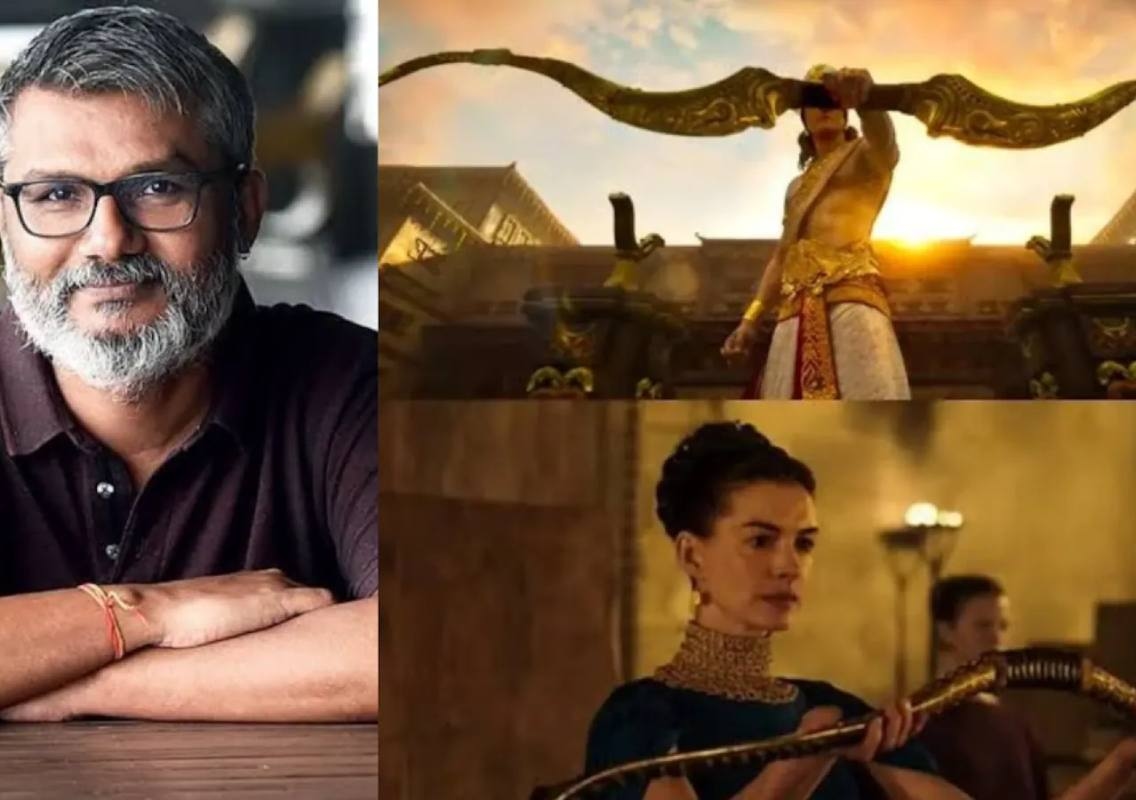


Mumbai: Filmmaker Nitesh Tiwari believes the ancient Indian epic Ramayana may have influenced Homer’s celebrated Greek epic The Odyssey. Drawing parallels between the two literary works, the director said similarities in their storytelling suggest that elements of the Indian epic could have travelled beyond the country’s borders centuries ago.
Tiwari recently discussed the similarities between Christopher Nolan’s The Odyssey and the Ramayana, expressing happiness that audiences across the world could find connections between the two epics. He suggested that Homer’s work might have drawn inspiration from the Indian epic, which has influenced storytelling traditions across different cultures.
The filmmaker’s comments have attracted attention as Nolan’s adaptation of The Odyssey explores themes and narrative elements that Indian audiences may find familiar. One particularly striking similarity involves a challenge centred on stringing a powerful bow, a pivotal moment in both stories.
For Tiwari, who is currently bringing the Ramayana to the big screen through an ambitious two-part cinematic adaptation, the comparison offers an opportunity to introduce India’s ancient literary heritage to international audiences.
Nitesh Tiwari sees Ramayana connections in Homer’s Odyssey
In an interview with ScreenRant, Tiwari spoke about the similarities between the two epics and suggested that the Ramayana could have influenced Homer while writing parts of The Odyssey.
“Ramayana is the oldest epic, and I believe Homer was inspired by Ramayana in some way, having written those bits in Odyssey. And yes, I did notice those equivalents, and I felt very happy that our greatest epic has got a tribute in another epic that belongs to the Western world, and it’s going to make it much easier for people to connect with what we were trying to bring to the West as well,” he said.
The filmmaker also recalled his reaction when he watched The Odyssey. He said the similarities immediately reminded him of the Indian epic, although he acknowledged the possibility of coincidence.
“To be honest, it was written in our text 4,000 years ago. So actually, when I saw The Odyssey, I thought, ‘That’s from Ramayana.’ Exactly. But yeah, sweet coincidence. I love The Odyssey. I love Christopher Nolan. But yeah, doing Ramayana had a very different feeling,” Tiwari added.
His remarks reflect his belief that Indian epics have a wider cultural reach than is often recognised. However, the suggestion that Homer directly drew inspiration from the Ramayana remains the filmmaker’s interpretation rather than an established historical conclusion.
The bow challenge that connects Ramayana and The Odyssey
One of the most noticeable similarities between the two stories involves a test of strength and skill centred on a bow.
In Homer’s The Odyssey, Penelope, the wife of Odysseus, faces pressure from numerous suitors who want to marry her in the presumed absence of her husband. To determine who deserves her hand, she announces a challenge involving Odysseus’ powerful bow.
The suitors are required to string the bow, but none of them succeeds. Odysseus, who has returned to his kingdom in disguise, eventually takes up the weapon and completes the challenge. His achievement reveals his identity and establishes his claim over his household.
A comparable episode appears in the Ramayana during Sita’s swayamvar.
King Janaka announces that whoever can lift and string Lord Shiva’s mighty celestial bow will win Sita’s hand in marriage. Several kings and warriors attempt the challenge but fail to move the enormous weapon.
Lord Rama eventually steps forward, lifts the bow and breaks it into two while attempting to string it. His extraordinary feat fulfils the condition laid down by Janaka, leading to his marriage to Sita.
Although the circumstances and narrative consequences differ, both episodes feature a seemingly impossible bow challenge that establishes the central male character’s exceptional abilities.
These parallels have prompted discussions among audiences about the similarities between Indian mythology and classical Western literature.
Ramayana’s global storytelling legacy
The Ramayana is among India’s most influential ancient literary and religious traditions. Traditionally attributed to the sage Valmiki, the Sanskrit epic narrates the life of Lord Rama, his exile, Sita’s abduction by Ravana and the eventual battle to rescue her.
Over centuries, the story travelled across geographical and cultural boundaries, inspiring different versions and adaptations throughout South and Southeast Asia.
Countries such as Thailand, Indonesia, Cambodia and Laos have developed their own interpretations of the Ramayana, incorporating the story into literature, theatre, dance and cultural traditions.
Its themes of duty, loyalty, sacrifice, courage and the struggle between good and evil have helped the epic remain relevant across generations.
Homer’s The Odyssey, meanwhile, is one of the foundational works of ancient Greek literature. Traditionally attributed to Homer, it follows Odysseus on his long and difficult journey home after the Trojan War. The epic explores themes of perseverance, identity, loyalty, family and the challenges faced by individuals confronting extraordinary circumstances.
While both works contain familiar storytelling motifs, similarities alone do not establish a direct historical connection. The question of whether Homer knew the Ramayana or drew from it remains open to historical and literary examination.
Nevertheless, Tiwari believes the parallels can help international audiences appreciate the storytelling traditions of India.
Nitesh Tiwari’s Ramayana brings Indian epic to global audiences
Tiwari is directing the ambitious two-part cinematic adaptation of the Ramayana, produced by Namit Malhotra and Yash. The project features Ranbir Kapoor as Lord Rama, Sai Pallavi as Sita and Yash in a prominent role.
Titled Ramayana: Part One, the film arrived in theatres on November 5, 2026. The makers have presented the project as an attempt to take India’s ancient epic to audiences worldwide while retaining its cultural and historical significance.
The production has also been promoted through the message, “Our truth. Our history”, reflecting the filmmakers’ ambition to present the Indian epic on an international cinematic platform.
For Tiwari, the similarities between The Odyssey and the Ramayana offer an additional opportunity to build connections with viewers unfamiliar with India’s traditional stories.
The filmmaker has also acknowledged his admiration for Christopher Nolan, whose interpretation of Homer’s epic has generated conversations about the relationship between classical literature and contemporary cinema.
Ramayana records strong worldwide box-office performance
The film’s commercial performance has added to the attention surrounding its international ambitions.
According to early box-office estimates reported on November 8, Ramayana: Part One collected approximately Rs 375.50 crore worldwide during its first three days in theatres.
Overseas markets contributed an estimated Rs 157.25 crore to the worldwide total, indicating substantial business beyond India.
The strong opening weekend has placed the film among the major Indian cinematic releases of the year. Its performance is also drawing attention to the global market for adaptations of Indian epics and culturally rooted stories.
As the makers continue to expand the film’s international reach, Tiwari’s comments about the relationship between the Ramayana and The Odyssey have added another dimension to the conversation surrounding the project.
A shared conversation between Indian and Western epics
Nitesh Tiwari’s observations have reopened discussions about the similarities between two of the world’s celebrated literary traditions. The bow challenge in the Ramayana and The Odyssey offers an interesting example of how comparable narrative elements can appear in stories from different cultures.
Although a direct influence of the Ramayana on Homer has not been historically established, the filmmaker believes the parallels deserve recognition and can help introduce India’s literary heritage to a wider audience.
With his cinematic adaptation reaching theatres, Tiwari hopes that viewers beyond India will discover the depth and cultural significance of the ancient epic. The conversation also highlights how stories written centuries ago can continue to find new audiences through literature, mythology and modern cinema.