







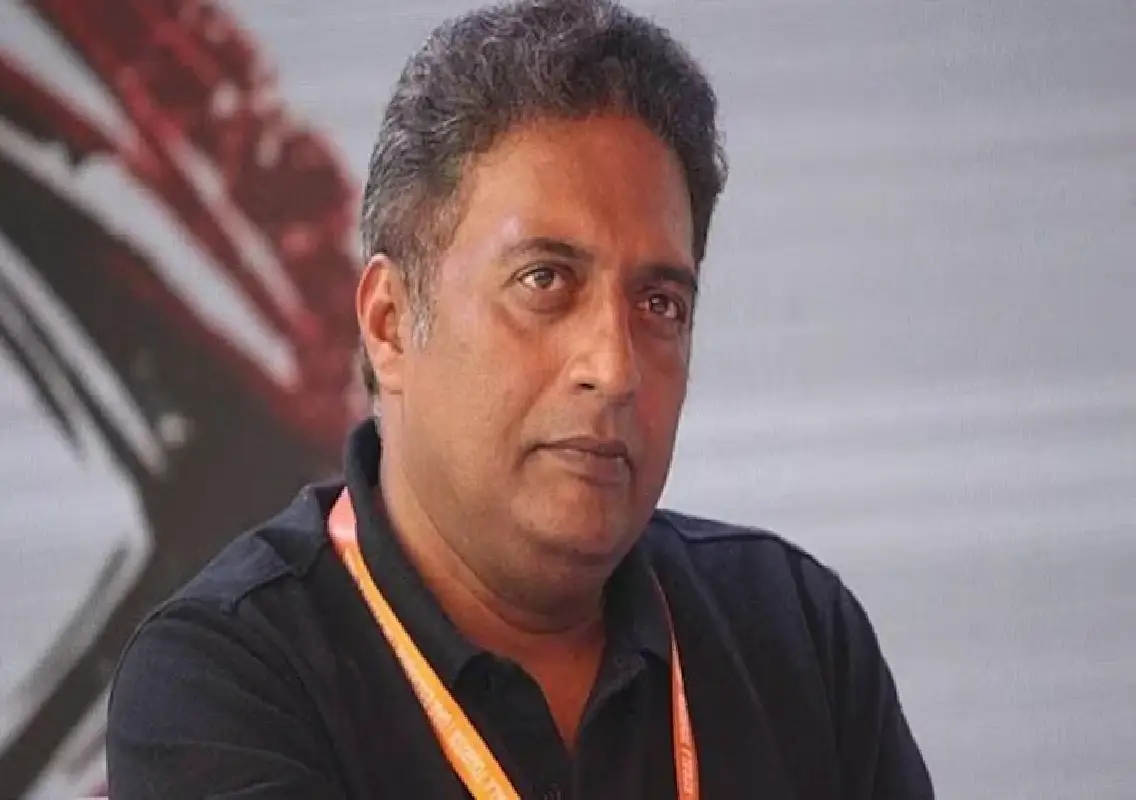


Kozhikode: Actor and filmmaker Prakash Raj on Saturday delivered a sharp critique of mainstream Hindi cinema, saying it has become increasingly “fake” and overly driven by money, while praising Malayalam and Tamil cinema for their strong, content-focused storytelling. Speaking at the ninth edition of the Kerala Literature Festival (KLF), Raj said Hindi films have drifted away from their social and emotional roots, losing touch with large sections of the audience.
Addressing a packed audience at the four-day literary event, the award-winning actor compared contemporary Hindi cinema to a “Madame Tussauds museum”, arguing that while everything appears glossy and beautiful on the surface, it lacks depth and substance. Raj, who has worked extensively across Tamil, Telugu, Kannada, Malayalam and Hindi cinema, said the contrast between storytelling traditions in different film industries has become increasingly stark.
‘South cinema still has stories to tell’
During a session titled “The Artist I Became”, the 60-year-old actor highlighted how Malayalam and Tamil filmmakers continue to engage with real social issues, offering narratives rooted in lived experiences.
“In the present context, I feel Malayalam and Tamil cinema are making very strong films,” Raj said. “Hindi cinema, on the other hand, has lost its roots. Everything looks beautiful, wonderful, like plastic, as you see in the Madame Tussauds museum.”
He specifically praised young Tamil filmmakers for addressing issues related to caste, marginalisation and social justice. According to Raj, the willingness of new directors to speak about Dalit lives and uncomfortable truths gives him hope for the future of Indian cinema.
“We still have stories to tell. The new young directors of Tamil cinema are talking about Dalit issues, and that gives so much of hope,” he added.
Experience across industries
Prakash Raj’s comments carry weight given his long and varied career. He has acted in several popular Hindi films such as Wanted and Singham, while also being a prominent presence in South Indian cinema for decades. Known for his outspoken views, Raj has often spoken about the role of art in reflecting society and questioning power structures.
At the festival, he reflected on how his exposure to multiple film industries has shaped his understanding of storytelling. He argued that industries which remain rooted in local cultures and realities are better placed to survive creatively in the long run.
Multiplex era blamed for Bollywood’s decline
Analysing what he sees as the decline of Hindi cinema, Raj traced the shift back to the post-multiplex era. According to him, once multiplexes became dominant, filmmakers began catering primarily to urban, elite audiences, leaving behind the vast rural and semi-urban population that once formed the backbone of Hindi cinema’s viewership.
“After multiplexes, the Bombay film industry started making films only for multiplexes,” he said. “Very cute films and things like that, because they were running well. They went into that Page 3 culture, and with that lost touch with rural Rajasthan and Bihar.”
Raj argued that this shift towards glamour, celebrity culture and surface-level aesthetics weakened Bollywood’s emotional bond with its audience. He said films increasingly became products designed for social media visibility and box office numbers rather than vehicles for meaningful storytelling.
Loss of nation-building narratives
The actor also lamented the disappearance of what he described as nation-building narratives that once defined post-Independence Hindi cinema. To illustrate his point, Raj cited the 1977 blockbuster Amar Akbar Anthony, a film that symbolised unity in diversity.
Referring to the iconic scene where three men from different religions donate blood to save a single person, Raj said such moments reflected shared values, social harmony and collective aspirations.
“That cinema spoke about who we are as a society,” he said. “Now, it’s not like that anymore.”
According to Raj, today’s Hindi film industry is dominated by concerns about money, appearances and self-promotion. “Today, it’s all about money and appearances — reels, Page 3 coverage, loud self-promotion,” he observed. “In the process, I feel the industry has lost its connection with the audience.”
Kerala Literature Festival draws global voices
The ninth edition of the Kerala Literature Festival has brought together more than 400 speakers from across the world. The event features a diverse lineup including Nobel laureates Abdulrazak Gurnah and Abhijit Banerjee, astronaut Sunita Williams, author Kiran Desai, essayist Pico Iyer, Jnanpith Award winner Pratibha Ray, sports icons Rohan Bopanna and Ben Johnson, and Wikipedia founder Jimmy Wales.
Raj’s session was among the most discussed at the festival, drawing attention for its candid assessment of Indian cinema and its evolving priorities.
Conclusion
Prakash Raj’s remarks at the Kerala Literature Festival underline a growing debate within the film industry about the direction of mainstream Hindi cinema. As Malayalam and Tamil films continue to earn acclaim for grounded storytelling and social relevance, his comments raise uncomfortable but timely questions about whether Bollywood can reconnect with its roots and audiences beyond urban multiplexes.