


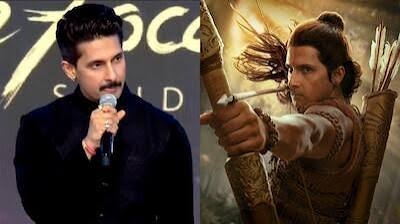


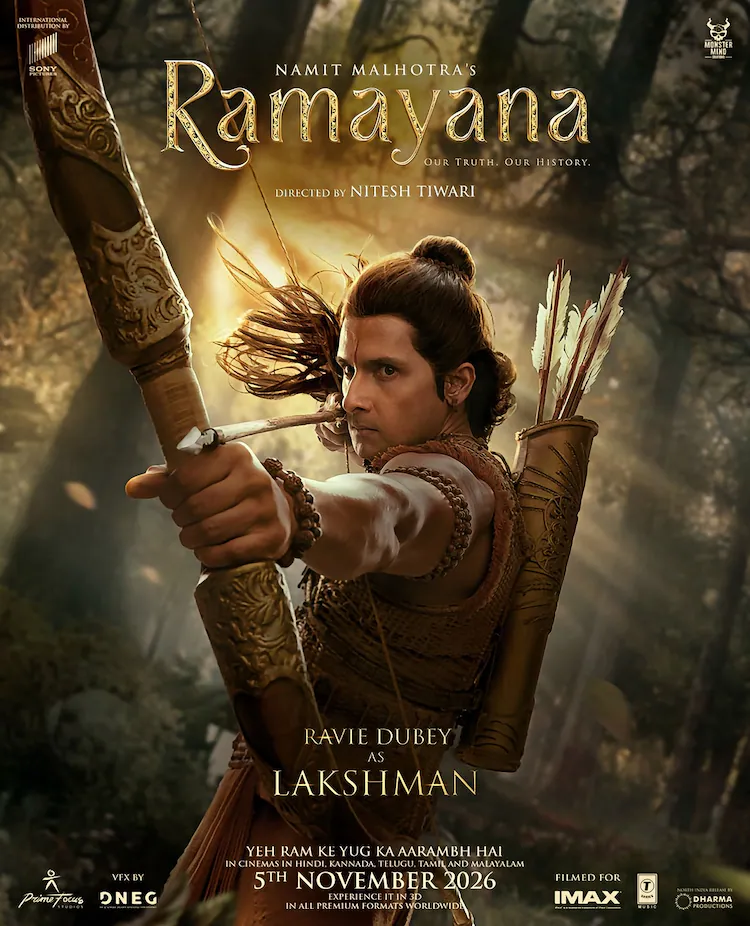
Mumbai: Actor Ravie Dubey makes his big-screen debut as Lakshman in Nitesh Tiwari‘s Ramayana: Rise of a Legend, delivering a performance that brings humour, emotional depth and fiery conviction to one of the epic’s most familiar characters. In a film featuring Ranbir Kapoor as Rama, Yash as Ravana and Sai Pallavi in a prominent role, Dubey manages to create a distinct identity for Lakshman without competing for the spotlight.
Best known for his television performances in Jamai Raja and Saas Bina Sasural, Ravie takes on a character whose significance extends far beyond being Rama’s younger brother. Lakshman is devoted, fiercely protective, impulsive and quick to anger. He is also affectionate, playful and unafraid to challenge situations he considers unjust.
It is this combination of qualities that makes Lakshman such a compelling figure in the Ramayana. Dubey understands that the character needs more than unquestioning devotion. His portrayal gives Lakshman an emotional personality of his own while preserving the deep bond he shares with Rama.
A Lakshman who stands apart from Rama
One of the strengths of Dubey’s performance is that Lakshman is not presented merely as a supporting presence in Rama’s journey. Although his loyalty to his elder brother remains central to the character, he has his own reactions, emotions and convictions.
The relationship between the brothers is among the most enduring elements of the Ramayana. Lakshman’s decision to accompany Rama into exile reflects his commitment, but his personality is also shaped by his willingness to speak openly when he believes something is wrong.
Dubey brings this quality to the screen through a combination of affection, humour and anger. His Lakshman can tease Rama one moment and fiercely defend him the next. These shifts make the character feel more human and prevent his devotion from becoming a single defining trait.
The film’s portrayal also gives the younger brother room to express his own perspective. He is not simply present to react to Rama’s decisions; he has an independent emotional response to the events unfolding around him.
That individuality is particularly important in a large-scale mythological film, where the central characters can easily dominate the narrative.
Humour adds warmth to the brothers’ relationship
Some of Dubey’s most enjoyable moments come through the playful exchanges between Lakshman and Rama.
One such moment occurs when Rishi Vishwamitra speaks about Sita and Rama’s impending participation in her swayamvar. Lakshman’s teasing is affectionate and spontaneous, offering a glimpse of the familiarity between the brothers.
The humour does not feel out of place in the larger narrative. Instead, it adds warmth to a relationship that is often remembered primarily for its devotion and sacrifice.
Dubey’s comic timing helps these exchanges land naturally. His one-liners and expressions bring a lighter quality to the film without reducing Lakshman to a source of comic relief.
The lighter moments also help establish the emotional foundation of the brothers’ relationship. Their closeness is conveyed not only through solemn declarations of loyalty but also through the ease with which they interact.
This balance becomes important when the story moves towards more difficult moments.
Anger and disbelief after Kaikeyi’s demand
When Kaikeyi’s demand leads to Rama’s exile, Lakshman’s playful affection gives way to anger and disbelief.
For Lakshman, the development is not simply a disruption of his own life. He is distressed by the treatment of someone he deeply respects and considers deserving of better. His reaction comes from a sense of injustice and an inability to accept the circumstances surrounding Rama’s departure.
Dubey navigates this emotional shift effectively. His performance conveys the character’s frustration without making him appear one-dimensional.
Lakshman’s anger is rooted in affection and loyalty, rather than simply an instinct to oppose authority. He is unwilling to remain silent when he believes his brother has been wronged.
This is one reason the character’s spirited temperament may connect with younger viewers. Some have drawn comparisons between Lakshman’s quick reactions and the outspoken attitude associated with Gen Z.
Beneath that contemporary interpretation, however, is a more timeless idea: standing up for someone you love, even when doing so creates conflict.
The Lakshman Rekha sequence reveals his emotional depth
The sequence involving the Lakshman Rekha provides one of the clearest demonstrations of Dubey’s understanding of the character.
When Maarich, Ravana’s uncle and a shape-shifter, imitates Rama’s voice and cries out for help, Lakshman recognises the possibility of deception. Sita, overcome with anxiety, insists that he leave her and go to Rama’s aid.
Lakshman is caught between his understanding of the situation and his responsibility to protect Sita. He has made a commitment to safeguard her, but he also cannot ignore what appears to be a call for help from his brother.
Dubey’s response is marked by restraint. Rather than relying on exaggerated anger or theatrical gestures, he conveys the character’s distress through his expressions.
His eyes reflect the pain of someone forced to choose between two responsibilities that matter deeply to him. The scene works because the actor allows the emotional conflict to emerge without overplaying it.
It also highlights an important aspect of Lakshman’s personality: his strength does not come only from his ability to fight or defend others. It also comes from the emotional weight he carries while trying to fulfil his duties.
A fresh interpretation after Sunil Lahri’s iconic portrayal
Playing Lakshman comes with the additional challenge of living up to the audience’s established image of the character.
For viewers who grew up watching Ramanand Sagar’s television adaptation of Ramayan, actor Sunil Lahri’s portrayal remains deeply familiar. His performance helped shape how generations of audiences visualised Lakshman.
Dubey does not appear to be attempting a direct recreation of that interpretation. Instead, he brings a different energy to the role, with a more contemporary style of emotional expression while retaining the character’s traditional values.
That is a difficult balance, particularly when the character is part of an epic that has been retold through television, cinema, theatre and other forms of storytelling.
Audiences bring their own expectations to familiar mythological figures. A new actor must therefore establish a distinct interpretation without losing the qualities that make the character recognisable.
Dubey’s portrayal works through its emphasis on personality. His Lakshman is affectionate, argumentative, humorous and vulnerable, while remaining fiercely loyal to Rama.
Holding his own in a star-studded ensemble
For his first theatrical outing, sharing screen space with Ranbir Kapoor, Yash and Sai Pallavi is a significant opportunity.
The scale of Ramayana: Rise of a Legend places considerable attention on its central characters and their larger-than-life roles. Rama and Ravana naturally command some of the film’s most prominent moments, but Lakshman’s contribution gives the narrative another emotional centre.
Dubey does not appear to approach the role as a contest for screen presence. Instead, he allows the character’s personality to establish its importance.
His performance is particularly effective in smaller interactions, where humour, expressions and emotional reactions help audiences connect with the story. He also brings the necessary intensity to action-oriented and emotionally charged sequences.
The actor seems aware that Lakshman’s strength lies in knowing when to raise his voice and when to hold back. That understanding gives the character a balance between fierceness and vulnerability.
For a television actor making his theatrical debut in an ambitious mythological production, the performance offers an opportunity to reach a much wider audience.
Ravie Dubey gives the epic a human touch
Mythological cinema often faces the challenge of presenting familiar figures as both larger-than-life icons and believable characters. The challenge is especially pronounced with Lakshman, whose identity is closely connected to Rama’s journey.
Dubey’s portrayal works because it gives the younger brother an emotional vocabulary beyond devotion. His Lakshman can be playful without losing dignity, angry without becoming unreasonable, and vulnerable without appearing weak.
The humour adds warmth, while the more serious sequences reveal the depth of his loyalty and the personal cost of the choices he makes.
Ramayana: Rise of a Legend has an expansive ensemble and a narrative built around some of the most recognised figures in Indian mythology. Yet Dubey’s Lakshman demonstrates that an epic does not depend on spectacle alone to create memorable moments.
Sometimes, the character standing beside the hero can leave an impression of his own. With his theatrical debut, Ravie Dubey makes a strong case for his interpretation of Lakshman, bringing heart, humour and fire to a role that audiences already know and cherish.