










Singer Mangli has issued a public apology following the controversy surrounding the song Sarke Chunar Teri Sarke from the upcoming film KD: The Devil.
The track, featuring Nora Fatehi and Sanjay Dutt, drew criticism from viewers over its Hindi lyrics, which many described as inappropriate and suggestive.
Apology issued after backlash
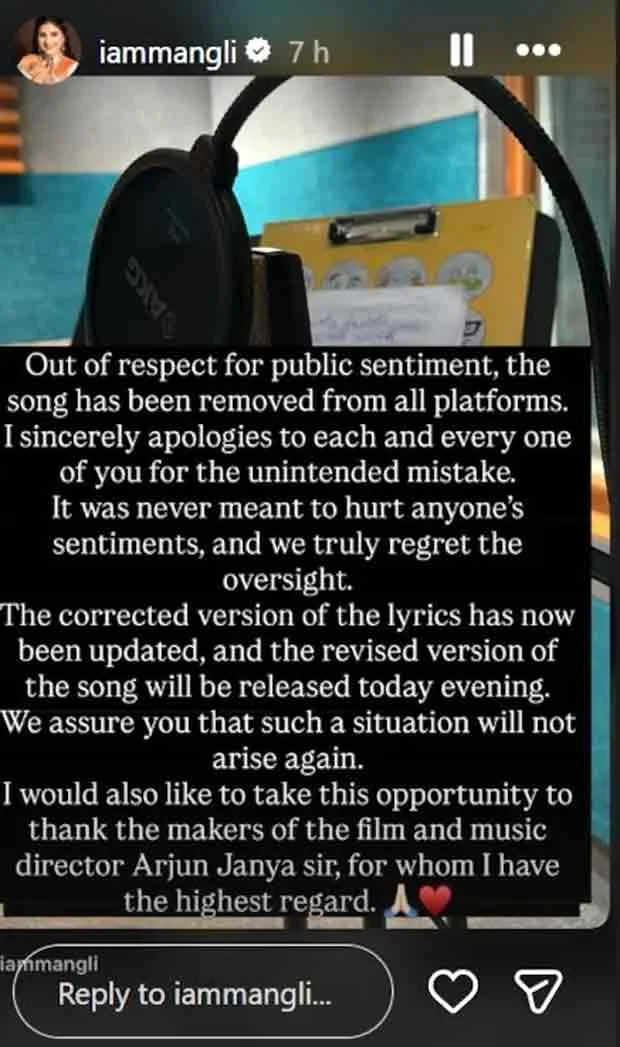
Taking to Instagram Stories, Mangli acknowledged the concerns raised by audiences and apologised for what she described as an unintended oversight.
She stated that the song has been removed from all platforms in response to public sentiment. “We truly regret the oversight,” she said, adding that the intent was never to hurt anyone’s feelings.
The singer also assured listeners that corrective steps have already been taken.
Revised version to be released
Addressing the issue further, Mangli revealed that the team has revised the lyrics following the backlash. A corrected version of the song is expected to be released shortly.
She emphasised that the updated version would address the concerns raised by audiences and align better with expectations.
Mangli also expressed gratitude towards the film’s team and music director Arjun Janya, stating that she holds him in high regard.
How the controversy unfolded
The controversy escalated earlier this month when viewers flagged the Hindi version of the song for containing double meanings.
Critics pointed out that certain lines appeared suggestive before shifting into metaphorical references, which led to widespread debate online.
Following the backlash, the Hindi version of the song was taken down from YouTube.
Lyricist clarifies role
Lyricist Raqueeb Alam had earlier clarified that he did not originally write the controversial lines.
According to him, he was contractually required to provide a literal translation of the Kannada lyrics written by director Prem, which contributed to the issue.
Nora Fatehi responds
Nora Fatehi also addressed the situation, stating that she had filmed the song nearly three years ago and did not understand the Kannada lyrics at the time.
She further claimed that the Hindi version, along with certain AI-generated visuals, was released without her approval.
Her statement added another dimension to the controversy, raising questions about content approval and production processes.
Industry response and broader concerns
The incident has sparked wider discussions about quality control in multilingual film productions, especially when translating songs across languages.
Experts note that literal translations without cultural or contextual adaptation can sometimes lead to unintended interpretations.
The controversy also highlights the importance of reviewing content before release, particularly in an era where digital platforms amplify audience reactions rapidly.
Conclusion
Mangli’s apology and the decision to release a revised version mark an attempt to address public concerns and move forward from the controversy.
As the updated song prepares for release, the episode serves as a reminder of the need for careful handling of language, context, and audience sensitivity in the entertainment industry.